Red card for faking footballers
A new study by Dr Paul Morris from the University of Portsmouth could help referees know when a top player has genuinely been fouled or taken a dive.
Dr Morris, an expert on the embodiment of emotions and intentions in the Department of Psychology, says refs could be helped to spot the tell tale signs of cheating, sometimes even in the split seconds in which they occur.
“Referees have a very difficult job and given the demands of the task they do it remarkably well. We think even experienced professionals could enhance their decision-making by studying the categories of deceptive behaviour we have identified,” said Dr Morris.
Published in the Springer Journal of Nonverbal Behavior, and conducted in three separate studies, the research could also help by improving decisions based on video evidence.
Dr Morris’s research shows that there are distinct actions which footballers use - either individually or in any combination - when faking a fall. These include:
• clutching their body where they haven’t been hit
• taking an extra roll when they hit the ground
• after being tackled taking fully controlled strides before falling
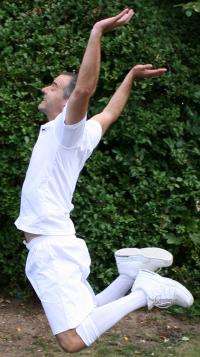
• holding up both arms in the air, with open palms, chest thrust out, legs bent at the knee in an “archer’s bow” position
“In most dishonest tackles the behaviour itself does not indicate dishonesty - the deception is revealed in the timing and co-ordination of the behaviours,” said Dr Morris.
“But one action is unique to a faked fall - the archer’s bow. This occurs in many dives but biomechanically it does not occur in a natural fall. Instead instinctively the arms either go down in an attempt to cushion the fall or out to the side for balance.
“Although this behaviour is absurd, the fraudulent footballer does it to try to deceive the referee into believing that the tackle was illegal, and the histrionics are necessary to get the referee’s attention in the first place.
“This behaviour has no national boundaries; everyone does it, it even occurred unprompted during our research trials.”
Dr Morris said that a player who positions his body into this peculiar shape to show that he has been fouled as a result of a tackle looks quite bizarre.
“Moving the body like this is completely controlled behaviour so it clearly doesn’t show a genuine fall.
“The moment both arms go above the shoulder is a clear indication of deception,” he said.
Previous research has focused on whether incidental factors such as the colour of clothing, crowd expectation, or a team’s or player’s reputation subconsciously affects a referee’s decision about cheating players.
This is the first research, co-authored with David Lewis, also from the University of Portsmouth, to examine individuals’ behaviour to determine their intentions in football. The researchers found that a footballer’s deceptive intentions are easy to identify.
During his research Dr Morris showed four-second clips of tackles from televised live games to over 300 people. The participants were only allowed to see the clip twice in real-time before they were asked to spot the fakers. The results showed that there was a high level of agreement by participants in their classification of the players who intended to deceive and those who did not. However, there was also strong agreement about tackles where the intentions were ambiguous.
“The result shows how, that regardless of all factors such as team allegiance and players’ reputations, behaviour during a fall is a clear indication of the intention to deceive,” said Dr Morris.
Although participants were in agreement about which falls were faked, Dr Morris then needed to test that their judgements were correct.
He employed over 30 experienced amateur footballers to stage a scenario taken from a Football Association coaching manual.
Attackers were instructed to dribble the ball past approaching defenders and then deceptively exaggerate the effects of a tackle to varying degrees. Nearly 50 observers were asked to judge if the attackers were faking and the level of exaggeration, if any.
The relationship between the intentions of the tackled player and the observer’s judgement of the player’s intentions was consistent.
The third study involved a frame by frame analysis of dishonest and legitimate tackles in order to produce a comprehensive list of deceptive behaviours.
The research is part of on-going work in the University’s departments of Psychology and Sport and Exercise Science on the perceptions of intentions in sport. Studies currently being conducted seek to produce a precise mathematical description of the difference between intentional and unintentional behaviour.
More information: J Nonverbal Behav; DOI 10.1007/s10919-009-0075-0
Source: University of Portsmouth


