Venus Express adds evidence for atmospheric water loss on Earth's Twin
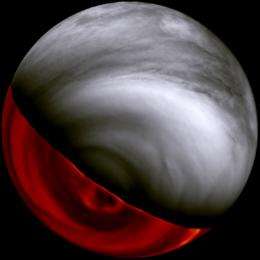
Observations by the European Space Agency’s Venus Express mission have provided strong new evidence that the solar wind has stripped away significant quantities of water from Earth’s twin planet. The data also shed new light on the transfer of trace gases in the Venusian atmosphere and wind patterns. The results will be presented at the European Planetary Science Congress in Potsdam, Germany, today.
The SPICAV and VIRTIS instruments carried by the spacecraft have been used to measure concentrations of water vapour in the Venusian atmosphere at altitudes ranging from the lowest 10 km up to 110 km, high above the cloud tops. Studies led by scientists from Belgium and Russia have found that the ratio of heavy water, which contains the isotope deuterium instead of hydrogen, to normal water is nearly twice as high above the clouds compared to its value in the lower atmosphere.
“Water vapour is a very rare species in the Venusian atmosphere: if it were in liquid form now, it would cover the surface of Venus with just a few centimetres of water. However, we believe Venus once had large volumes of water that have since escaped into space or stripped away by the solar wind. These results from Venus Express demonstrate that the heavier water containing deuterium has not been able to escape Venus’s gravity as easily as normal H2O. This enrichment of heavy water provides strong evidence that water loss is occurring in the upper atmosphere and that Venus was probably more humid and Earth-like in the distant past,” said Dr Emmanuel Marcq of the LATMOS laboratory in France.
Other studies by groups at the LESIA laboratory and the University of Oxford show that concentrations of water vapour decline from around 44 parts per million in the hot lower atmosphere to 25 parts per million at an altitude of 30-40 km. At this level, the amounts of water vapour vary according to the overlying sulphuric acid cloud cover, with regions of thicker cloud containing less water vapour.
A team led by Dr Marcq has also used SPICAV to study the variation of sulphur dioxide with latitude and found that there is a gradual decrease of concentrations of the gas towards the poles.
“This fits well with our knowledge of global circulation,” said Dr Marcq. “Incoming energy from the Sun is redistributed so that the atmosphere rises near the equator and subsequently falls towards the poles. We also see a decrease in the amounts of sulphur dioxide in the upper atmosphere, where it is destroyed by ultraviolet radiation. Globally, our measurements confirm the downward trend in sulphur dioxide concentrations since the first measurements were made in the 1970s, which indicates that there may be active volcanism on Venus, although it has never been directly observed yet.”
The VIRTIS and VMC team has also been able to measure the velocity of the wind at different altitudes in Venus atmosphere by analysing observations in different wavelengths. The cloud tops at an altitude of 70 kilometres reflect visible and ultraviolet light on day side. The lower atmosphere can be viewed on the night side in infrared wavelengths, in which radiation escapes from the lower atmosphere and the surface through narrow spectral intervals called “transparency windows”.
Observations of the lower cloud layer over a two year period show that the wind is nearly constant in time with no seasonal effects or variations linked to the position of the Sun in the Venusian sky. A study, led by Dr Ricardo Hueso at the Universidad País Vasco, has found that variations in the intensity of the wind happen from time to time, especially in subpolar regions close to 65ºS latitude.
“The variations seem to be linked to the polar vortex which may affect latitudes beyond its overall location, however we don’t yet have an explanation as to how this occurs,” said Dr Hueso.
Previous studies have shown that East-West wind speeds are very high, reaching 400km/h in the upper clouds at equatorial latitudes and 230 km/h in the lower cloud at tropical latitudes. However, the new analysis also shows that there is almost no wind in meridional (North-South) directions between tropical and subpolar latitudes in the lower cloud, which is in contrast to wind speeds of around 35 km/h in the upper clouds flowing from tropics to the pole transporting heat. Intriguingly, particular structures in the lower cloud layer may still travel North and South in this region with significant velocities of up to 40 km/h.
“Most of the cloud structures in the lower cloud do not travel in the meridional direction but sometimes some of them travel Northwards and others Southwards. The average of all these turbulent and chaotic motions is very close to zero but rarely some structures can travel at these high speeds of 40 km/h to the North or the South. When we have been able to analyse further these turbulent motions in the lower cloud, we might discover important hints to the origin of the atmospheric super-rotation and finally solve the big mystery of why the winds on Venus flow faster than the planet’s rotation,” said Dr Hueso.
Source: Europlanet


