Ozone hole smaller in 2009 than 2008: WMO
September 16, 2009 This year the hole began forming "earlier than before" said WMO's expert on the ozone Geir Braathen

Enlarge

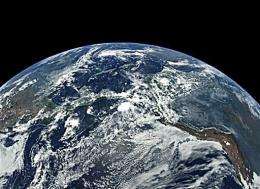
NASA image of the planet Earth. The World Meteorological Organisation said that the ozone hole is expected to be smaller in 2009 than a year ago.

The World Meteorological Organisation said Wednesday that the ozone hole is expected to be smaller in 2009 than a year ago.

"The meteorological conditions observed so far could indicate that the 2009 hole will be smaller than those of 2006 and 2008 and close to that of 2007," said the UN agency in a statement.

The hole in the layer over the Antarctic was discovered in the 1980s. It regularly tends to form in August, reaching a maximum size late September or early October before it fills again in December.

The size is dependent on weather conditions.

This year the hole began forming "earlier than before" said WMO's expert on the ozone Geir Braathen.

On September 16, it stood at 24 million square kilometers, he said.

In 2008, the maximum reached was 27 million square km while in 2007, the maximum was 25 million square km.

Experts have warned that the damage to the , which shields the Earth from harmful ultra-violet rays, is so bad that it will only attain full recovery in 2075.

Ozone provides a natural protective filter against harmful ultra-violet rays from the sun, which can cause sunburn, cataracts and as well as damage vegetation.

Its depletion is caused by extreme cold at high altitude and a particular type of pollution, from chemicals often used in refrigeration, some plastic foams, or aerosol sprays, which have accumulated in the atmosphere.

Most of these chemicals, chlorofluorocarbons (CFCs), are being phased out under the 1987 Montreal Protocol, but they linger in the atmosphere for many years.

(c) 2009 AFP


print this article email this article download pdf blog this article bookmark this article     Stumble it Digg this share on Facebook retweet share on Reddit add to delicious
Rate this story - not rated yet


September 16, 2009 all stories

Comments: 0

not rated yet
  • Stumble this up

  • Digg this

  • share this

  • hide
  • Related Stories

  • 2008 ozone hole larger than last year
    created Oct 07, 2008 | popularity not rated yet | comments 0
  • AURA satellite peers into Earth's ozone hole
    created Dec 07, 2005 | popularity not rated yet | comments 0
  • Antarctic ozone - not a hole lot worse or better
    created Nov 10, 2005 | popularity not rated yet | comments 0
  • NASA scientists reveal latest information on ozone hole
    created Sep 28, 2006 | popularity not rated yet | comments 0
  • Study Finds Clock Ticking Slower On Ozone Hole Recovery
    created Jun 30, 2006 | popularity not rated yet | comments 0


  • hide
  • Relevant PhysicsForums posts

  • The IPCC and the term "most"
    created Nov 23, 2009
  • Is global warming a fact?
    created Nov 23, 2009
  • Random variability of wind patterns
    created Nov 23, 2009
  • Record precipitation in the UK
    created Nov 22, 2009
  • More from Physics Forums - Earth

Other News

Mars Reconnaissance Orbite

Mars Reconnaissance Orbite Team Plans Uplink of Protective Files

Space & Earth / Space Exploration

created 55 minutes ago | popularity not rated yet | comments 0

(PhysOrg.com) -- The team operating NASA's Mars Reconnaissance Orbiter plans to uplink protective files to the spacecraft next week as one step toward resuming the orbiter's research and relay activities.


America's increasing food waste is laying waste to the environment

Space & Earth / Environment

created 3 hours ago | popularity not rated yet | comments 0

Food waste contributes to excess consumption of freshwater and fossil fuels which, along with methane and carbon dioxide emissions from decomposing food, impacts global climate change. In a new paper published in the open-access, ...


Shuttle Atlantis leaves space station, headed home (AP)

Shuttle Atlantis leaves space station, headed home

Space & Earth / Space Exploration

created 3 hours ago | popularity not rated yet | comments 0

(AP) -- Atlantis and its seven astronauts have left the International Space Station.


First black holes may have incubated in giant, starlike cocoons, says CU-Boulder study

First black holes may have incubated in giant, starlike cocoons

Space & Earth / Astronomy

created 19 hours ago | popularity 4.4 / 5 (10) | comments 15

(PhysOrg.com) -- The first large black holes in the universe likely formed and grew deep inside gigantic, starlike cocoons that smothered their powerful x-ray radiation and prevented surrounding gases from ...


Cassini Captures Ghostly Dance of Saturn's Northern Lights

Cassini Captures Ghostly Dance of Saturn's Northern Lights (w/ Video)

Space & Earth / Space Exploration

created 16 hours ago | popularity 5 / 5 (7) | comments 1

(PhysOrg.com) -- In the first video showing the auroras above the northern latitudes of Saturn, Cassini has spotted the tallest known "northern lights" in the solar system, flickering in shape and brightness ...