DNA origami

September 16, 2009 How to spell B-Y-U with DNA

Enlarge

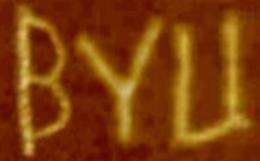
Researchers from Brigham Young University took DNA strands of customized length and spelled "BYU." Their advances in the field of DNA origami put them one critical step closer to making nanoscale electronic circuits. Credit: American Chemical Society

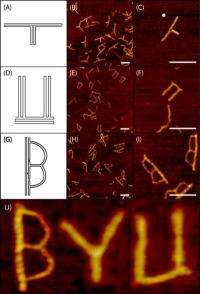
Researchers from Brigham Young University found how to shape customized segments of DNA into tiny letters that spell "BYU." This new method of DNA origami will appear in the aptly titled journal Nano Letters.

The letters are about 100 in size. That's roughly a billion times smaller than the block Y on the mountain overlooking BYU's campus and 1/1000 the width of a human hair.

The team's larger pursuit is to design nanoscale shapes for electrical circuitry and make tiny - yet inexpensive - computer chips.

origami came on the scene a few years ago when a computer scientist at Caltech wove strands of DNA into smiley faces and other shapes. But until now scientists had to hunt for viruses and microbes whose DNA strands were the right length for the particular task. That's like building a log cabin without a saw: Instead of cutting the trees down to size, you have to size your cabin to the trees available.

The BYU researchers instead replicate DNA to make strands precisely as long or as short as they need.
Spelling B-Y-U with DNA
Enlarge

In an advance toward developing nanoelectronic devices, scientists in Utah arranged segments of DNA into tiny letters that spell "BYU." Credit: The American Chemical Society

BYU chemistry professor Adam Woolley authored the paper with three of his students, Elisabeth Pound, Jeffrey Ashton and Hector Becerril. Ashton is an undergraduate.

"I was blown away when the students were able to make B's," Woolley said. "Right angle shapes, that's one thing. But to make something with curves and multiple intersections, I thought 'Wow, that is really cool.'"

The work is funded by a $1 million grant from the National Science Foundation.

"This very quickly went from the initial design of a simple rectangle shape to more sophisticated branching," Woolley said. "It's a testament to the quality of graduate students and undergraduates we have here in our department and at BYU in general."

Source: Brigham Young University (news : web)


print this article email this article download pdf blog this article bookmark this article     Stumble it Digg this share on Facebook retweet share on Reddit add to delicious
Rate this story - 3.8 /5 (5 votes)


September 16, 2009 all stories

Comments: 0

3.8 /5 (5 votes)
  • Stumble this up

  • Digg this

  • share this

  • hide
  • Related Stories


  • hide
  • Relevant PhysicsForums posts

  • What is transpulmonary pressure?
    created Nov 24, 2009
  • Is there a gay gene?
    created Nov 23, 2009
  • Super quick question about Starling forces?
    created Nov 22, 2009
  • Questions about diffusion
    created Nov 22, 2009
  • More from Physics Forums - Biology

Other News

Fast, easy, and highly sensitive arsenic detection with gold nanoparticles

Nanotechnology / Nanomaterials

created 10 hours ago | popularity 5 / 5 (1) | comments 0

(PhysOrg.com) -- Mention of arsenic poisoning usually brings to mind underhanded murder. However, the danger of arsenic poisoning from contaminated drinking water is far greater. Low concentrations of arsenic are found in ...


Nanotech in Space: Experiment To Weather the Trials of Orbit

Nanotech in Space: Experiment To Weather the Trials of Orbit

Nanotechnology / Nanomaterials

created 22 hours ago | popularity 4 / 5 (2) | comments 0

Novel nanomaterials developed at Rensselaer were sent into orbit on Nov. 16 aboard Space Shuttle Atlantis.


Water droplets direct self-assembly process in thin-film materials

Nanotechnology / Nanomaterials

created Nov 23, 2009 | popularity 5 / 5 (4) | comments 2

You can think of it as origami - very high-tech origami. Researchers at the University of Illinois have developed a technique for fabricating three-dimensional, single-crystalline silicon structures from thin films by coupling ...


Nanotube defects equal better energy and storage systems

Nanotube defects equal better energy and storage systems

Nanotechnology / Nanomaterials

created Nov 19, 2009 | popularity 4.4 / 5 (10) | comments 2

(PhysOrg.com) -- Most people would like to be able to charge their cell phones and other personal electronics quickly and not too often. A recent discovery made by UC San Diego engineers could lead to carbon ...


Peptides control crystal growth with 'switches, throttles and brakes'

Peptides control crystal growth with 'switches, throttles and brakes'

Nanotechnology / Bio & Medicine

created Nov 23, 2009 | popularity 5 / 5 (3) | comments 0

(PhysOrg.com) -- By producing some of the highest resolution images of peptides attaching to mineral surfaces, scientists have a deeper understanding how biomolecules manipulate the growth crystals. This research ...