Pesky fruit flies learn from experienced females: Study
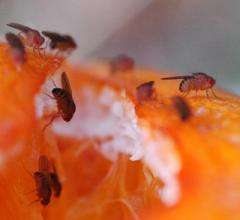
September 16, 2009 Fruit Fly (Drosophila melanogaster)

Enlarge

Fruit flies. Credit: Ted Morrow

A common household nuisance, the fruit fly, is capable of intricate social learning much like that used by humans, according to new research from McMaster University.

The study, published online today in the journal , found that inexperienced female , known as Drosophila melanogaster, can learn from their more experienced counterparts, mated fruit flies.

As part of an ongoing examination of the evolutionary roots of in insects, researchers found that when the novices landed on decaying fruit where the mated females had laid their eggs, the novices later preferred to lay their eggs in the same place rather than seek out other ripe fruit.

"For humans, our entire culture is based on social learning so it is very natural for us to gain valuable knowledge from one another, but most animals are completely on their own," explains Reuven Dukas, associate professor in the Department of Psychology, Neuroscience and Behaviour, who co-authored the study along with graduate student Sachin Sarin.

This research suggests that even solitary insects can exhibit social learning, which raises the possibility that learning from each other has promoted the evolution of socializing among insects as a survival mechanism.

Researchers found no social learning, however, when the observer females were exposed to food with more ambiguous social information provided by the presence of virgin fruit flies. Similarly, the presence of an aggregation pheromone—a pheromone derived from male fruit flies which attracts both sexes—had no influence.

"The fruit fly is much more sophisticated than many people think or really want to believe," explains Dukas. "It shares many of the same genes and the same compounds that control learning in humans. This first documentation of social learning in fruit flies opens up exciting avenues for research on the evolution and neurogenetics of social learning."

Source: McMaster University


print this article email this article download pdf blog this article bookmark this article     Stumble it Digg this share on Facebook retweet share on Reddit add to delicious
Rate this story - 4.3 /5 (4 votes)


September 16, 2009 all stories

Comments: 0

4.3 /5 (4 votes)
  • Stumble this up

  • Digg this

  • share this

  • hide
  • Related Stories

  • Researchers Study Gene Regulation In Insects
    created Apr 27, 2006 | popularity not rated yet | comments 0
  • Long-term memory controls discovered
    created Jan 13, 2006 | popularity not rated yet | comments 0
  • One missing gene leads to fruitless mating rituals
    created Jul 23, 2008 | popularity not rated yet | comments 0
  • Flies may reveal evolutionary step to live birth
    created Nov 25, 2008 | popularity not rated yet | comments 0
  • Researchers find genes important to sleep
    created Feb 22, 2009 | popularity not rated yet | comments 0


  • hide
  • Relevant PhysicsForums posts

  • What is transpulmonary pressure?
    created Nov 24, 2009
  • Is there a gay gene?
    created Nov 23, 2009
  • Super quick question about Starling forces?
    created Nov 22, 2009
  • Questions about diffusion
    created Nov 22, 2009
  • More from Physics Forums - Biology

Other News

Redback spiders were first spotted in Japan in 1995

Venomous Aussie redback spiders invading Japan

Biology / Ecology

created 2 hours ago | popularity not rated yet | comments 0

Australia's venomous redback spiders are on the march in Japan, where they are believed to have arrived years ago as stowaways on cargo ships, a wildlife expert warned Wednesday.


Study explores violent world of raptors

Biology / Plants & Animals

created 2 hours ago | popularity not rated yet | comments 0

A journey that started with a box of bird feet carried three Montana State University graduate students into the gruesome world of raptors and led to their findings being published in a prominent journal.


Asian carp may have breached barrier protecting Lake Michigan

Biology / Ecology

created 10 hours ago | popularity 5 / 5 (4) | comments 0

Two feared species of Asian carp have zoomed beyond the $9 million electric barriers built to keep them out of Lake Michigan. Now, the only thing left between the carp and the Great Lakes is a lock and dam in southern Chicago.


Got a pain? -- Have a cup of Brazilian mint

Biology / Plants & Animals

created 12 hours ago | popularity 4.6 / 5 (7) | comments 0

For thousands of years it has been prescribed by traditional healers in Brazil to treat a range of ailments from headaches and stomach pain to fever and flu.


Opposites attract: Monkeys choose mating partners with different genes

Biology / Evolution

created 12 hours ago | popularity 5 / 5 (1) | comments 0

The world's largest species of monkey 'chooses' mates with genes that are different from their own to guarantee healthy and strong offspring, according to a new research study.