New nanostructure technology provides advances in eyeglass, solar energy performance
September 16, 2009
Thin-film 'nanostructure' deposits

Enlarge

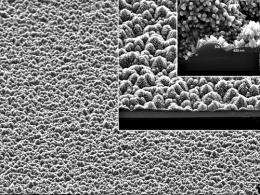
Chemical engineers at Oregon State University are using extraordinarily small films at the nanostructure level to improve the performance of eyeglasses and, ultimately, solar energy devices. These films, which resemble millions of tiny pyramids, reduce the reflectance of any light that strikes the material. (Image by Seung-Yeol Han)

(PhysOrg.com) -- Chemical engineers at Oregon State University have invented a new technology to deposit "nanostructure films" on various surfaces, which may first find use as coatings for eyeglasses that cost less and work better.

Ultimately, the technique may provide a way to make more efficiently produce energy.

The films reduce the reflectance of light, and in the case of would capture more light, reduce glare and also reduce exposure to . Some coatings with these features are already available, but the new technology should perform better at a lower cost, and be able to be applied on-site in a dispenser's office.

"There's really a whole range of things this technology may ultimately be useful for," said Chih-hung Chang, an associate professor in the OSU Department of Chemical, Biological and Environmental Engineering. "They should be able to make almost any type of system work more efficiently, and ultimately could be used in cameras or other types of lenses."

A patent has been applied for on the new technology, and the first commercial products may be ready within a year, Chang said.

The key to the process is use of a chemical bath, controlled by a microreactor, to place thin-film deposits on various substrates such as glass, plastic, or . In this case, the technology will create a type of nanostructure that resembles millions of tiny pyramids in a small space, which function to reduce the reflectance of any light that strikes the material.

The scientists are now working on the application of this thin film to polycarbonate, the type of plastic most commonly used in eyeglass production, and also plan to create a small unit that can apply the films inexpensively in an office setting.

The final product should be faster to apply, less costly, reduce waste of materials and perform better than existing technologies, the researchers said.

Provided by Oregon State University (news : web)

Filter


Move the slider to adjust rank threshold, so that you can hide some of the comments.


Display comments: newest first

holoman
Sep 16, 2009

Rank: not rated yet
Why not develop holographic lenses ?
Rank 4 /5 (3 votes)
Relevant PhysicsForums posts
  • polymer nanocomposites
    createdFeb 10, 2012
  • Corrosion Tests on Magnesium
    createdFeb 09, 2012
  • polyethylene copper nanocomposite
    createdFeb 09, 2012
  • Output of xrd analysis
    createdFeb 08, 2012
  • Transport phenomena problem based on problems 18.B11 and 19B.6 from Bird, stewart, lw
    createdFeb 06, 2012
  • Help with material selection - Car Piston
    createdFeb 05, 2012
  • More from Physics Forums - Materials & Chemical Engineering

More news stories

Lab study raises questions over nano-particle impact

Tests involving chickens have raised questions about the impact on health from engineered nano-particles, the ultra-fine grains commonly used in drugs and processed foods, scientists said on Sunday.

Nanotechnology / Bio & Medicine

created 10 hours ago | popularity 5 / 5 (7) | comments 1

New kind of solar cell could capture significantly more energy than current cells

New solar cells could increase the maximum efficiency of solar panels by over 25%, according to scientists from the University of Cambridge.

Nanotechnology / Nanophysics

created Feb 08, 2012 | popularity 4.5 / 5 (13) | comments 14 | with audio podcast

Nanoshell whispering galleries improve thin solar panels

Visitors to Statuary Hall in the U.S. Capitol Building may have experienced a curious acoustic feature that allows a person to whisper softly at one side of the cavernous, half-domed room and for another on ...

Nanotechnology / Nanomaterials

created Feb 07, 2012 | popularity 4.4 / 5 (7) | comments 6 | with audio podcast

'Dark plasmons' transmit energy

Microscopic channels of gold nanoparticles have the ability to transmit electromagnetic energy that starts as light and propagates via "dark plasmons," according to researchers at Rice University.

Nanotechnology / Nanophysics

created Feb 09, 2012 | popularity 4.8 / 5 (10) | comments 1 | with audio podcast

Revealing how a battery material works

Since its discovery 15 years ago, lithium iron phosphate (LiFePO4) has become one of the most promising materials for rechargeable batteries because of its stability, durability, safety and ability to deliver ...

Nanotechnology / Nanomaterials

created Feb 08, 2012 | popularity 5 / 5 (6) | comments 0 | with audio podcast


Scientists discover molecular secrets of 2,000-year-old Chinese herbal remedy

For roughly two thousand years, Chinese herbalists have treated Malaria using a root extract, commonly known as Chang Shan, from a type of hydrangea that grows in Tibet and Nepal. More recent studies suggest that halofuginone, ...

New method to examine batteries -- MRI from the inside

There is an ever-increasing need for advanced batteries for portable electronics, such as phones, cameras, and music players, but also to power electric vehicles and to facilitate the distribution and storage of energy derived ...

Google might launch Drive for cloud storage soon

(PhysOrg.com) -- Google's next big move, according to the Wall Street Journal, is a cloud storage service called Drive. Hardly first to the plate, Google is simply catching up to introducing its cloud reposi ...

A mitosis mystery solved: How chromosomes align perfectly in a dividing cell

Although the process of mitotic cell division has been studied intensely for more than 50 years, Whitehead Institute researchers have only now solved the mystery of how cells correctly align their chromosomes during symmetric ...

Starve a virus, feed a cure? Findings show how some cells protect themselves against HIV

A protein that protects some of our immune cells from the most common and virulent form of HIV works by starving the virus of the molecular building blocks that it needs to replicate, according to research published online ...

Researchers find extensive RNA editing in human transcriptome

In a new study published online in Nature Biotechnology, researchers from BGI, the world's largest genomics organization, reported the evidence of extensive RNA editing in a human cell line by analysis of RNA-seq data, demons ...