Chesapeake Bay cleanup a local issue for Pennsylvania, expert says
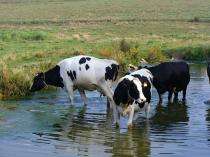
(PhysOrg.com) -- As federal agencies respond this month to President Barack Obama's executive order to redouble efforts to clean up the Chesapeake Bay, the challenge in Pennsylvania is to focus on local initiatives aimed at helping agricultural producers and their nonfarming neighbors adopt conservation practices that can improve water quality in bay tributaries, according to an agricultural pollution expert in Penn State's College of Agricultural Sciences.
Because the Susquehanna River -- which drains about half of Pennsylvania -- provides more than half the bay's fresh water and much of its excess nutrient pollution, Pennsylvania agricultural, residential and urban practices will play a huge role in the Chesapeake's future, said Kristen Saacke Blunk, senior extension associate and director of the University's Agriculture and Environment Science and Policy Center.
For decades the Chesapeake has experienced harmful algae blooms due to excess nutrients, primarily coming from animal agriculture and sewage-treatment plants in the watersheds feeding the bay. When the algae die, their decomposition absorbs huge amounts of oxygen in the water, creating dead zones in the bay where aquatic life can't survive.
"We need to clean up one stream, one watershed at a time -- that's the heart of the issue," Saacke Blunk said. "We can do that best when we engage communities with local watershed associations, government agencies, foundations and other groups to find the solutions that work best for them. Pennsylvanians care deeply about their water resources and will work to protect them. Those watershed-by-watershed actions that are done to meet local goals are what it takes to restore the bay."
There has been enormous progress, and the challenge is to show that the progress has made a difference in the condition of the bay, Saacke Blunk said.
"We know we have had progress because we have significantly reduced the nutrients coming out of sewage treatment plants, we have converted thousands of acres in the state to no-till agriculture, we know that we are not losing the soil and nutrients that we were, and we see overall improvements in water quality indicators in the Susquehanna River," she said. "In addition, we have created and restored thousands of miles of riparian buffers and fenced thousands of miles of tributary streams in the Susquehanna watershed to keep stream banks intact and livestock out of the creeks."
Saacke Blunk disputes charges made in other states that Pennsylvanians don't care about the bay because it does not border the Commonwealth.
"That is not true -- most Pennsylvanians care, and many are doing something to help," she said. "The original agreement between the states and U.S. Environmental Protection Agency to clean up the bay is two-and-a-half decades old, so we have one generation of Pennsylvanians that has grown up with the Chesapeake Bay on its radar screen. We have one generation that is literate about watershed education. Given where we are, we have a window of opportunity going into the second generation of people understanding the bay issues. We may have had unrealistic expectations about the time frame required for improvements."
More recently, the Chesapeake Bay Foundation sued the EPA, contending that the states have done everything they said they would do, but the federal government has failed in its obligation by not making funding available. The foundation also charged that the EPA has not enforced anti-pollution regulations already in place to clean up the bay.
The lawsuit, filed in the fall of 2008, precipitated the president's executive order, Saacke Blunk noted, and the most recent version of the Farm Bill, for the first time ever, has a mechanism for triggering funding that targets small watersheds across the Chesapeake Bay region.
"While the federal government has been engaged in cleaning up the bay, there are some who have concerns about the effectiveness of federal programs," Saacke Blunk said. "But there is now a significant amount of funding in the Farm Bill available to farmers to pay for practices that will limit nutrient pollution."
However, it is not just farmers who must be engaged to clean up the bay, Saacke Blunk said, and the effort is complex because cleaning up the bay, in the long run, involves all of society in watersheds like the Susquehanna River.
"If it was easy, it would have been done by now," she said. "Anyone purchasing food, yard services or making land-use decisions has the potential to impact the bay. Residents must be 'bay literate.' We must develop a better understanding in the next 10 or 15 years about what is happening in the local watersheds that negatively impacts the bay."
Policy innovations are needed that will better reward agriculture and other sectors for progress in adopting sometimes-costly practices or technology, Saacke Blunk contended.
"These might be in the form of tax relief or other incentives that would result in the acceleration of getting practices on the ground," she said. "This is a big issue -- and a point of debate around the president’s executive order."
"It is a sensitive and complex subject -- someone must pay for solutions, such as technologies that will ensure nutrients are not released into the air or water," she said. "We don't want to drive animal agriculture out of Pennsylvania or drive animal agriculture offshore. Interestingly, the executive order's inclusion of the Department of Homeland Security is an indication that the federal government views Chesapeake Bay health, agriculture and food security as a matter of national security."
Provided by Pennsylvania State University (news : web)


