Swift makes best-ever ultraviolet portrait of Andromeda Galaxy
September 16, 2009 Swift makes best-ever ultraviolet portrait of Andromeda Galaxy

Enlarge

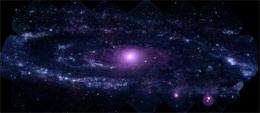
This mosaic of M31 merges 330 individual images taken by the Ultraviolet/Optical Telescope aboard NASA's Swift spacecraft. It is the highest-resolution image of the galaxy ever recorded in the ultraviolet. The image shows a region 200,000 light-years wide and 100,000 light-years high (100 arcminutes by 50 arcminutes). Credit: NASA/Swift/Stefan Immler (GSFC) and Erin Grand (UMCP)

In a break from its usual task of searching for distant cosmic explosions, NASA's Swift satellite has acquired the highest-resolution view of a neighboring spiral galaxy ever attained in the ultraviolet. The galaxy, known as M31 in the constellation Andromeda, is the largest and closest spiral galaxy to our own.

"Swift reveals about 20,000 ultraviolet sources in M31, especially hot, young stars and dense star clusters," said Stefan Immler, a research scientist on the Swift team at NASA's Goddard Space Flight Center in Greenbelt, Md. "Of particular importance is that we have covered the galaxy in three ultraviolet filters. That will let us study M31's star-formation processes in much greater detail than previously possible."

M31, also known as the Andromeda Galaxy, is more than 220,000 light-years across and lies 2.5 million light-years away. On a clear, dark night, the galaxy is faintly visible as a misty patch to the naked eye.

Between May 25 and July 26, 2008, Swift's Ultraviolet/Optical Telescope (UVOT) acquired 330 images of M31 at wavelengths of 192.8, 224.6, and 260 nanometers. The images represent a total exposure time of 24 hours.

The task of assembling the resulting 85 gigabytes of images fell to Erin Grand, an undergraduate student at the University of Maryland at College Park who worked with Immler as an intern this summer. "After ten weeks of processing that immense amount of data, I'm extremely proud of this new view of M31," she said.

Several features are immediately apparent in the new mosaic. The first is the striking difference between the galaxy's central bulge and its . "The bulge is smoother and redder because it's full of older and cooler stars," Immler explained. "Very few new stars form here because most of the materials needed to make them have been depleted."

Dense clusters of hot, young, blue stars sparkle beyond the central bulge. As in our own galaxy, M31's disk and spiral arms contain most of the gas and dust needed to produce new generations of stars. Star clusters are especially plentiful in an enormous ring about 150,000 light-years across.

What triggers the unusually intense star formation in Andromeda's "ring of fire"? Previous studies have shown that tides raised by the many small satellite in orbit around M31 help boost the interactions within gas clouds that result in new stars.

In 1885, an exploding star in M31's central bulge became bright enough to see with the naked eye. This was the first supernova ever recorded in any galaxy beyond our own Milky Way. "We expect an average of about one supernova per century in galaxies like M31," Immler said. "Perhaps we won't have to wait too long for another one."

"Swift is surveying nearby galaxies like M31 so astronomers can better understand star- formation conditions and relate them to conditions in the distant galaxies where we see gamma-ray bursts occurring," said Neil Gehrels, the mission's principal investigator at NASA Goddard. Since Swift's November 2005 launch, the satellite has detected more than 400 gamma-ray bursts -- massive, far-off explosions likely associated with the births of black holes.

Source: NASA/Goddard Space Flight Center


print this article email this article download pdf blog this article bookmark this article     Stumble it Digg this share on Facebook retweet share on Reddit add to delicious
Rate this story - 5 /5 (5 votes)

Rank Filter

Move the slider to adjust rank threshold, so that you can hide some of the comments.


Display comments: newest first

  • earls - Sep 16, 2009
    • Rank: not rated yet
    http://www.nasa.g...eda.html

    "The task of assembling the resulting 85 gigabytes of images fell to Erin Grand"

    Lucky her. ;P

    What's going on there in the bottom right hand corner?


September 16, 2009 all stories

Comments: 1

5 /5 (5 votes)
  • Stumble this up

  • Digg this

  • share this

  • hide
  • Related Stories

  • Swift satellite images a galaxy ablaze with starbirth
    created Feb 26, 2008 | popularity not rated yet | comments 0
  • Lady in Red: Andromeda Galaxy Shines in Spitzer's Eyes
    created Oct 14, 2005 | popularity not rated yet | comments 0
  • Hubble photographs grand spiral galaxy Messier 81
    created May 29, 2007 | popularity not rated yet | comments 0
  • Astronomers Discover Mysterious New Star Clusters
    created Apr 04, 2005 | popularity not rated yet | comments 0
  • Amazing Andromeda Galaxy
    created Oct 03, 2006 | popularity not rated yet | comments 0


  • hide
  • Relevant PhysicsForums posts

  • Sideral question
    created 16 hours ago
  • Doppler shifted blackbody spectrum
    created 19 hours ago
  • Earth v. Moon
    created 21 hours ago
  • help me with coordinates and orbits
    created 21 hours ago
  • More from Physics Forums - General Astronomy

Other News

Astronauts finish another spacewalk, still no baby (AP)

Astronauts finish another spacewalk, still no baby

Space & Earth / Space Exploration

created 8 hours ago | popularity 3 / 5 (2) | comments 0

(AP) -- A spacewalking astronaut put aside the impending birth of his daughter and blazed through his first-ever venture outside the International Space Station on Saturday.


Unseasonably hot and dry weather combined with strong winds to fan scores of blazes in the country's southeastern states

Australia issues 'catastrophic' alerts as fires rage

Space & Earth / Environment

created 14 hours ago | popularity 4.5 / 5 (2) | comments 0

Australia has issued "catastrophic" alerts after record-breaking temperatures and wild lightning storms sparked more than 100 fires across the country, officials said Saturday.


Commuters wait on the platform shrouded by fog in London

Climate change not man-made, say majority of Britons: poll

Space & Earth / Environment

created Nov 15, 2009 | popularity 3.3 / 5 (15) | comments 46

Less than half of Britons believes that human activity is to blame for global warming, according to a poll carried out for The Times newspaper and published on Saturday.


Mysteriously warm times in Antarctica

Mysteriously warm times in Antarctica

Space & Earth / Earth Sciences

created Nov 18, 2009 | popularity 4.2 / 5 (21) | comments 28

(PhysOrg.com) -- A new study of Antarctica's past climate reveals that temperatures during the warm periods between ice ages (interglacials) may have been higher than previously thought. The latest analysis ...


UN: Fight climate change with free condoms (AP)

UN: Fight climate change with free condoms

Space & Earth / Environment

created Nov 18, 2009 | popularity 3.1 / 5 (11) | comments 24

(AP) -- The battle against global warming could be helped if the world slowed population growth by making free condoms and family planning advice more widely available, the U.N. Population Fund said Wednesday.