Melting of the Greenland ice sheet mapped
September 16, 2009 Melting of the Greenland ice sheet mapped

Enlarge

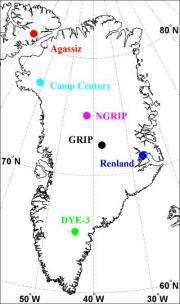
This is a map of the ice core drilling locations discussed in the article. Credit: Center for Ice and Climate, Niels Bohr Institute, University of Copenhagen

Will all of the ice on Greenland melt and flow out into the sea, bringing about a colossal rise in ocean levels on Earth, as the global temperature rises? The key concern is how stable the ice cap actually is and new Danish research from the Niels Bohr Institute at the University of Copenhagen can now show the evolution of the ice sheet 11,700 years back in time - all the way back to the start of our current warm period. The results are published in the esteemed journal Nature.

Numerous drillings have been made through both Greenland's ice sheet and small ice caps near the coast. By analysing every single annual layer in the kilometres long ice cores researchers can get detailed information about the climate of the past. But now the Danish researcher Bo Vinther and colleagues from the Centre for Ice and Climate at the Niels Bohr Institute, University of Copenhagen, in collaboration with researchers from Canada, France and Russia, have found an entirely new way of interpreting the information from the ice core drillings.

"Ice cores from different drillings show different climate histories. This could be because they were drilled at very different places on and near , but it could also be due to changes in the elevation of the ice sheet, because the elevation itself causes different temperatures" explains Bo Vinther about the theory.

Today the ice sheet is more than three kilometres thick at its highest point and thinning out towards the coast. Four of the drillings analysed are from the central ice sheet, while two of the drillings are from small ice caps outside of the ice sheet itself, at Renland on the east coast and Agassiz which lies just off of the northwest coast of Greenland in Canada.
Melting of the Greenland ice sheet mapped
Enlarge

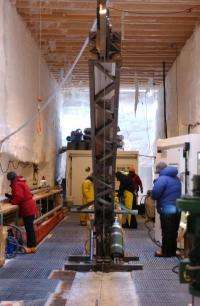
The ice is approximately 3 km thick in central Greenland and by analyzing every single annual layer in the kilometers-long ice cores researchers can get detailed information about the climate of the past. Credit: Centre for Ice and Climate, Niels Bohr Institute, University of Copenhagen.

Small ice caps show the standard

The small ice caps are stable and have not changed in elevation, and even though they lie very far apart from each other on either side of the central ice sheet, they show the same climate history. This means that one can use the small ice caps climate history as a standard reference for the others.

Bo Vinther explains, that the four drillings through the ice sheet would have had the same climate history if there had not been changes in elevation throughout the course of time. It is known that for every 100 meter increase in elevation, there is a 0.6 per mille decrease in the level of the oxygen isotope Oxygen-18, which indicates the temperature in the air. So if there is a difference of 1.2 per mille, the elevation has changed by 200 meters.

By comparing the Oxygen-18 content in all of the annual layers from the four drillings through the ice sheet with the Oxygen-18 content of the same annual layers in the small ice caps, Bo Vinther has calculated the elevation course through 11,700 years.

Temperature sensitive ice sheet

Just after the ice age the elevation of the ice sheet rose slightly. This is because when the climate transitions from ice age to warm age, there is a rapid increase in precipitation. But at the same time, the areas lying near the coast begin to decrease in size, because the ice is melting at the edge. When the ice melts at the edge, it slowly causes the entire ice sheet to 'collapse' and become lower.

The calculations show that in the course of about 3,000 years the elevation changed and became up to 600 meters lower in the coastal areas. But in the middle it was a slow process, where the elevation decreased around 150 meters in the course of around 6,000 years. It then stabilised.

The elevations that were found with the help of the Oxygen-18 measurements from the ice cores are checked with other methods, for example, by measuring the air content, which is also dependent upon the elevation.

The new results show the evolution of elevation of the ice sheet throughout 11,700 years and they show that the is very sensitive to the temperature. The results can be used to make new calculations for models predicting future consequences of climate changes.

Source: University of Copenhagen


print this article email this article download pdf blog this article bookmark this article     Stumble it Digg this share on Facebook retweet share on Reddit add to delicious
Rate this story - 3.9 /5 (18 votes)


September 16, 2009 all stories

Comments: 0

3.9 /5 (18 votes)
  • Stumble this up

  • Digg this

  • share this

  • hide
  • Related Stories

  • Melting glacier worries scientists
    created Jul 25, 2005 | popularity not rated yet | comments 0
  • Ice cores map dynamics of sudden climate changes
    created Jun 19, 2008 | popularity not rated yet | comments 0
  • East Antarctic Ice Sheet Gains Mass and Slows Sea Level Rise, Study Finds
    created May 20, 2005 | popularity not rated yet | comments 0
  • New structure found deep within West Antarctic Ice Sheet
    created Sep 23, 2004 | popularity not rated yet | comments 0
  • Greenland's rising air temperatures drive ice loss at surface and beyond
    created Feb 20, 2008 | popularity not rated yet | comments 0


  • hide
  • Relevant PhysicsForums posts

  • The IPCC and the term "most"
    created Nov 23, 2009
  • Is global warming a fact?
    created Nov 23, 2009
  • Random variability of wind patterns
    created Nov 23, 2009
  • Record precipitation in the UK
    created Nov 22, 2009
  • How to move cloud from one time to another..
    created Nov 22, 2009
  • Which countries around the world cause the most destruction to the rain forest
    created Nov 21, 2009
  • More from Physics Forums - Earth

Other News

Small faults in Southeast Spain reduce earthquake risk of larger ones

Small faults in Southeast Spain reduce earthquake risk of larger ones

Space & Earth / Earth Sciences

created 49 minutes ago | popularity not rated yet | comments 0

A team of Spanish scientists, studying recent, active deformations in the Baetic mountain range, have shown that the activity of smaller tectonic structures close to larger faults in the south east of the ...


Cutting greenhouse pollutants could directly save millions of lives worldwide

Space & Earth / Environment

created 20 minutes ago | popularity not rated yet | comments 0

Tackling climate change by reducing carbon dioxide and other greenhouse emissions will have major direct health benefits in addition to reducing the risk of climate change, especially in low-income countries, according to ...


It's not just dirt!

Space & Earth / Environment

created 17 minutes ago | popularity not rated yet | comments 0

Soil is the linchpin of the environment, where atmosphere, biosphere, and hydrosphere meet. Despite that, many students see soil as "just dirt" - a place to grow plants, but nothing more. Soil science educators are challenged ...


First black holes may have incubated in giant, starlike cocoons, says CU-Boulder study

First black holes may have incubated in giant, starlike cocoons

Space & Earth / Astronomy

created 21 hours ago | popularity 4.5 / 5 (11) | comments 15

(PhysOrg.com) -- The first large black holes in the universe likely formed and grew deep inside gigantic, starlike cocoons that smothered their powerful x-ray radiation and prevented surrounding gases from ...


Mars Reconnaissance Orbite

Mars Reconnaissance Orbite Team Plans Uplink of Protective Files

Space & Earth / Space Exploration

created 3 hours ago | popularity 5 / 5 (1) | comments 0

(PhysOrg.com) -- The team operating NASA's Mars Reconnaissance Orbiter plans to uplink protective files to the spacecraft next week as one step toward resuming the orbiter's research and relay activities.