Study on effect of electricity on liquids bucks conventional science (w/ Video)
September 16, 2009
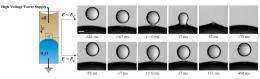
Above, a sketch of the experimental setup in which the bouncing droplets were studied. Image: W. D. Ristenpart and A. Belmonte
(PhysOrg.com) -- Whether gazing into lava lamps or watching balsamic vinegar mix with olive oil, people have long been transfixed by the seemingly mystical way that droplets of one liquid find each other within another liquid and join together. Conventional scientific wisdom has held that this merging of liquid droplets, a process called coalescence, is enhanced by applying an electrical field, but a new study, which will be published in the Sept. 17 issue of the journal Nature, shows that an increased electrical field actually can prevent droplets from merging.
"These surprising results could lead to improved applications in diverse fields including petroleum purification, food-oil processing and even biodiesel production," said Andrew Belmonte, an associate professor of mathematics at Penn State and one of the leaders of the project. "The results also could increase our understanding of atmospheric high-voltages that are generated in thunderstorms."
According to William Ristenpart, an assistant professor at the University of California at Davis and another of the project's leaders, "It has long been assumed that oppositely charged droplets experience an attractive force that encourages them to coalesce. This study, however, demonstrates that while droplets move toward each other when a low-strength electrical field is applied, those same droplets actually are repelled from one another after they make contact under higher-strength electrical fields."
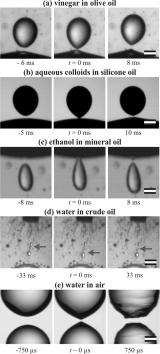
The scientists performed the same experiment in a number of different situations, using both everyday and/or industrially important liquids. In each case, Belmonte reports, "we saw how general this droplet-bouncing effect was, since we could inhibit coalescence by raising the voltage in all these different cases." The examples shown here include salad dressing (a - vinegar droplets in olive oil), petroleum (d- water droplets in sweet crude oil), and raindrops (e - water droplets in air). Some of the potential applications and extensions involve the removal of water from crude oil, the control of emulsion properties, and the understanding of electrification in thunderstorms. Credit W. D. Ristenpart, J. C. Bird, and A. Belmonte.
Belmonte explained the process with a household example."Say you have a bottle of salad dressing -- vegetable oil with droplets of vinegar. If you put two electrodes into the dressing, you would produce an electric field, and the droplets of oil and vinegar may become either positively or negatively charged. We used to think that oppositely charged droplets would be attracted to each other and coalesce, and that the electric field would bring them together even faster. Now we know that if the electric field -- or voltage -- is high enough, oppositely charged droplets will not coalesce. Instead, when they come into contact with one another, they bounce and move in opposite directions."
In their experiment, the research team observed that water droplets, sitting in oil between two electrodes, appeared to bounce off each other under strong electrical fields. High-speed video and still images revealed that, between bouncing, a temporary fluid "bridge" formed between the meniscus, or curved surface, of each droplet. That temporary bridge, which existed for less than 40 microseconds before it snapped, seems to have been responsible for transferring an electrical charge between the droplets.
This video is not supported by your browser at this time.
This movie shows two droplets bouncing back and forth in a high-voltage electrical field. Credit: W. D. Ristenpart and A. Belmonte
"It appears that the charge from the electrode at the top of the cylinder caused one droplet to fall through the oil until it momentarily made contact with another droplet, and then the falling droplet quickly bounced back up," Ristenpart said. "The fact that the top droplet was able to move upward, against the force of gravity, suggests there was a change in the net electrical charge of the droplet and that the charge was transmitted during the bounce."According to Belmonte, the surface tension naturally occurring between oil and water makes droplets spherical.
"We know that electric fields can elongate a single water droplet, leading eventually to a sharp point known as a Taylor cone," he said. "We see something like these cones just before the two droplets merge, a fleeting shape resembling an elongated hour glass."
The researchers propose that when the electrical field is strong enough, the hour glass becomes too "steep" to hold up against surface tension. As a result, the bridge breaks, but not before allowing the electrical charge to be transmitted between the droplets.
Belmonte, who performed the experiment while he was on sabbatical leave from Penn State at Harvard University, plans to rebuild the device at Penn State in the W.G. Pritchard Laboratories in order to further study the phenomenon.
"Among other things, we're interested in investigating the chemical reactions that could be placed inside the droplets," he said.
-
Droplets that Roll Uphill
Sep 24, 2007 |
not rated yet |
0
-
Dancing droplets
Nov 18, 2008 |
not rated yet |
0
-
Mathematicians defy gravity
Oct 03, 2007 |
not rated yet |
0
-
Water running uphill a cooling idea
May 01, 2006 |
not rated yet |
0
-
Riding on a cushion of vapor
Mar 28, 2006 |
not rated yet |
0
-
Engineers build first sub-10-nm carbon nanotube transistor
Feb 01, 2012 |
4.9 / 5 (30) |
30
-
Something old, something new: Evolution and the structural divergence of duplicate genes
Jan 31, 2012 |
4.6 / 5 (7) |
1
-
The hidden nanoworld of ice crystals: Revealing the dynamic behavior of quasi-liquid layers
Jan 30, 2012 |
5 / 5 (3) |
1
-
Stock market network reveals investor clustering
Jan 27, 2012 |
3.9 / 5 (23) |
8
-
Of microchemistry and molecules: Electronic microfluidic device synthesizes biocompatible probes
Jan 26, 2012 |
5 / 5 (1) |
0
-
Light & Sight
1 hour ago
-
Wind Turbine Power
4 hours ago
-
Steam Table issues
6 hours ago
-
electrostatic induction in a conductor should be immpossible
9 hours ago
-
Help! Physics Momentum/Impulse problem!
12 hours ago
-
Gauss' law cubes, how to prove
14 hours ago
- More from Physics Forums - General Physics
More news stories
Hovering not hard if you're top-heavy, researchers find
Top-heavy structures are more likely to maintain their balance while hovering in the air than are those that bear a lower center of gravity, researchers at New York University's Courant Institute of Mathematical Sciences ...
1 hour ago |
5 / 5 (1) |
1
|
SLAC, Stanford team focuses on high-energy electrons to treat cancer
Accelerator physicists at SLAC and cancer specialists from Stanford are working on a new technology that could dramatically reduce the time needed for cancer radiation treatments. The team ran an initial experiment ...
4 hours ago |
5 / 5 (1) |
0
Measurements from high-energy collisions lead to better understanding of why meson particles disappear
For several years, physicists at the Relativistic Heavy Ion Collider (RHIC) at Brookhaven National Laboratory (BNL), USA, have studied an unusual state of matter called the quarkgluon plasma, which they ...
4 hours ago |
not rated yet |
0
Quantum physicist explains $100K offer for proof scaled-up quantum computing is impossible
(PhysOrg.com) -- MIT researcher Scott Aaronson has certainly riled the physics community with his offer this past Friday, of $100,000 to anyone who can prove that scaled-up quantum computing is impossible. ...
Explained: Sigma
It's a question that arises with virtually every major new finding in science or medicine: What makes a result reliable enough to be taken seriously? The answer has to do with statistical significance -- but ...
Feb 09, 2012 |
5 / 5 (14) |
34
Grass to gas: Researchers' genome map speeds biofuel development
Researchers at the University of Georgia have taken a major step in the ongoing effort to find sources of cleaner, renewable energy by mapping the genomes of two originator cells of Miscanthus x giganteus, a large perenn ...
Researchers develop new method for creating tissue engineering scaffolds
Researchers at Northwestern University have developed a new method for creating scaffolds for tissue engineering applications, providing an alternative that is more flexible and less time-intensive than current technology.
Molecular profiling reveals differences between primary and recurrent ovarian cancers
There is a need to analyze tumor specimens at the time of ovarian cancer recurrence, according to a new study published in Molecular Cancer Therapeutics. Researchers used a diagnostic technology called molecular profiling to examine ...
C-sections linked to breathing problems in preterm infants
Research conducted at Yale School of Medicine shows that a cesarean (C-section) delivery, which was thought to be harmless, is associated with breathing problems in preterm babies who are small for gestational age.
Review: Netflix and Hulu's new scripted originals
Within just over a week, Netflix and Hulu are both debuting their first stabs at original scripted programming.
India probes Google over 'forex transactions'
Indian authorities are probing whether online giant Google broke domestic foreign-exchange transactions rules while shifting funds abroad, the Press Trust of India reported on Friday.

Sep 16, 2009
Rank: not rated yet
http://www.nature...4-s5.mpg
Sep 17, 2009
Rank: 1 / 5 (1)
http://focus.aps..../v15/st7
Sep 17, 2009
Rank: 1 / 5 (1)
ORBITING, AND THUS THE WHOLE ATOM!
Sep 18, 2009
Rank: 1 / 5 (1)
IMO if we would increase potential scale accross space-time brane gradient and number of nested level of particle hierarchy, we could achieve a sort of intelligent life conceptually. We are moving from one person to another, exchanging and dissipating energy density gradient of Solar energy like ants.
These bouncing droplets are behaving like intelligent stock-market brokers: buy-sell.. buy-sell-sell... They' appear to solve 1D traveling salesman problem: which closest broker should visit first under given distance and charge density? These dropplets are quite clever, if u think about it!