Robotics desert test provides NASA with new set of wheels for moon
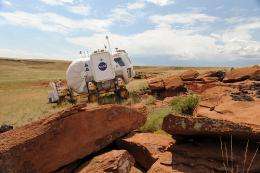
(PhysOrg.com) -- Every year, for two weeks in the Arizona desert at Black Point Lava Flow, NASA's Desert Research and Technology Studies group (Desert RATS) conducts technology development tests in anticipation of lunar exploration. Teams of engineers and geologists from several NASA laboratories as well as a variety of private and academic partners participated in this year's test, including two key members from ASU's School of Earth and Space Exploration (SESE).
New for this year was an intensive simulated mission during which two crew members, an astronaut and a geologist, lived for more than 300 hours inside NASA's new lunar wheels, the Lunar Electric Rover (LER). The explorers scouted the area for features of geological interest then donned spacesuits and conducted simulated moonwalks to collect samples. The crew also docked to a simulated habitat, drove the rover across difficult terrain, performed a rescue mission and made a four-day traverse across the rough landscape.
"We are continuously working to meet the challenges of a human outpost on the moon," says James Rice, faculty research associate in SESE and principal investigator of one of the study's geology traverses. "To meet these challenges, scientists and engineers must conduct hands-on field tests and research here on earth to better prepare and understand the complex challenges that will be encountered on the moon."
Analogs are conducted to test robotics, vehicles, habitats and in-situ resource utilization in realistic environments that will aid astronauts, engineers and scientists as they define ways to combine human and robotic efforts to enhance scientific exploration. The Arizona desert is well suited for testing technologies and procedures for future human-robotic exploration in extreme environments.
"You have to test hardware and concepts in a real-world environment with real geology, slopes, rocks, dust ... and the unexpected," Rice says. "It can't be done in a controlled laboratory. The terrain of Black Point Lava Flow contains challenging topography for LER operations and also contains lunar and Mars analog geomorphology and geology."
Rice was in charge of making traverse routes or paths that the rover and crew followed during the simulation. He had to factor in science objectives, rover driving speed, time for the crew to put on and take off spacesuits before and after geology investigations, and the time required to drive to the next station.
"We had a very detailed timeline from Mission Control that we had to work with to make sure we achieved our science goals," says Rice, who has been involved with the field tests for about six years. "Sometimes we had issues with loss of communications, equipment or the rover and this caused the whole operation to get behind on the timeline. It was very realistic."
Kip Hodges, founding director of SESE and science team member of Desert RATS, has been involved with this year's tests on a number of levels. He was the principal scientist of the K10 robot, which was developed at NASA's Ames Research Center and deployed prior to the simulated mission to identify areas of interest for the crew, and he served in the science "backroom" for the LER human tests.
"The K10 robot was employed in these tests in order to evaluate the added value of robotic reconnaissance of a planetary landscape prior to sending humans into the field for scientific research," says Hodges. "While the final field test results are not yet in, I think that my collaborators and I are extremely pleased with the exercise and looking forward to further tests. For example, we are also using K10 for follow-up work after human exploration. In that case, our analogue study site is in a bit farther afield: the high Arctic of Canada. Perhaps we'll also deploy K10 for this purpose next year at the Desert RATS tests."
New wheels for a new generation of exploration
LER, the next-generation rover, is an all-electric vehicle with 12 wheels. A little bigger than a Humvee, the LER was built for extreme exploration. The frame of this mobile base camp was developed in conjunction with an off-road race truck team, making it able to travel hundreds of kilometers over rugged terrain. Its wheels can move sideways in a "crabbing" motion, one of many features that make it skilled at scrambling over rocks. During the mission, LER was able to climb slopes on the lava flow that the team's SUV chase vehicles couldn't handle. Remarkably, the advanced suspension and drivetrain of the LER allows it to perform such feats using only 20 horsepower, an order of magnitude less than the standard off-road vehicles it left in the dust.
If that isn't enough to make the Apollo-era astronauts envious, LER is also capable of housing two astronauts for up to two weeks with sleeping and sanitary facilities. It is equipped with a time- and space-saving concept called suit ports, designed to allow astronauts to quickly enter and exit their EVA suits via a rear-entry hatch.
"Unlike during the Apollo Program where the astronauts had to drive their lunar rover wearing space suits," says Rice, "this new manned lunar rover concept with its pressurized environment will allow the crew to drive wearing more comfortable clothing and not be stuck in a space suit."
NASA has not yet confirmed the technologies that will be used in future lunar missions, but with the successful testing of analogue systems and procedures in simulated environments here on earth, we move one step closer to a sustainable human presence on the moon.
The Desert RATS tests have been held for more than a decade, as engineers from NASA centers work with representatives from industry and academia to determine what will be needed for human exploration of the moon and other destinations in the solar system. It is the culmination of the various individual science and advanced engineering discipline areas' year-long efforts. This year's work built on the investigations of previous years and increased the scope and length of the tests.
Provided by Arizona State University (news : web)


