Company Claims ESLs to be the Future of Light Bulbs (w/ Video)
September 16, 2009 by Lisa Zyga weblog
Vu1 ESL

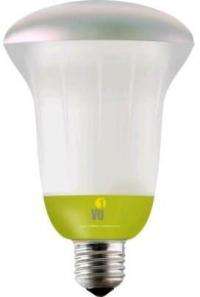
Vu1's conceptual design for its R-30 bulb. Credit: Vu1.

(PhysOrg.com) -- While compact fluorescent lights (CFLs) are currently the primary alternative to incandescent light bulbs, a company from Seattle predicts that its own novel light bulbs will eventually replace CFLs and LEDs. Vu1 ("view one") Corporation has been working on its electron stimulated luminescence (ESL) bulbs, and has recently released a demo video (below).

ESL technology works by firing electrons at phosphor, which then glows. As Vu1 explains, the technology is similar to that used in cathode ray tubes and TVs. However, the bulbs have several improvements, such as in uniform electron distribution, energy efficiency, phosphor performance and manufacturing costs. "CRT and TV technology is based on delivering an electron 'beam' and then turning pixels on and off very quickly," the company explains on its website. "ESL technology is based on uniformly delivering a 'spray' of electrons that illuminate a large surface very energy efficiently over a long lifetime."

With ESLs, Vu1 hopes to overcome some of the challenges faced by CFLs and LEDs, the two lighting technologies considered to have the most potential in the post-incandescent era. As the company explains, CFLs' biggest problem is that they contain about 5 milligrams of mercury. If not recycled properly - or if they're accidentally broken - CFLs release mercury into the air or groundwater. In addition, some people find the CFLs' cooler colors less pleasing than the warmer tones of incandescent bulbs.

This video is not supported by your browser at this time.

On the other hand, LEDs don't contain hazardous materials like mercury, and can last for up to 50,000 hours. However, their heat dissipation requirements make them more expensive than other bulbs, with a projected retail price of about $40 each.

In contrast, ESLs don't contain hazardous substances and should cost about $20, or the equivalent of a dimmable CFL reflector bulb, according to Vu1. Similar to CFLs, ESLs use 65% less energy than incandescent bulbs, and last for up to 6,000 hours, or about four times the lifespan of incandescents. Other advantages of ESLs include a warm color temperature similar to incandescent light, as well as the ability to be turned on instantly and be fully dimmable.

Vu1 plans to begin manufacturing ESLs by the end of the year, and hopes to market the bulb starting in mid-2010. Initially, the company will launch reflector-shaped bulbs, which are used in recessed lighting. Later they hope to expand into other bulb forms such as standard A bulbs and tubes.

More information: www.vu1.com

via: CNet Crave

© 2009 PhysOrg.com

3.5 /5 (24 votes)  

Filter


Move the slider to adjust rank threshold, so that you can hide some of the comments.


Display comments: newest first

Joeviocoe
Sep 16, 2009

Rank: 4.5 / 5 (6)
So LEDs are not appealing why?

They cost twice as much but last 8 times as long as these ESLs. And since LED technology has so many other applications, the price will continue to drop at a faster pace compared to ESLs.

Thanks for the advertisement article, but no thanks.
nkalanaga
Sep 16, 2009

Rank: 4.3 / 5 (3)
A properly made LED is also more durable. These ESLs are still "vacuum tubes", and as such, will still break. I'm with you. I'll wait for the LEDs.
earls
Sep 16, 2009

Rank: 3.4 / 5 (5)
Agreed, Joe.

Why is heat such a problem for LEDs? How can they be so efficient but generate so much "waste heat"?
ealex
Sep 16, 2009

Rank: 2 / 5 (2)
We need to start deciding on a light-bulb standard, if I keep changing my lightbulbs with the new kid on the market I'll end up being broke.

LED's seem like the best tech at the moment though, and even at 40$ for a 60W equiv I would still invest in equipping my home with these once I settle down, but I wouldn't invest in them while I am still renting.

The EU mandates the death of incandescent lightbulbs but sadly without a proper recycling infrastructure implemented in member countries, because even though they have longer lifespans, they are considerably more hazardous to dispose of and people WILL be just throwing them in the garbage bin.

It remains to be seen what the future of the LED lightbulbs will be. At 50000hrs MTBF, even at a daily use of 10-12hrs which is likely above average, you'd still get about 10 years of usage, so it'd pose a problem business-wise for the manufacturers, once they satisfy the market the business is pretty much dead for the next few years
Bob_Wallace
Sep 16, 2009

Rank: 4 / 5 (1)
Mercury is a very small issue. There's only a tiny bit in a CFL and that can be recovered during recycling.

(We have recycling in the US. If you're in Europe, check your Ikea store.)

ESLs apparently give about 40 lumins per watt. CFLs produce about 60.

You're going to have to purchase more electricity if you use ESLs and you're going to have to pay more for the bulbs.

Doesn't make sense to me unless you're someone who breaks a lot of light bulbs.
eastavin
Sep 16, 2009

Rank: 4 / 5 (2)
Interesting initiative. Remains to be seen who will have the price competitive alternative when ESL comes to market. The article quotes dimmable CFL's at $20 (US I assume)... a quick trip to Home Depot shows dimmable CFLs for $14... so this article is already stretching the facts.
poi
Sep 16, 2009

Rank: 3 / 5 (1)
@ealex
you'd still get about 10 years of usage, so it'd pose a problem business-wise for the manufacturers, once they satisfy the market the business is pretty much dead for the next few years

Not quite.
read on market expansion strategies.
for example, just like the cellphone industry, the market is far from saturation despite the fact that an average cellphone should last for 5 years.
a new product has the ability to create its own market.
[sorry. not the proper forum but i guess it's related]
Rsonnist
Sep 16, 2009

Rank: 4 / 5 (2)
These ESLs lamps seem like a good complement to LED lighting at the least. Being an electrician and installing CFL and LED lighting in various applications and then having to replace them because of poor spectrum and incompatibility with preexisting fixtures is a serious problem. Most companies do not want to replace the fixture (heating issues-LED) or sacrifice light quality (CFL) but would think nothing of buying an equivalent lamp that was more efficient than the preexisting lamps that they replaced.

New construction is another story. I believe LED lighting will become the norm because the fixtures will be designed for LED, but ESLs are ideal for retrofit upgrades and spectrum sensitive applications.
nkalanaga
Sep 16, 2009

Rank: 4.3 / 5 (3)
Spectrum isn't really a problem for the LEDs. So far they're made with multiple emitters, so they can be tailored to almost any spectrum one wants. You want redder light? Use more red emitters.

Some critics say that LEDs don't spread their light like a bulb, but again, the multiple emitters can easily be mounted on a bulb-shaped surface.

With the proper electronics, it would be possible to change the color of an LED "bulb" as easily as dimming the light, simply by adjusting the brightness of the various emitters.
RayWilson
Sep 16, 2009

Rank: 4 / 5 (1)
What chemicals will be present in the phosphors?
What voltage will be necessary to accelerate the electrons?
abzu
Sep 16, 2009

Rank: 4 / 5 (1)
Because I want little fragile pods of hazmat hanging out of every ceiling.

OLED paneling will be the future.
Rsonnist
Sep 16, 2009

Rank: 3 / 5 (1)
Spectrum isn't really a problem for the LEDs. So far they're made with multiple emitters, so they can be tailored to almost any spectrum one wants. You want redder light? Use more red emitters.

Some critics say that LEDs don't spread their light like a bulb, but again, the multiple emitters can easily be mounted on a bulb-shaped surface.

With the proper electronics, it would be possible to change the color of an LED "bulb" as easily as dimming the light, simply by adjusting the brightness of the various emitters.


Spectrum is a problem in single LED lighting such as spot lights and smaller lamps. While it would be nice to replace halogen spotlights with LED they neither have the power or spectrum as of current. There is a niche for ESLs that is not currently being filled.
ThomasS
Sep 17, 2009

Rank: 4 / 5 (1)
Although I love LEDs, the problem is that they are not as efficient at high currents as they are at low currents (its called droop). And you want to crank it up beyond the 1 watt, if it is to be used for general lighting. See this months IEEE spectrum issue, http://www.spectr...secret/1
LuckyExplorer
Sep 17, 2009

Rank: 3.7 / 5 (3)
The whole article is not very accurate, some arguments are even nonsens, it is a real advertisement.
Well designed LED systems have good efficiency (>50 lm/W) and excellent color quality (Ra >90) with CCT about 2700-3500K.
Luminous flux is limited depending on the bulb size, that is correct, but will be improved continousely.
The Mercury in CFL lamps is no real problem as long you don't break the bulb. Recyceling is a standard (in most western countries).
GOOD JOB from the marketing department
danman5000
Sep 17, 2009

Rank: 2.5 / 5 (2)
What do they mean by heat dissipation problems for LED lights? LEDs don't generate hardly any heat at all so I assume theyd be talking about the electronics, but that can't possibly be that bad. All it takes for one LED is two wires and a resistor.
autosyn
Sep 17, 2009

Rank: not rated yet
Sounds a lot like a crookes tube. (http://en.wikiped...es_tube)
Lots of experts and no emission spectrum...

Does it come with leaded glass or soft x-rays?

Bonn
Sep 17, 2009

Rank: 4.5 / 5 (2)
The heat dissipation problems for LED is that LED's do better when cold. So while they are 3-4 times more efficient than incandescent bulbs they still put out more heat than light. To get enough light for a room you have to use metal heat sinks to dissipate the heat or else your LED will get dimmer as it warms up. And may die quicker than if you kept it cool.
TRonDavis
Sep 17, 2009

Rank: not rated yet
We at Vu1 have read through many of the posted comments and would like to suggest that anyone interested in getting the lastest facts on ESL, the technology, the features, the performance, go to the Vu1 Blog where I have posted a Q & A.

The blog is at vu1corp.blogspot.com

T. Ron Davis
Chief Marketing Officer
Vu1 Corporation
alq131
Sep 18, 2009

Rank: 4 / 5 (2)
OLED lighting is also a technology that is showing promise. Though it would be for a different market application, that of area lighting. LED, ESL, CFL are all point sources, where OLED is a Panel or area source. Costs are still quite high, but as manufacturing technologies improve it will make a dent in costs.

And for the ESL, That was my question too...so it doesn't have Hg, but does it have Lead--or x-rays? I didn't see this answered on the marketing video at Vu1.
retrosurf
Sep 20, 2009

Rank: 1 / 5 (1)
Like a lot of marketing literature, it is characteristically thin on technical details.
It might have a niche in places where the tungsten bulb has been banned, and among the Fox news crowd
(note the fear based appellation "mercury bulbs" or "toxic bulbs").
I love light bulbs. I'll buy at least one of these if they come to market, just out of curiosity, but
it cannot compete, dollar for lumen, with mercury based fluorescence.
NameIsNotNick
Sep 21, 2009

Rank: not rated yet
A lot of people seem surprised that LEDs generate heat... and a lot of it. They are efficient compared to incandescent lights but at this stage they are roughly equivalent to a CFL as far as overall efficiency is concerned. The problem is an individual LED die is small so the heat is concentrated and difficult to get rid of.
lee_chongeu
Sep 21, 2009

Rank: not rated yet
It's like placing a CRT above my head!
Rank 3.5 /5 (24 votes)
Related Stories
Relevant PhysicsForums posts
  • feed hold button on CNC lathe
    created12 hours ago
  • Mechanics of Solids ( Final exam question) please help!
    created14 hours ago
  • RFAC in Fortran
    created17 hours ago
  • dynamics 2/32
    created22 hours ago
  • dynamics
    created23 hours ago
  • Vibration Absorbtion Problem
    createdFeb 08, 2012
  • More from Physics Forums - General Engineering

More news stories

First Google hire leaving for online academy

The first person hired by Google's founders is leaving the Internet giant to devote himself to an innovative online education website called Khan Academy.

Technology / Internet

created 1 hour ago | popularity not rated yet | comments 0

NY attorney general ends lawsuit against Intel

(AP) -- Intel Corp. is paying $6.5 million as part of a deal to terminate an antitrust lawsuit filed against the chip maker by the New York attorney general's office.

Technology / Business

created 1 hour ago | popularity not rated yet | comments 0

FBI file: Steve Jobs was considered for govt post

(AP) -- FBI background interviews of some people who knew Apple co-founder Steve Jobs reveal a man driven by power and alienating some of the people who worked with him.

Technology / Business

created 1 hour ago | popularity 2.3 / 5 (3) | comments 0

LinkedIn's 4Q earnings strong, revenue doubles

(AP) -- LinkedIn reported a strong fourth quarter as the online professional-networking service added 14 million members. Its net income and revenue beat Wall Street's expectations.

Technology / Business

created 1 hour ago | popularity not rated yet | comments 0

New integrated building model may improve fish farming operations

Today's "locavore" movement with its emphasis on eating more locally-produced food is a natural fit for fruits and vegetables in nearly every region, but few entrepreneurs have dared to apply the concept to ...

Technology / Engineering

created 1 hour ago | popularity not rated yet | comments 0


Cannabis use doubles chances of vehicle crash

Drivers who consume cannabis within three hours of driving are nearly twice as likely to cause a vehicle collision as those who are not under the influence of drugs or alcohol claims a paper published today in the British ...

Study says children of women exposed to chemotherapy in pregnancy develop as well as other children

A study published Online First by The Lancet Oncology, and linked to The Lancet Series on cancer in pregnancy, shows that children of women exposed to chemotherapy while pregnant develop as well as children in the genera ...

Focus on self-improvement, rather than winning, benefits young athletes

Underserved youth athletes report more life skill and character development when their coaches place greater emphasis on creating caring climates instead of focusing on competition, according to research from ...

Current trend is to preserve pregnancy in patients diagnosed with cervical or ovarian cancer

The first paper in The Lancet Series on cancer in pregnancy explores the issues around gynaecological cancers, with cervical and ovarian being the most common. The current trend is to preserve pregnancy wherever possible. The fi ...

Surgery and chemotherapy are possible for pregnant women with breast cancer

Breast cancer in pregnant women is as common as in non-pregnant women of the same age, with no evidence to suggest pregnancy increases the risk of such cancer. In the majority of cases, pregnant women can have their breast ...

Complications of blood cancers make termination advisable at early stages of pregnancy

Lymphoma is the fourth most common cancer in pregnancy, affecting one in 6000 pregnancies. Non-Hodgkin lymphoma, acute leukaemia, and other blood cancers, while also rare, can also occur in pregnancy. The need for urgent ...