Researcher thinks 'inside the box' to create self-contained wastewater system for soldiers, small towns
September 16, 2009 Researcher thinks 'inside the box' to create self-contained wastewater system for soldiers, small towns

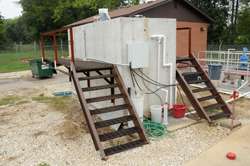
This pilot-scale testing unit demonstrates how the wastewater treatment system would work. Recently Wang received approval for full-scale system demonstration.

(PhysOrg.com) -- Cheaper. Better. Faster. Most people will say you can't have all three. But don't tell that to Dr. Jianmin Wang, a professor of civil, architectural and environmental engineering at Missouri University of Science and Technology.

Wang has created a wastewater system "in a box." Each system, built by re-purposing a shipping container, is low power, low maintenance and highly efficient. Built from weathering steel, these containers are designed to be tough and can be dropped on site by helicopters.

The system's scorecard is so good that it could be deployed anywhere - from small, rural communities to forward operating bases, like those in Iraq or Afghanistan. Currently, the typical 600-soldier forward operating base requires a daily convoy of 22 trucks to supply the base with fuel or water and dispose of wastewater and solid waste. With few mechanical parts and a small footprint, the system is ideal for military use, Wang says.

"Currently, human wastes are typically burned in burn pits, and the wastewater is usually hauled away and dumped by local contractors," Wang explains. "This results in high costs, security issues, potential health risks, negative environmental impacts to the hosting country and a potential negative image.

"Moreover, almost all fresh water used in the camp - including water for drinking, bathing, showering, laundry, car washing and toilet flushing ¬- is from outside sources in the form of bottled and surface water. A deployable and easy-to-use water reclamation station, which transforms wastewater into reusable water within the base, would improve the base environment, security, soldiers' health, stewardship of foreign lands and concurrently reduce cost and fresh water demand from off-base sources."

Current wastewater treatment options include membrane bioreactor, activated sludge, fixed film or on-site septic systems. Similar to these methods, Wang's process uses microorganisms to break down the organic pollutants. Membrane bioreactor, activated sludge process and fixed-film process have been built using standard shipping containers, too. But that's where the similarities end.

The membrane bioreactor process, while similar in size and quality of effluent produced, has extremely higher energy and maintenance costs, and up to 10 times more expensive parts.

"The fixed-film system, as developed by other companies, needs to be monitored and controlled constantly," Wang says. "Plus our system is much smaller than their systems - only 20-30 percent of the size of these systems for the same treatment capacity. Our system does not use any media, which significantly reduces construction and maintenance cost."

Wang's system, named a baffled bioreactor (BBR) by Wang, modifies the conventional activated sludge process by using baffles to create a maintenance-free intermediate settling chamber for sludge return. It uses off-the-shelf, low-tech parts to treat wastewater at a level that exceeds federal standards. The water can be used for non-contact applications, including toilet flushing and car washing.

Although this project is focused on military needs, Wang says the small, low-maintenance and low-power system makes sense for small communities, mobile home parks, motels and even facilities in remote areas, such as highway rest areas and camps.

A few days ago, the U.S. Army approved Wang's request to demonstrate a full-scale, company-size water reclamation station for advanced wastewater and non-potable reuse. During this project, he will also explore the feasibility of producing potable from wastewater in emergency situations.

"A lesson learned from Hurricane Katrina is that untreated sewage can cause many health and psychological problems for displaced people," Wang adds. "The transportable, modular baffled reactor units could even be deployed to regions where natural disasters occur to quickly prevent untreated wastewater discharge and improve hygiene."

Provided by Missouri University of Science and Technology (news : web)


print this article email this article download pdf blog this article bookmark this article     Stumble it Digg this share on Facebook retweet share on Reddit add to delicious
Rate this story - 5 /5 (8 votes)

Rank Filter

Move the slider to adjust rank threshold, so that you can hide some of the comments.


Display comments: newest first

  • NotAsleep - Sep 17, 2009
    • Rank: 5 / 5 (1)
    I wish we'd had that in Iraq a couple years ago... some of the worst things out there were the sewage ponds
  • Sean_W - Sep 17, 2009
    • Rank: not rated yet
    While killer robots and other weapons systems technologies are cool, technologies like this which can speed deployment, reduce costs, improve security and transfer over to improving reconstruction/development efforts is where a much of the progress in military technology will be made in the near future.

    Now develop a tank that can bury electric cables and plumbing lines while laying pavement at the same time as it kills terrorists and brews beer at the same time and you would really have something.
  • winthrom - Sep 17, 2009
    • Rank: not rated yet
    This looks like a "no brainer" for refugee camps, national park camping sites, etc. Another possible use is commercial buildings to lower potable water purchasing for toilets and urinals. Construction sites could consider this also.
  • GregHight - Sep 17, 2009
    • Rank: not rated yet
    It could also be scaled down for almost every home so that sewage is pretty much processed before it heads back to the municiple treatment plant. It could also be used in lieu of septic tanks for the untold millions of homes not connected to public sewer systems.

September 16, 2009 all stories

Comments: 4

5 /5 (8 votes)
  • Stumble this up

  • Digg this

  • share this

  • hide
  • Related Stories

  • Too much nanotechnology may be killing beneficial bacteria
    created Apr 29, 2008 | popularity not rated yet | comments 0
  • LA to turn sludge into electricity
    created Apr 06, 2007 | popularity not rated yet | comments 0
  • 'If a Package Stinks, It Belongs to Me'
    created Dec 08, 2006 | popularity not rated yet | comments 0
  • Drug metabolites found in wastewater
    created Mar 16, 2006 | popularity not rated yet | comments 0
  • Wastewater: Energy of the future?
    created Nov 14, 2005 | popularity not rated yet | comments 0


  • hide
  • Relevant PhysicsForums posts

  • Control System
    created Nov 24, 2009
  • Base Isolation Systems in Skyscrapers?
    created Nov 23, 2009
  • Need to interview a Computer Hardware Engineer for school project
    created Nov 23, 2009
  • transient heat transfer
    created Nov 23, 2009
  • Trying to adapt a fuel gage circuit
    created Nov 22, 2009
  • Pushing the piston.
    created Nov 22, 2009
  • More from Physics Forums - General Engineering

Other News

Design chosen for British 1,000 mph car

Design chosen for British 1,000 mph car (w/ Video)

Technology / Engineering

created 8 hours ago | popularity 4 / 5 (4) | comments 3

(PhysOrg.com) -- A British team hoping to be the first to get a car to 1,000 mph (1,610 km/h) has made its final design selection. The six-tonne car, known as the Bloodhound, will be powered by a Eurofighter ...


US online ad revenue down 5.4 pct in third quarter

Technology / Internet

created 2 hours ago | popularity not rated yet | comments 0

(AP) -- Online advertising revenue in the U.S. fell 5.4 percent in the third quarter from a year ago, as the sputtering economy kept its tight grip on even the fastest growing segment of industry, according to a report released ...


Taking the drudgery out of software development

Taking the drudgery out of software development

Technology / Software

created 22 hours ago | popularity 3.6 / 5 (10) | comments 12

(PhysOrg.com) -- Software developers will no longer have to reinvent the wheel when writing new programs and applications thanks to a clever new set of tools and a central repository of 'building blocks'.


Wikileaks

Wikileaks releases pager intercepts from 9/11

Technology / Internet

created 2 hours ago | popularity not rated yet | comments 0

Whistleblower website Wikileaks began publishing on Wednesday what it said were hundreds of thousands of pager messages from the day of the September 11, 2001 attacks on New York and Washington.


EU assembly adopts Internet, phone user rights

Technology / Telecom

created 4 hours ago | popularity not rated yet | comments 0

(AP) -- The European Parliament has endorsed new telecom rules that would give phone and Internet users more rights and allow them to appeal to national courts if they are cut off for illegal file-sharing.