Cars running on ethanol can pollute too: Brazil study
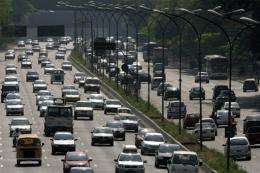
September 17, 2009 Sao Paulo traffic

Enlarge

Sao Paulo traffic. Cars running on sugarcane ethanol can produce as many harmful pollutants as those using ordinary petrol (gasoline), according a study published by Brazil's environment ministry.

Cars running on sugarcane ethanol can produce as many harmful pollutants as those using ordinary petrol (gasoline), according a study published by Brazil's environment ministry.

But the report on the emissions of the cars on Brazil's roads does not count .

"We want to make sure that customers are aware of pollutant emissions" when they buy a car, Environment Minister Carlos Minc said Tuesday on delivering the report.

The study ranked emissions based of a scale of "green grades" that measured three pollutant gases that do not produce but do affect the health of a country's population: carbon monoxide, hydrocarbons and nitrogen oxide.

The green grade scale, ranging from 0-10, does not count carbon emissions, which are the main driver of global warming, because emissions from burning ethanol are offset by the carbon dioxide that sugar cane absorbs as it grows, the study said.

The research also examined 250 so-called "flex-fuel" cars, which use both ethanol and petrol and constitute about 85 percent of all cars on the road in Brazil.

Among those receiving the lowest scores, eight were cars running on , including several with "flex" engines, the study said, though all of the models examined met Brazil's standards for maximum emissions levels in 2008.

Environmental group Greenpeace welcomed the report, but an official with the group's climate change campaign in Brazil, Joao Talochhi, told Estado de Sao Paulo newspaper that "when it comes to public health, the Brazilian government should invest in non-polluting technology."

(c) 2009 AFP


print this article email this article download pdf blog this article bookmark this article     Stumble it Digg this share on Facebook retweet share on Reddit add to delicious
Rate this story - 3.7 /5 (9 votes)

Rank Filter

Move the slider to adjust rank threshold, so that you can hide some of the comments.


Display comments: newest first

  • dachpyarvile - Sep 17, 2009
    • Rank: 3 / 5 (6)
    Kind of not so funny when one realizes that it is the other pollutants that cause far more harm than CO2, including health problems.

    It is quite ironic when one considers the commercials for so-called green, environmentally friendly vehicles, including the PRIUS with all the smiling and waving clouds, plants and so forth. :)
  • Mavin - Sep 17, 2009
    • Rank: 2.6 / 5 (5)
    If CO2 is so bad that we need to act now to prevent irreversible climate change, I want someone to tell me just how green our planet would be if we got rid of all that nasty bad CO2?
  • dachpyarvile - Sep 17, 2009
    • Rank: 2.8 / 5 (4)
    The article does not really discuss CO2 with reference to these vehicles, and indeed CO2 is not counted as mentioned above, because use of cane ethanol is CO2 neutral because of the CO2 consumed by the sugar cane when growing.

    As to preventing irreversible climate change, I do not believe that we are capable of either causing or preventing major change.

    I also do not believe in climate change being irreversible except in one case. It is in what will happen to this planet in the future if we do not double the amount of CO2 in the atmosphere. The oceans will be blasted into space when the Sun ramps up its fusion rate sometime within the next million to billion years.

    CO2 will have a protective effect on the atmosphere sans bleeding off or permanent sequestration of nitrogen in suffient quantities.

    The CO2 option is cost effective (we already are doing it as a byproduct of other services in use!) and actionable with present technology.
  • PPihkala - Sep 17, 2009
    • Rank: 2.7 / 5 (3)
    We should not eliminate CO2 altogether and we can not do that. What we should do is to reduce CO2 to levels that it would be without all the pollution humans cause by current technology, including burning oil and coal.

    What this article is about, is that there are other pollutants too, that need to be addressed, but CO2 should come first.
  • dachpyarvile - Sep 18, 2009
    • Rank: 3 / 5 (2)
    I forgot to add that we recently dropped back down to an annual increase of 1.5 ppm CO2 annually.

    Catastrophic predictions by the IPCC and NSIDC, as well as others, for the year 2100 are not plausible since that is 91 years away and a 1.5 ppm CO2 annual increase will not get us to the tipping point that allowed Antarctic ice to begin forming by that time.

    At current rates of increase, by 2100 we will be at 136.5 ppm higher, or 523.5 ppm atmospheric CO2. Once again, the hotly debated, newly discovered tipping point that allowed ice to begin forming on Antarctica is 760 ppm atmospheric CO2.
  • jerryd - Sep 18, 2009
    • Rank: 3 / 5 (2)
    I see the political nut cases are out in force. There is nothing in this article about CO2, just the other pollutants. Those who don't believe in GW just refuse to look at the facts. And try to stay on topic.

    The worst is NOx which ethanol makes little of because it runs cool which cuts the heat needed to make it. The others depend on the state of tune, complete burning, the motors are in.
  • dachpyarvile - Sep 18, 2009
    • Rank: 4 / 5 (1)
    No, the article does discuss CO2-briefly. It only mentions that it is not included in the report because cane sugar ethanol is considered carbon neutral.

    But the report on the emissions of the cars on Brazil's roads does not count carbon dioxide emissions.

    * * *

    The green grade scale, ranging from 0-10, does not count carbon emissions, which are the main driver of global warming, because emissions from burning ethanol are offset by the carbon dioxide that sugar cane absorbs as it grows, the study said.


    So far as NOx is concerned, it depends upon the engine. NOx still is produced, which is why the study wishes proper information to be presented to the buyer. It may be less produced but it still is produced and will add up when you multiply how many vehicles produce it and how much still gets into the atmosphere over time.
  • otto1923 - Sep 19, 2009
    • Rank: 1 / 5 (1)
    @dachpyrville
    The oceans will be blasted into space when the Sun ramps up its fusion rate sometime within the next million to billion years.
    By that time we should know enough to be able to ramp it back down again. Or move the earth on a whim.

September 17, 2009 all stories

Comments: 8

3.7 /5 (9 votes)
  • Stumble this up

  • Digg this

  • share this

  • hide
  • Related Stories

  • For some, it's comfort vs. global warming
    created Jul 05, 2007 | popularity not rated yet | comments 0
  • Fuel ethanol cannot alleviate US dependence on petroleum
    created Jul 01, 2005 | popularity not rated yet | comments 0
  • Ethanol production said increasing erosion
    created Jul 06, 2005 | popularity not rated yet | comments 0
  • U.S. greenhouse emissions up 1.7 percent
    created Feb 28, 2006 | popularity not rated yet | comments 0
  • A new measure of global warming from carbon emissions
    created Jun 10, 2009 | popularity not rated yet | comments 0


  • hide
  • Relevant PhysicsForums posts

  • The IPCC and the term "most"
    created Nov 23, 2009
  • Is global warming a fact?
    created Nov 23, 2009
  • Random variability of wind patterns
    created Nov 23, 2009
  • Record precipitation in the UK
    created Nov 22, 2009
  • More from Physics Forums - Earth

Other News

Aqua satellite sees Tropical Storm Bongani approaching Mozambique Channel

Aqua satellite sees Tropical Storm Bongani approaching Mozambique Channel

Space & Earth / Earth Sciences

created 1hour ago | popularity not rated yet | comments 0

NASA's Aqua satellite flew over Cyclone Bongani today and provided some important data that have helped forecasters figure out where the storm is headed, and helped them see that it has changed course.


Cosmic 'dig' reveals vestiges of the Milky Way's building blocks

Cosmic 'Dig' Reveals Vestiges of the Milky Way's Building Blocks

Space & Earth / Astronomy

created 3 hours ago | popularity 5 / 5 (6) | comments 0

(PhysOrg.com) -- Peering through the thick dust clouds of our galaxy's "bulge" (the myriads of stars surrounding its center), a team of astronomers has unveiled an unusual mix of stars in the stellar grouping ...


Oceanic crust formation is dynamic after all

Oceanic crust formation is dynamic after all

Space & Earth / Earth Sciences

created 2 hours ago | popularity 4 / 5 (1) | comments 0

Imagine the Earth's crust as the planet's skin: Some areas are old and wrinkled while others have a fresher, more youthful sheen, as if they had been regularly lathered with lotion.


Mars Reconnaissance Orbite

Mars Reconnaissance Orbite Team Plans Uplink of Protective Files

Space & Earth / Space Exploration

created 8 hours ago | popularity 5 / 5 (1) | comments 0

(PhysOrg.com) -- The team operating NASA's Mars Reconnaissance Orbiter plans to uplink protective files to the spacecraft next week as one step toward resuming the orbiter's research and relay activities.


NASA's Aqua satellite sees Nida explode into a category 5 Super typhoon

NASA's Aqua satellite sees Nida explode into a category 5 Super typhoon

Space & Earth / Earth Sciences

created 2 hours ago | popularity 5 / 5 (1) | comments 0

Typhoon Nida is in a favorable environment that has enabled it to intensify faster and stronger than previously forecast, and has now exploded into a Super typhoon. NASA's Aqua satellite passed over Nida and ...