Mechanical and nuclear engineers receive award for top-100 technology product of 2009
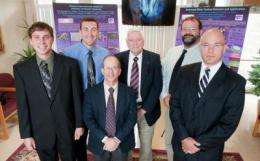
A neutron detector created at Kansas State University has been named one of the top 100 technologies of the year.
K-State's Douglas McGregor, professor of mechanical and nuclear engineering, and his team of researchers designed and developed a microstructured semiconductor neutron detector that was given a 2009 R&D 100 Award. The award is sponsored by R&D Magazine and recognizes the year's 100 most technologically significant new products introduced into the marketplace.
"What a proud accomplishment for Dr. McGregor and his team to be recognized in this way," said John English, dean of K-State's College of Engineering. "The quality of research being conducted by the faculty and students in our nuclear engineering program certainly speaks well of our excellence in this area."
The microstructured semiconductor neutron detector is a portable device designed to detect neutrons, a signature radiation emitted by some nuclear materials used in nuclear weapons. An R&D 100 Award signifies that a product has merit as one of the most innovative new ideas of the year, nationally and internationally, and is recognized as a mark of excellence by national laboratories, universities, industrial companies and government agencies. The award honors technology developments that are designed to meet current or future societal, scientific or business challenges.
"We are all pleased to be recognized with an R&D 100 Award for the years of work that have gone into developing this technology," McGregor said. "The students and faculty who helped design, fabricate and test the detectors have much to be proud of, and we hope to see the product commercialized soon."
Researchers in McGregor's Semiconductor Materials and Radiological Technologies Laboratory, or SMART Laboratory, created the device and will be honored at an awards banquet Nov. 12 in Orlando, Fla. They include J. Kenneth Shultis, professor of mechanical and nuclear engineering; Troy Unruh, graduate student in nuclear engineering, Hillsboro; Steven Bellinger and Eric Patterson, graduate students in nuclear engineering, Manhattan; Clell Solomon, graduate student in nuclear engineering, Wichita; and Walter McNeil, graduate student in nuclear engineering, Winfield. Jamie Gardner, operations manager at Alion Science and Technology, also was involved in the research and will participate in the ceremony.
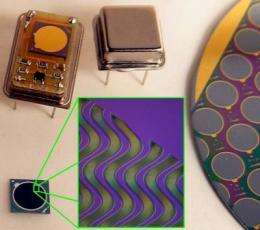
The microstructured semiconductor neutron detectors are constructed from semiconductor wafers, most commonly silicon. The detector's distinction is in its thousands of tiny perforations, only a few microns wide, etched deep into the semiconductor wafer. A diode is formed inside these perforations, which are subsequently backfilled with neutron reactive materials. When neutrons interact, energetic particles are emitted that create a cloud of electrical charge in the semiconductor, producing an electrical pulse.
"Developing sophisticated devices such as those fabricated in Dr. McGregor's laboratory clearly demonstrates the high level of research that is conducted in the mechanical and nuclear engineering department at K-State," said Don Fenton, who heads the department.
McGregor and his SMART Laboratory team first demonstrated an early version of these neutron detectors in 2001. The devices initially were designed as neutron dosimeters, which measure neutron radiation dosage for radiation workers. Since then, the devices have been improved with lower noise, lower leakage currents, larger size and increased detection efficiency. They can now be used for various applications requiring robust compact neutron detectors. These latest detectors operate on just a few volts and can yield more than 45 percent thermal neutron detection efficiency.
"The development of our new technology is timely in that helium-3, a rare isotope of helium and the resource used for common commercial neutron detectors, is expensive and in short supply," McGregor said. "Our development appears to be a viable alternative to the older helium-3 based neutron detector technology."
Several instruments have been manufactured with the new technology, including compact dosimeters, remote neutron detector arrays and wireless neutron monitors. Most recently, a neutron imaging array has been constructed for the Spallation Neutron Source, the world's most intense pulsed accelerator-based neutron source. The SMART Laboratory mass produces the detectors at a low cost. This allows for wide-scale detector deployment for detection of illicit nuclear materials, for monitoring of international safeguards agreements regarding nuclear materials and to protect personnel.
The neutron detector research has resulted in more than 20 publications and two allowed patents. The research was supported primarily by the U.S. Department of Defense through the Defense Threat Reduction Agency and by the National Science Foundation through an Instrumentation for Materials Research-Major Instrumentation Projects grant. The U.S. Department of Energy provided support through the Nuclear Engineering Educational Research program. Additional support to the SMART Laboratory has been provided by the U.S. Department of Energy National Nuclear Security Administration through the Office of Nonproliferation Research and Development.
Source: Kansas State University


