Scientists begin Southeast Asia study of aerosols linked to global warming
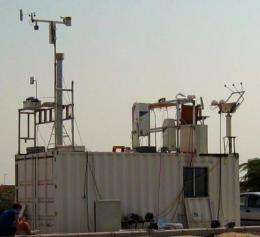
NRL's Marine Meteorology Division has deployed the Mobile Atmosphere, Aerosol, and Radiation Characterization Observatory (MAARCO) to the National University of Singapore to begin the first comprehensive radiation and aerosol assessment in the Maritime Continent region. NRL is leading the effort to investigate ways in which to infer larger aerosol and visibility features from limited data sets, and to analyze the aerosol physical interactions and processes to aid numerical aerosol and weather predictions.
The Marine Meteorology Division, Monterey, Calif., has specifically designed and developed the unique MAARCO to be a rugged, easily transportable, flexible and comprehensive suite of instruments to make surface measurements of the radiometric and meteorological properties of the atmosphere, the microphysical and compositional properties of aerosols and the vertical distribution of aerosols and clouds. The instrumentation suite includes a LIDAR, Sun photometer, radiometers, particle probes, filter samplers, and impactors as well as a host of weather instruments.
The impact of biomass burning and pollution on the Maritime Continent is of considerable concern to global climate change researchers. The deployment of MAARCO is part of the overarching 7 Southeast Asian Studies (7SEAS) program—a comprehensive interdisciplinary atmospheric sciences program to study the interactions of pollution and smoke with regional meteorology, air quality, land surface science and oceanography..
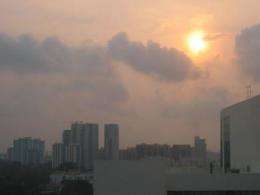
"The extreme cloud cover and complicated environment of the Maritime Continent allows for very few satellite observations of pollution and smoke to be properly ingested in the models," said Dr. Simon Chang, superintendent, NRL Marine Meteorology Division. "Field investigations will help researchers develop methods to make the best use of the limited data available and yield insight on how to constrain aerosol optical properties in models and satellite retrievals."
NRL began developing the 7 SEAS program in 2007 in partnership with NASA, and since has initiated satellite and model based research programs with regional scientists. Through collaboration with Southeast Asia regional science partners (in Malaysia, Philippines, Singapore, Taiwan, Thailand and Vietnam) and with sponsorship by NASA and the Office of Naval Research, NRL's Marine Meteorology Division is co-leading the effort with NASA's Goddard Space Flight Center, to dramatically ramp up activity with the introduction of significant field observatory deployments scheduled over the next five years. Initial field research is being performed in cooperation with the National University of Singapore's Center for Remote Imaging, Sensing and Processing (CRISP) and the Department of Environmental Engineering.
"The 7SEAS mission plan calls for active collaborative research with regional scientists, and includes significant outreach and educational components for students," said Jeffrey Reid, 7SEAS mission scientist, NRL Marine Meteorology Division. "This interdisciplinary research program incorporates participation of multiple U.S. and international agencies at a grass-roots level which separates it from other programs in the region."
Scientists are concerned that pollution and smoke in the Maritime Continent at times can be so dense that it may modify the weather and hampers their ability to forecast in the region.
According to Anthony Bucholtz, radiation scientist at NRL's Monterey laboratory, Singapore provides an ideal location for studying the effects of the complex interactions between sunlight, haze, clouds and pollution on the radiative balance of the tropical atmosphere.
The Navy aerosol models are used for a variety of scientific and operational purposes, including visibility forecasting and the development of aerosol light scattering and absorption climatologies. Recent research has surrounded aerosol-weather interaction and it is anticipated that in the future the direct impact of aerosol particles on the meteorological fields of Navy weather models will be included in forecasts.
Following a previous major aerosol/dust field experiment in Southwest Asia (The Unified Aerosol Experiment in the United Arab Emirates (UAE2), interest in 7 SEAS focuses on aerosol meteorology interaction determining how aerosol particles perturb cloud properties and boundary layer dynamics, subsequently feeding back into pollution emissions, concentrations, evolution, scavenging and transport. These feedbacks cause interactions of interest to a wide variety of other Earth systems science fields including oceanography and land surface science.
Navy interest lies in aerosol observability and numerical prediction issues, and in particular, aerosol radiative impacts. NRL developed many of the "world's firsts" of aerosol and pollution forecasting. NRL developed the first operational aerosol prediction system (NRL Aerosol Analysis and Prediction System, NAAPS) as well as the world's first operational aerosol data assimilation system which uses NASA satellite measurements to track pollution, dust and smoke (the Navy Variational Analysis Data Assimilation System-Aerosol Optical Depth, NAVDAS-AOD). Lastly, NAAPS is the world's first global operational model to employ satellite data to actively track emissions. Operationally the Navy uses both geostationary meteorological and NASA climate satellite sensors.
Source: Naval Research Laboratory (news : web)


