Proposal to reintroduce Iberian lynx on abandoned agricultural land
September 17, 2009 Proposal to reintroduce Iberian lynx on abandoned agricultural land

Enlarge

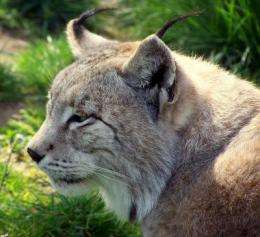
This is an Iberian lynx. Credit: Miguel Rodríguez / SINC

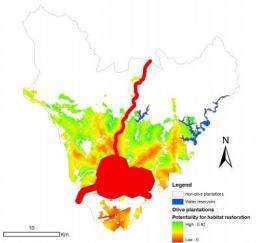
Spanish scientists have developed a model to identify the agricultural areas with the greatest potential for restoring the habitat of the Iberian lynx (Lynx pardinus), which is at risk of extinction. The study shows that olive groves with low production close to the Natural Park of the Sierra de Cardeņa y Montoro, in Córdoba - which is the only place, along with Doņana, where this species lives - are the most appropriate sites for this purpose.

Researchers from the regional government of Andalusia's Institute for Agricultural and Fishing Research and Training (IFAPA) have studied the impact and risk of these mountain olive groves being abandoned, in order to come up with an appropriate management system for them (conventional, mixed or organic), or to suggest they should be reconverted to Mediterranean forest.

The risk of these olive groves being abandoned is "due to their location, which has serious socioeconomic implications (mainly in terms of the population leaving rural areas) and environmental ones (erosion and risk of fires)", Manuel Arriaza, director of the study and a researcher at the IFAPA, tells SINC. "Although the olive groves have low production levels and high production costs, they are areas with great environmental value", adds Arriaza.

The general model of the research study, which has been published recently in the Spanish Journal of Agricultural Research, was developed using various Geographical Information Systems (GISs), and also took into account experts' opinions about the commercial and non-commercial functions of the olive groves, as well as those of 480 people in the province of Córdoba about the importance that society places on these functions in agricultural areas.
Proposal to reintroduce Iberian lynx on abandoned agricultural land
Enlarge

This is a map of the most suitable areas for habitat restoration of the Iberian lynx. Credit: Manuel Arriaza et al./ SINC

The scientists evaluated the socioeconomic functions (olive oil production and retention of the rural population), environmental ones (prevention of erosion and fires, conservation and improvement of biodiversity, with special focus on the habitat of the Iberian lynx), and cultural ones.

The results suggest that the most highly-valued function of mountain olive groves is their ability to retain the rural population (24%), followed by production of olive oil (17%) and the prevention of erosion (16%).

On the basis of the interviews and the geographical features of the area, the model's final proposal suggests that 36% of the land should be planted to conventional olive groves, 23% should be reconverted to Mediterranean forest, 22% should be mixed olives and forest, and 19% organic olive groves.

However, once the best areas for restoration of Iberian lynx habitat have been generically identified, "other aspects not covered by the initial land analysis should also be looked at before any action is taken, such as the size of the rabbit population present, or fragmentation of certain areas", points out Arriaza.

More information: Nekhay, O.; Arriaza, M. "Restoration of abandoned agricultural lands toward habitats for umbrella species" Spanish Journal of Agricultural Research 7(2): 375-389, 2009.

Source: FECYT - Spanish Foundation for Science and Technology


print this article email this article download pdf blog this article bookmark this article     Stumble it Digg this share on Facebook retweet share on Reddit add to delicious
Rate this story - 3 /5 (2 votes)


September 17, 2009 all stories

Comments: 0

3 /5 (2 votes)
  • Stumble this up

  • Digg this

  • share this

  • hide
  • Related Stories

  • Olive oil's heart effect identified
    created Nov 27, 2005 | popularity not rated yet | comments 0
  • New medical use for olive oil suggested
    created Feb 07, 2007 | popularity not rated yet | comments 0
  • Powered by olive stones? Turning waste stones into fuel
    created Oct 29, 2008 | popularity not rated yet | comments 0
  • Study: Olive oil fed 2,000 B.C. foundries
    created Mar 07, 2006 | popularity not rated yet | comments 0
  • British olives: A sign of global warming
    created Jun 26, 2006 | popularity not rated yet | comments 0


  • hide
  • Relevant PhysicsForums posts

  • What is transpulmonary pressure?
    created Nov 24, 2009
  • Is there a gay gene?
    created Nov 23, 2009
  • Super quick question about Starling forces?
    created Nov 22, 2009
  • Questions about diffusion
    created Nov 22, 2009
  • More from Physics Forums - Biology

Other News

Variable Temperatures Leave Insects wtih a Frosty Reception

Biology / Plants & Animals

created 5 hours ago | popularity not rated yet | comments 0

(PhysOrg.com) -- For the first time, scientists at The University of Western Ontario have shown that insects exposed to repeated periods of cold will trade reproduction for immediate survival.


When camouflage is a plant's best protection

Rare woodland plant uses 'cryptic coloration' to hide from predators

Biology / Plants & Animals

created 7 hours ago | popularity 4.3 / 5 (3) | comments 0

It is well known that some animal species use camouflage to hide from predators. Individuals that are able to blend in to their surroundings and avoid being eaten are able to survive longer, reproduce, and ...


Cells defend themselves from viruses, bacteria with armor of protein errors

Biology / Cell & Microbiology

created 8 hours ago | popularity 5 / 5 (5) | comments 0

When cells are confronted with an invading virus or bacteria or exposed to an irritating chemical, they protect themselves by going off their DNA recipe and inserting the wrong amino acid into new proteins to defend them ...


'Safety valve' protects photosynthesis from too much light

Biology / Cell & Microbiology

created 8 hours ago | popularity 5 / 5 (2) | comments 0

Photosynthetic organisms need to cope with a wide range of light intensities, which can change over timescales of seconds to minutes. Too much light can damage the photosynthetic machinery and cause cell death. Scientists ...


Researchers discover biological basis of 'bacterial immune system'

Biology / Cell & Microbiology

created 9 hours ago | popularity 4.5 / 5 (2) | comments 0

Bacteria don't have easy lives. In addition to mammalian immune systems that besiege the bugs, they have natural enemies called bacteriophages, viruses that kill half the bacteria on Earth every two days.