Lunar Reconnaissance Orbiter's LAMP shedding light on permanently shadowed regions of the moon
September 17, 2009 Lunar Reconnaissance Orbiter's LAMP shedding light on permanently shadowed regions of the moon

Enlarge

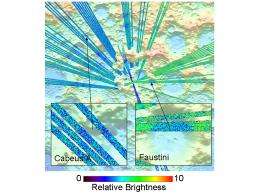
Initial LAMP observations of the faint nightside ultraviolet brightness of the Moon are shown here as tracks overlain on a shaded topography map of the south pole region. A permanently shadowed crater, Faustini, shows an interesting decrease in brightness compared to surrounding regions, while the crater selected for the October 9 LCROSS impact, Cabeus A, has a more modest contrast. The LAMP measurements are preliminary at this point in the mission. Credit: NASA/SwRI

NASA's Lunar Reconnaissance Orbiter (LRO), launched on June 18 of this year, has begun its extensive exploration of the lunar environment and will return more data about the Moon than any previous mission. The Lyman-Alpha Mapping Project (LAMP), developed by Southwest Research Institute, is an integral part of the LRO science investigation. LAMP uses a novel method to peer into the perpetual darkness of the Moon's so-called permanently shadowed regions.

LAMP "sees" the Moon's surface using the ultraviolet light from nearby space and stars, which bathes all bodies in space in a soft glow of ultraviolet light. A particularly bright ultraviolet emission is the so-called Lyman-alpha emission. Like all ultraviolet light, Lyman alpha is invisible to our eyes and cameras, but visible to LAMP as it reflects off the .

LAMP's objectives are to use its novel technique for studying the permanently shadowed polar regions of the lunar surface to look for water frost, to investigate the general ultraviolet reflectance properties and composition of the entire lunar surface, and to determine the composition of the lunar atmosphere.

"LAMP is working well. In fact, LAMP is more sensitive than we expected, which is fantastic," says team member Dr. Alan Stern, associate vice president of the SwRI Space Science and Engineering Division.

"We're already seeing some interesting variations in the limited data we've received so far," says Institute Scientist Dr. Randy Gladstone, LAMP acting principal investigator. "We can't make any firm assessments yet, but they are correlating well with some of the permanently shadowed craters in the region of the south pole."

LAMP is nearly identical to the successful Alice instruments developed by SwRI, already flying aboard the joint NASA/ESA Rosetta spacecraft, which is targeting the ancient comet Churyumov-Gerasimenko, and NASA's New Horizons spacecraft, which will probe the of Pluto and search for an atmosphere over its large moon Charon. LAMP weighs only 6.1 kilograms and uses only 4.5 watts of power.

The planned Oct. 9 impact into the Moon of the Lunar Crater Observation and Sensing Satellite (LCROSS), which launched with LRO, complements the search for water. Several LRO instruments will watch as a plume of debris and possibly water vapor rise from the impact. During subsequent orbits, LAMP will look for gases liberated during the impact as they migrate across the Moon.

LRO's findings are expected to be valuable to the future consideration of a permanent Moon base. Just as the south pole hosts permanently shadowed regions because of the Moon's orientation to the Sun, it also hosts areas that are in nearly perpetual sunlight, which would enable the operation of solar-powered equipment. Any discovery of water-frost and other resources in the area also would reduce the need to transport resources from Earth.

Upon the conclusion of the one-year reconnaissance mission for NASA's Exploration Systems Mission Directorate, NASA's Science Mission Directorate will oversee in-depth investigations for the science instruments. At that time, LAMP may shift into more detailed evaluations of the Moon's atmosphere and its variability.

LRO is one of the first missions in NASA's plan to return to the Moon and then to travel to Mars and beyond. The Goddard Space Flight Center manages the LRO mission for NASA's Exploration Systems Mission Directorate.

Source: Southwest Research Institute (news : web)


print this article email this article download pdf blog this article bookmark this article     Stumble it Digg this share on Facebook retweet share on Reddit add to delicious
Rate this story - 4.8 /5 (4 votes)


September 17, 2009 all stories

Comments: 0

4.8 /5 (4 votes)
  • Stumble this up

  • Digg this

  • share this

  • hide
  • Related Stories

  • NASA Lunar Spacecraft Ships South in Preparation for Launch
    created Feb 11, 2009 | popularity not rated yet | comments 0
  • Send Your Name to the Moon Aboard LRO
    created May 01, 2008 | popularity not rated yet | comments 0
  • New NASA Moon Mission Begins Integration of Science Instruments
    created Apr 17, 2008 | popularity not rated yet | comments 0
  • Prospecting for Lunar Water
    created Apr 29, 2005 | popularity not rated yet | comments 0
  • NASA's Next Moon Mission Begins Thermal Vacuum Test
    created Oct 23, 2008 | popularity not rated yet | comments 0


  • hide
  • Relevant PhysicsForums posts

  • Sideral question
    created Nov 21, 2009
  • Doppler shifted blackbody spectrum
    created Nov 21, 2009
  • Earth v. Moon
    created Nov 21, 2009
  • help me with coordinates and orbits
    created Nov 21, 2009
  • More from Physics Forums - General Astronomy

Other News

The shore of Deception Island in Antarctica, in 2008

Antarctic ice loss vaster, faster than thought: study

Space & Earth / Earth Sciences

created 3 hours ago | popularity 4 / 5 (5) | comments 5

The East Antarctic icesheet, once seen as largely unaffected by global warming, has lost billions of tonnes of ice since 2006 and could boost sea levels in the future, according to a new study.


Astronaut's baby daughter born as he circles Earth (AP)

Astronaut's baby daughter born as he circles Earth

Space & Earth / Space Exploration

created 3 hours ago | popularity not rated yet | comments 0

(AP) -- Astronaut Randolph Bresnik jubilantly welcomed his new daughter into the world Sunday as he floated 220 miles above it.


Denmark: 65 world leaders for UN climate summit (AP)

Denmark: 65 world leaders for UN climate summit

Space & Earth / Environment

created 3 hours ago | popularity not rated yet | comments 0

(AP) -- Sixty-five world leaders have said they will attend the Copenhagen climate summit in December, and several more have responded positively to invitations, Danish officials said Sunday.


Commuters wait on the platform shrouded by fog in London

Climate change not man-made, say majority of Britons: poll

Space & Earth / Environment

created Nov 15, 2009 | popularity 3.4 / 5 (16) | comments 46

Less than half of Britons believes that human activity is to blame for global warming, according to a poll carried out for The Times newspaper and published on Saturday.


Mysteriously warm times in Antarctica

Mysteriously warm times in Antarctica

Space & Earth / Earth Sciences

created Nov 18, 2009 | popularity 4.2 / 5 (21) | comments 31

(PhysOrg.com) -- A new study of Antarctica's past climate reveals that temperatures during the warm periods between ice ages (interglacials) may have been higher than previously thought. The latest analysis ...