New water-depth evaluation system will aid Everglades research, study shows
September 17, 2009 New water-depth evaluation system will aid Everglades research, study shows

Enlarge

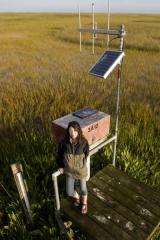
In this photo released by the University of Florida’s Institute of Food and Agricultural Sciences, spatial ecologist Ikuko Fujisaki visits one of the more than 200 monitoring stations used in the Everglades Depth Information Network, or EDEN - Thursday, Sept. 10, 2009. The stations provide information that is available to scientists online, to aid research on organisms in the Everglades and the progress of restoration efforts. Fujisaki, with UF’s Fort Lauderdale Research and Education Center, was part of the project team that developed EDEN.

(PhysOrg.com) -- When scientists discuss Everglades restoration, one phrase pops up again and again -- "getting the water right."

It refers to the importance of water depth -- making sure the proper areas are dry or marshy or submerged. For decades, experts had to take their own water-depth measurements or get data from multiple agencies.

In March 2005, things got easier. A modeling system called the Everglades Depth Estimation Network, or EDEN, went online. Developed by the U.S. Geological Survey working with the University of Florida and Florida Atlantic University, the system provides daily estimates of water depth and other information for most of the Everglades.

Now, a UF study verifies that EDEN’s estimates are accurate.

As reported in the current issue of Ecohydrology, researchers with UF, FAU, the University of Connecticut and the South Florida Natural Resources Center took water-depth measurements at 24 locations and compared them with EDEN’s estimates. Most estimates matched the measurements within 2 inches.
Frank Mazzotti, an associate professor with UF’s Institute of Food and Agricultural Sciences, says now that the system has been verified, he hopes it will gain popularity with scientists who assess the progress of Everglades restoration efforts, which aim to restore natural water flow throughout the region and support populations of indigenous animals and plants.

“We’ve never had a tool like this,” said Mazzotti, one of the study authors. “The idea is to make it freely available.”

Already, experts with UF and other Florida institutions have used EDEN to investigate populations of wading birds, , fish and amphibians.
The system uses more than 200 monitoring stations throughout the Everglades that measure water depth. That information, along with geographic data, is then interpreted by computer software. The system generates water-depth estimates for the entire freshwater portion of the greater , broken down into quadrants measuring about 1,300 feet by 1,300 feet.

Mazzotti says he’s thrilled to have EDEN available, and is using it in a study that correlates alligators’ body condition with water levels.
The system will receive upgrades in the near future to provide better modeling of topography below the water and better water surface estimates, said Pamela Telis, project team leader for the U.S. Geological Survey.

The system is the brainchild of Aaron Higer, a longtime USGS program manager and current UF employee, who first envisioned the idea in the 1960s.

The system is found at http://sofia.usgs.gov/eden/ .

Provided by University of Florida (news : web)


print this article email this article download pdf blog this article bookmark this article     Stumble it Digg this share on Facebook retweet share on Reddit add to delicious
Rate this story - not rated yet


September 17, 2009 all stories

Comments: 0

not rated yet
  • Stumble this up

  • Digg this

  • share this

  • hide
  • Related Stories

  • Feds failing to fix the Everglades
    created Sep 26, 2006 | popularity not rated yet | comments 0
  • Environmentalists sue for Everglades bird
    created Aug 23, 2005 | popularity not rated yet | comments 0
  • Everglades phosphorus limits on the right track, but more is needed
    created Oct 24, 2007 | popularity not rated yet | comments 0
  • Florida, federal officials reach deal for Everglades restoration
    created Aug 14, 2009 | popularity not rated yet | comments 0
  • Can hemp help the everglades?
    created Aug 06, 2007 | popularity not rated yet | comments 0


  • hide
  • Relevant PhysicsForums posts

  • The IPCC and the term "most"
    created Nov 23, 2009
  • Is global warming a fact?
    created Nov 23, 2009
  • Random variability of wind patterns
    created Nov 23, 2009
  • Record precipitation in the UK
    created Nov 22, 2009
  • More from Physics Forums - Earth

Other News

Monster Waves on the Sun are Real

Monster Waves on the Sun are Real (w/ Video)

Space & Earth / Astronomy

created 11 hours ago | popularity 4.8 / 5 (12) | comments 1

Sometimes you really can believe your eyes. That's what NASA's STEREO (Solar Terrestrial Relations Observatory) spacecraft are telling researchers about a controversial phenomenon on the sun known as the "solar ...


Cosmic 'dig' reveals vestiges of the Milky Way's building blocks

Cosmic 'Dig' Reveals Vestiges of the Milky Way's Building Blocks

Space & Earth / Astronomy

created 16 hours ago | popularity 4.9 / 5 (15) | comments 1

(PhysOrg.com) -- Peering through the thick dust clouds of our galaxy's "bulge" (the myriads of stars surrounding its center), a team of astronomers has unveiled an unusual mix of stars in the stellar grouping ...


Climate experts debate strategies for reducing atmospheric carbon and future warming

Climate experts debate strategies for reducing atmospheric carbon and future warming

Space & Earth / Environment

created 12 hours ago | popularity 2.6 / 5 (7) | comments 10

(PhysOrg.com) -- Reducing carbon dioxide to safe levels may require extracting carbon from the air, says Cornell climate researcher.


No Wheel Stall in Diagnostic Drive

Spirit Mars Rover: No Wheel Stall in Diagnostic Drive

Space & Earth / Space Exploration

created 11 hours ago | popularity 4.7 / 5 (3) | comments 0

(PhysOrg.com) -- On Sol 2095 (Tuesday, Nov. 24), Spirit performed a set of diagnostic actions related to a stall of the right-rear wheel on the previous drive, three days earlier.


Cutting greenhouse pollutants could directly save millions of lives worldwide

Space & Earth / Environment

created 18 hours ago | popularity 2.2 / 5 (10) | comments 6

Tackling climate change by reducing carbon dioxide and other greenhouse emissions will have major direct health benefits in addition to reducing the risk of climate change, especially in low-income countries, according to ...