Secrets of insect flight revealed
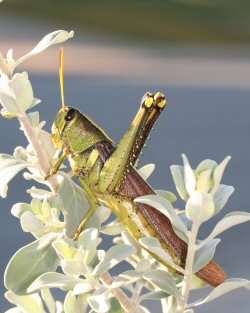
September 17, 2009 Locust, Schistocerca obscura

Locust, Schistocerca obscura. Credit: Spencer T Behmer

(PhysOrg.com) -- Researchers are one step closer to creating a micro-aircraft that flies with the manoeuvrability and energy efficiency of an insect after decoding the aerodynamic secrets of insect flight.

Dr John Young, from the University of New South Wales (UNSW) in Australia, and a team of animal flight researchers from Oxford University's Department of Zoology, used high-speed digital video cameras to film locusts in action in a wind tunnel, capturing how the shape of a locust's wing changes in flight. They used that information to create a which recreates the airflow and thrust generated by the complex flapping movement.

The breakthrough result, published in the journal Science this week, means engineers understand for the first time the aerodynamic secrets of one of Nature's most efficient flyers - information vital to the creation of miniature robot flyers for use in situations such as search and rescue, military applications and inspecting hazardous environments.

"The so-called 'bumblebee paradox' claiming that insects defy the laws of aerodynamics, is dead. Modern aerodynamics really can accurately model insect flight," said Dr Young, a lecturer in the School of Aerospace, Civil and Mechanical Engineering at the Australian Defence Force Academy (UNSW@ADFA).

"Biological systems have been optimised through evolutionary pressures over millions of years, and offer many examples of performance that far outstrips what we can achieve artificially.
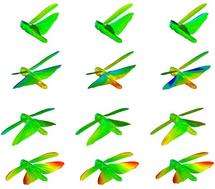
Secrets of insect flight revealed

The three models of the locust's wings, with the fully accurate model on the left and the two simplified models in the middle and on the right.

"An insect's delicately structured wings, with their twists and curves, and ridged and wrinkled surfaces, are about as far away as you can get from the streamlined wing of an aircraft," Dr Young said.

"Until very recently it hasn't been possible to measure the actual shape of an insect's wings in flight - partly because their wings flap so fast, and partly because their shape is so complicated.

"Locusts are an interesting insect for engineers to study because of their ability to fly extremely long distances on very limited energy reserves."

Once the computer model of the locust wing movement was perfected, the researchers ran modified simulations to find out why the wing structure was so complex.

In one test they removed the wrinkles and curves but left the twist, while in the second test they replaced the wings with rigid flat plates. The results showed that the simplified models produced lift but were much less efficient, requiring much more power for flight.

"The message for engineers working to build insect-like micro-air vehicles is that the high lift of insect wings may be relatively easy to achieve, but that if the aim is to achieve efficiency of the sort that enables inter-continental flight in , then the details of deforming wing design are critical," Dr Young said.

Provided by University of New South Wales (news : web)


Rate this story - 4.4 /5 (8 votes)


September 17, 2009 all stories

Comments: 0

4.4 /5 (8 votes)

  • hide
  • Related Stories

  • Micro flying robots can fly more effectively than flies
    created Aug 01, 2009 | popularity not rated yet | comments 0
  • Bumblebee flight 'triumph of power over finesse'
    created May 07, 2009 | popularity not rated yet | comments 0
  • Bird sized airplane to fly like a swift
    created Jul 18, 2007 | popularity not rated yet | comments 0
  • Deciphering the Mystery of Bee Flight
    created Nov 30, 2005 | popularity not rated yet | comments 0
  • Birds, bats and insects hold secrets for aerospace engineers
    created Feb 04, 2008 | popularity not rated yet | comments 0


  • hide
  • Relevant PhysicsForums posts

  • How to measure recoil force?
    created 7 minutes ago
  • How to obtain time constant of servo motor
    created 3 hours ago
  • How to calculate section constants for rectangular tubes?
    created 7 hours ago
  • how to welding thin SS foil (0.002")?
    created Feb 08, 2010
  • Civil Engineering is hazardous to your career prospects
    created Feb 06, 2010
  • hot water circulator, kitchen faucet, ? mixing
    created Feb 06, 2010
  • More from Physics Forums - General Engineering

Other News

Students find ?lost? office gear with tiny sensors

Students find 'lost' office gear with tiny sensors

Technology / Engineering

created 2 hours ago | popularity 3 / 5 (1) | comments 1 | with audio podcast

(PhysOrg.com) -- Miniature sensors being developed by CSIRO promise to provide the answers to questions which seem to arise regularly in modern office workplaces like: "Where's my pen?" and; "Who nicked my ...


Sprint Nextel slows subscriber loss in 4th quarter

Technology / Telecom

created 1hour ago | popularity not rated yet | comments 0

(AP) -- Sprint Nextel says its subscriber losses slowed in the fourth quarter, an encouraging sign for the wireless carrier that has lost millions of customers over the past few years.


Toshiba to spend billions on new chip factory: report

Technology / Semiconductors

created 4 hours ago | popularity not rated yet | comments 0

Japan's Toshiba plans to spend almost nine billion dollars to build a new factory producing memory chips for mobile telephones, cameras and other electronics, a report said Wednesday.


3 Questions: Steven Spear on Toyota's troubles

3 Questions: Steven Spear on Toyota's troubles

Technology / Other

created 1hour ago | popularity not rated yet | comments 0

For decades, Toyota has been viewed as a paragon of corporate improvement, innovation and effectiveness, qualities that helped it become the world’s largest automaker.


AOL integrates Facebook chat with AIM

Technology / Internet

created 5 hours ago | popularity not rated yet | comments 0

(AP) -- As part of an ongoing effort to improve its user experience, Internet company AOL Inc. is letting users of its AIM instant-messaging service chat with friends on Facebook.