Researchers find high numbers of heat-loving bacteria in cold Arctic Ocean
September 17, 2009
Researchers find high numbers of heat-loving bacteria in cold Arctic Ocean

Enlarge

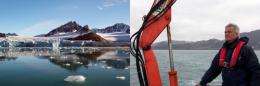
At a latitude of 79 degrees North it is cold. Even during the short arctic summer the mountains stay covered with snow. Max Planck director Bo Barker Jørgensen on board the research vessel FARM. Image: Kristine Barker, Andrew Steen

A team of scientists led by U of C grad Casey Hubert has detected high numbers of heat loving, or thermophilic, bacteria in subzero sediments in the Arctic Ocean off the Norwegian island of Spitsbergen. The bacterial spores might provide a unique opportunity to trace seepages of fluids from hot sub-seafloor habitats, possibly pointing towards undiscovered offshore petroleum reservoirs.

These thermophiles exist in the Arctic Ocean sediment as spores — dormant forms that withstand adverse conditions for long periods, waiting for better times. Experimental incubations at 40 to 60 degrees Celsius revive the Arctic spores, which appear to have been transported from deeper hot spots.

"The genetic similarities to bacteria from hot offshore oil reservoirs are striking," says Hubert. After completing his PhD in petroleum microbiology at University of Calgary, Hubert traveled to Bremen, Germany, with an NSERC post-doctoral fellowship to study the Arctic thermophiles at the renowned Max Planck Institute for Marine Microbiology. "We expect ongoing surveys will pin-point the source, or sources, of these misplaced microbes. This could have interesting applications if they are really coming up from leaky petroleum reservoirs."

Because these bacteria are anaerobic, their high abundance and steady supply into the sediments indicate they are coming from a huge oxygen-free habitat. Hubert says one source could be a deep pressurized oil reservoir from which upward-leaking hydrocarbons carry bacteria into overlying seawater. Another source could be related to fluid circulation through warm ocean crust at spreading ridges where "black smokers" and other hydrothermal vents are present. The thermophiles must be getting carried out of one of these abyssal hot spots and may be dispersed by ocean currents before ending up as hibernating spores in the cold sediments, where they were discovered.

"We hope further experiments and genetic forensics will reveal the warm source," adds Max Planck Director Prof. Bo Barker Jørgensen.

While the spores might provide an opportunity to track marine hot spots, they also offer fresh insight for understanding biodiversity and the "hidden rare biosphere." The dominant bacterial species in a given environment obscure many minor groups that don't seem to participate in ecosystem functioning. Dormant thermophiles in the cold ocean could be a useful model for understanding how biodiversity is maintained by the passive dispersal of small cells over great distances. "The Arctic thermophiles could hold important clues for solving broader riddles of bio-geography," says Hubert.

More information: A Constant Flux of Diverse Thermophilic Bacteria into the Cold Arctic Seabed by Casey Hubert, Alexander Loy, Maren Nickel, Carol Arnosti, Christian Baranyi, Volker Brüchert, Timothy Ferdelman, Kai Finster, Flemming Mønsted Christensen, Júlia Rosa de Rezende, Verona Vandieken, and Bo Barker Jørgensen, will be published in the journal Science on September 18, 2009.

Source: University of Calgary (news : web)

4.5 /5 (4 votes)  

Rank 4.5 /5 (4 votes)
Related Stories
Relevant PhysicsForums posts
  • Mitosis
    created4 hours ago
  • Stem cell question.
    created6 hours ago
  • Protease cleavage
    created12 hours ago
  • Pertubance in a model
    created18 hours ago
  • Cancer drugs and Alzheimer's, Oh my!
    createdFeb 09, 2012
  • Squishing cells
    createdFeb 09, 2012
  • More from Physics Forums - Biology

More news stories

The power of estrogen -- male snakes attract other males

A new study has shown that boosting the estrogen levels of male garter snakes causes them to secrete the same pheromones that females use to attract suitors, and turned the males into just about the sexiest ...

Biology / Plants & Animals

created 17 hours ago | popularity 4.8 / 5 (6) | comments 2 | with audio podcast

Grass to gas: Researchers' genome map speeds biofuel development

Researchers at the University of Georgia have taken a major step in the ongoing effort to find sources of cleaner, renewable energy by mapping the genomes of two originator cells of Miscanthus x giganteus, a large perenn ...

Biology / Biotechnology

created 14 hours ago | popularity 3.8 / 5 (5) | comments 0 | with audio podcast

Miami battling invasion of giant African snails

No one knows how they got there. But an invasion of African giant snails has southern Florida in a panic over potential crop damage, disease and general yuckiness surrounding the slimy gastropods.

Biology / Ecology

created 21 hours ago | popularity 4 / 5 (1) | comments 4

Experts reveal how plants don't get sunburn

(PhysOrg.com) -- Experts at the University of Glasgow have discovered how plants survive the harmful rays of the sun.

Biology / Cell & Microbiology

created 17 hours ago | popularity 4.8 / 5 (5) | comments 0 | with audio podcast

Protein libraries in a snap

(PhysOrg.com) -- A Rice University undergraduate will depart with not only a degree but also a possible patent for his invention of an efficient way to create protein libraries, an important component of biomolecular ...

Biology / Cell & Microbiology

created 20 hours ago | popularity 4.8 / 5 (4) | comments 1 | with audio podcast


Anonymous knocks CIA website offline (Update)

The website of the Central Intelligence Agency was inaccessible on Friday after the hacker group Anonymous claimed to have knocked it offline.

New error-correcting codes guarantee the fastest possible rate of data transmission

Error-correcting codes are one of the triumphs of the digital age. They’re a way of encoding information so that it can be transmitted across a communication channel — such as an optical fiber o ...

Google users warned of threat to smartphone wallets

Users of Google smartphone wallets were being warned on Friday that there is a way to crack pass codes intended to thwart thieves from going on illicit shopping sprees.

Humans may have helped the decline of African rainforests 3000 years ago

(PhysOrg.com) -- Large areas of rainforests in Central Africa mysteriously disappeared over three thousand years ago, to be replaced by savannas. The prevailing theory has been that the cause was a change ...

New power source discovered

(PhysOrg.com) -- Researchers at the Massachusetts Institute of Technology (MIT) and RMIT University have made a breakthrough in energy storage and power generation.

Small modular reactor design could be a 'SUPERSTAR'

(PhysOrg.com) -- Though most of today's nuclear reactors are cooled by water, we've long known that there are alternatives; in fact, the world's first nuclear-powered electricity in 1951 came from a reactor ...