NASA Lunar Satellite Begins Detailed Mapping of Moon's South Pole
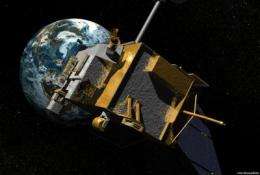
(PhysOrg.com) -- NASA reported Thursday that its Lunar Reconnaissance Orbiter, or LRO, has successfully completed its testing and calibration phase and entered its mapping orbit of the moon.
The spacecraft already has made significant progress toward creating the most detailed atlas of the moon's south pole to date. Scientists released preliminary images and data from LRO's seven instruments.
"The LRO mission already has begun to give us new data that will lead to a vastly improved atlas of the lunar south pole and advance our capability for human exploration and scientific benefit," said Richard Vondrak, LRO project scientist at NASA's Goddard Space Flight Center in Greenbelt, Md.
LRO is scheduled for a one-year exploration mission in a polar orbit of about 31 miles above the lunar surface, the closest any spacecraft has orbited the moon. During the next year, LRO will produce a complete map of the lunar surface in unprecedented detail, search for resources and safe landing sites for human explorers, and measure lunar temperatures and radiation levels.
"The LRO instruments, spacecraft, and ground systems continue to operate essentially flawlessly," said Craig Tooley, LRO project manager at Goddard "The team completed the planned commissioning and calibration activities on time and also got a significant head start collecting data even before we moved to the mission's mapping orbit."
The south pole of the moon is of great interest to explorers because potential resources such as water ice or hydrogen may exist there. Permanently shadowed polar craters that are bitterly cold at their bottoms may hold deposits of water ice or hydrogen from comet impacts or the solar wind. The deposits may have accumulated in these "cold-trap" regions over billions of years. If enough of these resources exist to make mining practical, future long-term human missions to the moon potentially could save the considerable expense of hauling water from Earth.
First results from LRO's Lunar Exploration Neutron Detector, or LEND, indicate that permanently shadowed and nearby regions may harbor water and hydrogen. Additional observations will be needed to confirm this. LEND relies on a decrease in neutron radiation from the lunar surface to indicate the presence of water or hydrogen.
"If these deposits are present, an analysis of them will help us understand the interaction of the moon with the rest of the solar system," Vondrak said.
Data from LRO's Lunar Orbiter Laser Altimeter, or LOLA, however, indicates that exploring these areas will be challenging because the terrain is very rough. The roughness is probably a result of the lack of atmosphere and absence of erosion from wind or water, according to David Smith, LOLA principal investigator at Goddard.
LRO's other instruments also are providing data to help map the moon's terrain and resources. According to the first measurements from the Diviner instrument, large areas in the permanently shadowed craters are about minus 400 degrees Fahrenheit (33 Kelvin), more than cold enough to store water ice or hydrogen for billions of years.
The Lunar Reconnaissance Orbiter Camera is providing high-resolution images of permanently shadowed regions while lighting conditions change as the moon's south pole enters lunar summer.
LRO's Lyman Alpha Mapping Project, or LAMP, also is preparing to search for surface ice and frost in the polar regions. The instrument provides images of permanently shadowed regions illuminated only by starlight and the glow of interplanetary hydrogen emission. LAMP has provided information to confirm the instrument is working well on both the lunar night and day sides.
The Mini RF Technology Demonstration on LRO has confirmed communications capability and produced detailed radar images of potential targets for LRO's companion mission, the Lunar Crater Observation and Sensing Satellite, which will impact the moon's south pole on Oct. 9.
Meanwhile, LRO's Cosmic Ray Telescope for the Effects of Radiation instrument is exploring the lunar radiation environment and its potential effects on humans during record high, "worst-case" cosmic ray intensities accompanying the extreme solar minimum conditions of this solar cycle.
Goddard built and manages LRO, a NASA mission with international participation from the Institute for Space Research in Moscow. Russia provides the neutron detector aboard the spacecraft.
For more information about LRO and to view the new images, visit: lro" target="_blank">www.nasa.gov/lro
Provided by JPL/NASA (news : web)


