'Smart Trash' concept could reinvent recycling with a cash incentive
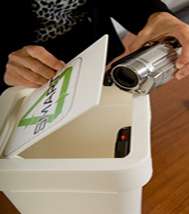
(PhysOrg.com) -- Envision a distasteful trip to the curb to take out the trash as a pleasant -- and profitable -- stroll. Some juiceless batteries - those are good for a few cents. An old keyboard might fetch a couple of bucks. Even that empty box of Pop-Tarts might be worth something.
No need to sort these discards: the trashcan has already done it, inventorying all contents and calculating the worth of this waste. Next month’s garbage bill could be accompanied by a check.
“Recycling and consumer waste are still managed with 1950s technology,” said Valerie Thomas, Anderson Interface Associate Professor at Georgia Tech’s School of Industrial and Systems Engineering. “Of course it can’t keep up. The flow of products out of the household needs to be managed with at least as much intelligence as the flow of products into the household. It’s sort of obvious.”
This is the concept behind “Smart Trash,” an approach developed by Thomas that has caught the attention of major corporations and the Environmental Protection Agency (EPA). Smart Trash systems not only provide sustainable and productive ways for discarding items, but also can redefine the relationship people have with their garbage.
There are a number of manufacturers, retailers, recyclers and researchers now working to actualize the Smart Trash idea. Project PURE (Promoting Understanding of RFID and the Environment) — featuring representatives of companies such as Wal-Mart and Hewlett-Packard, as well as recyclers and developers of product codes — is working to refine this concept and push it toward mainstream reality.
Consumer recycling is currently fairly simplistic, focusing mostly on paper, aluminum and steel cans and some plastic bottles. For the system to evolve and thrive, it must be expanded to a variety of different products while maintaining ease of use and adding incentives that encourage participation.
“There are advantages on both sides to the consumer and the recycler,” said Angie Leith, senior policy analyst at the EPA Office of Solid Waste in Washington, D.C.
Leith recruited Thomas to take part in Project PURE, which is funded by the EPA, after being impressed with her research and the promise of Smart Trash.
“Valerie understands industrial ecology,” she said. “If there’s always going to be trash, when it gets to end of life, you should be able to do something with it. Let’s try to do it in a smart way. It really makes sense.”
Two essential elements are involved in making Smart Trash function.
The first is a Universal Product Code (UPC) or radio frequency identification (RFID) tag that identifies specific merchandise. A scanner equipped within a trash receptacle would be able to immediately record what is being disposed, allowing consumers to track their trash and determine what pieces are potentially valuable.
The second component is a retrofitted recycling truck or recycling center that can sort trash that can sort recyclables. Valuable items could be sent to auction sites where the proceeds could be sent directly back to consumers. Items with hazardous components could be shunted aside for appropriate management.
A Wi-Fi connection provides the bridge between the trashcan and the recycling service, relaying information that can anticipate and properly organize the contents.
Recyclable items with significant value — such as consumer electronics — would be forwarded to online auction services where the maximum value could be actualized. Consumer recycling credits could also be issued for something as insignificant as a frozen pizza box or a shampoo bottle. Any money garnered from this waste could be applied to a consumer’s monthly sanitation bill or sent as a check.
Simple. Sensible. Sustainable.
“Just about anything could be recycled in this manner,” Thomas said.
Not everything can be resold for cash, though. Some items in the trashcan — a banana peel, a used paper towel — clearly have no resale value.
Those items would be disposed of in a more traditional matter, composted or even potentially be used for fuel.
“There’s no point in having a potato chip bag that’s going to last for thousands of years,” Thomas said. “I’m not advocating that everything be recycled because at some level it’s way too hard. Every product should either be completely safe to burn, compost, eat or it should be easy to recycle.”
Thomas advocates using non-recyclable waste to provide energy via combustion. Burning non-recyclable disposables in an environmentally friendly manner could provide power for everything from lights to appliances. It also helps resolve any privacy issues that result from the entire contents of a garbage can having a constant inventory.
“Depending on the nature of the product, there would be some reasonableness about how much information you would want to keep about something,” Thomas said. “There’s no reason for people to know how much cereal you eat. That’s another reason most of the packaging should be biodegradable or burnable.”
Smart Trash technology provides benefits that go beyond a garbage can. The system can potentially be used for inventory purposes or to pinpoint products that have been recalled for health and safety reasons.
With the ability to scan and determine the value of just about any item in a home, Smart Trash technology could eventually become a sustainable weapon against clutter. Just scan old items taking up space, note the value and send these straight to the recycling bin.
Think of it as a living yard sale.
“It’s such a pain to get rid of things when you don’t want to just throw it away or think you might use it later” Thomas said. “You could really have your house cleaning itself for you.”
Provided by Georgia Institute of Technology


