NASA's Aqua satellite catches 2 views of super Typhoon Choi-Wan
September 17, 2009 NASA's Aqua satellite catches 2 views of super Typhoon Choi-Wan

Enlarge

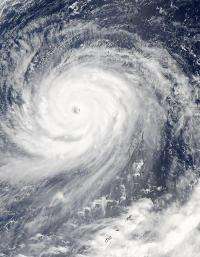
NASA's MODIS instrument on the Aqua satellite captured Super Typhoon Choi-Wan on Sept. 17 at 3:40 UTC (Sept. 16 at 11:40 p.m. EDT), west of the Mariana Islands in the Pacific Ocean. Credit: NASA, MODIS Rapid Response

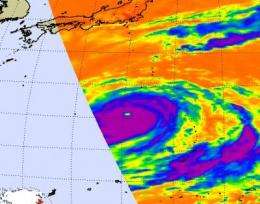
NASA's Aqua satellite again flew over Super Typhoon Choi-Wan late last night and captured visible and infrared imagery of the monster typhoon. Aqua's Atmospheric Infrared Sounder (AIRS) instrument and Moderate Imaging Spectroradiometer (MODIS) captured two different views of Choi-Wan's clouds.

AIRS showed Choi-Wan's cold high thunderstorm cloud temperatures were colder than minus 63 Fahrenheit indicating a very strong tropical cyclone. Also on Aqua, NASA's Moderate Imaging Spectroradiometer (MODIS) instrument captured a stunning look at Super Choi-Wan's clouds with a clear eye.

At 11 a.m. EDT on September 17, Super Typhoon Choi-Wan had maximum sustained winds near 149 mph (130 knots), bringing the storm back down to Category 4 typhoon status. The center of Choi-Wan was located about 205 miles south-southwest of the island of Iwo To, near 22.0 north and 139.7 east, and was moving northwest at 9 mph. It continues to generate extremely high waves, up to 42 feet high.
NASA's Aqua satellite catches 2 views of super Typhoon Choi-Wan
Enlarge

Aqua's Atmospheric Infrared Sounder (AIRS) instrument captured Choi-Wan's high thunderstorm cloud temperatures (in purple) on Sept. 17. They were colder than minus 63 Fahrenheit indicating very strong, high thunderstorms. Choi-Wan's eye is clearly visible in this image. Credit: NASA JPL, Ed Olsen

Choi-Wan has weakened a little but the U.S. Navy's Joint Typhoon Warning Center (JTWC) noted that the storm remains a "fully developed cyclone with a very distinct symmetrical eye." That eye is clearly visible in the imagery from NASA's Aqua today. The JWTC also noted that "Animated shows some erosion of deep convection to the northwest quadrant of the system. However, environmental analysis indicates the system remains in a corridor of low vertical wind shear and warm sea surface temperatures."

Choi-Wan is moving northwestward along the western edge of a sub-tropical ridge of high pressure, which has a clockwise circulation. If you think of a clock, Choi-Wan would be positioned near 7 or 8 o'clock. It will continue moving further in a northerly direction before heading in an easterly direction (think of it approaching 10 and 11 o'clock heading towards noon).

Choi-Wan is expected to start weakening on Friday, September 18 and will transition to an extra-tropical storm thereafter.

Source: NASA/Goddard Space Flight Center


print this article email this article download pdf blog this article bookmark this article     Stumble it Digg this share on Facebook retweet share on Reddit add to delicious
Rate this story - 3 /5 (1 vote)


September 17, 2009 all stories

Comments: 0

3 /5 (1 vote)
  • Stumble this up

  • Digg this

  • share this

  • hide
  • Related Stories


  • hide
  • Relevant PhysicsForums posts

  • The IPCC and the term "most"
    created Nov 23, 2009
  • Is global warming a fact?
    created Nov 23, 2009
  • Random variability of wind patterns
    created Nov 23, 2009
  • Record precipitation in the UK
    created Nov 22, 2009
  • More from Physics Forums - Earth

Other News

Monster Waves on the Sun are Real

Monster Waves on the Sun are Real (w/ Video)

Space & Earth / Astronomy

created 8 hours ago | popularity 4.8 / 5 (10) | comments 1

Sometimes you really can believe your eyes. That's what NASA's STEREO (Solar Terrestrial Relations Observatory) spacecraft are telling researchers about a controversial phenomenon on the sun known as the "solar ...


Cosmic 'dig' reveals vestiges of the Milky Way's building blocks

Cosmic 'Dig' Reveals Vestiges of the Milky Way's Building Blocks

Space & Earth / Astronomy

created 13 hours ago | popularity 4.9 / 5 (14) | comments 1

(PhysOrg.com) -- Peering through the thick dust clouds of our galaxy's "bulge" (the myriads of stars surrounding its center), a team of astronomers has unveiled an unusual mix of stars in the stellar grouping ...


No Wheel Stall in Diagnostic Drive

Spirit Mars Rover: No Wheel Stall in Diagnostic Drive

Space & Earth / Space Exploration

created 9 hours ago | popularity 4.5 / 5 (2) | comments 0

(PhysOrg.com) -- On Sol 2095 (Tuesday, Nov. 24), Spirit performed a set of diagnostic actions related to a stall of the right-rear wheel on the previous drive, three days earlier.


Climate experts debate strategies for reducing atmospheric carbon and future warming

Climate experts debate strategies for reducing atmospheric carbon and future warming

Space & Earth / Environment

created 9 hours ago | popularity 2.8 / 5 (6) | comments 8

(PhysOrg.com) -- Reducing carbon dioxide to safe levels may require extracting carbon from the air, says Cornell climate researcher.


Oceanic crust formation is dynamic after all

Oceanic crust formation is dynamic after all

Space & Earth / Earth Sciences

created 12 hours ago | popularity 4.6 / 5 (5) | comments 0

Imagine the Earth's crust as the planet's skin: Some areas are old and wrinkled while others have a fresher, more youthful sheen, as if they had been regularly lathered with lotion.