New NASA temperature maps provide 'whole new way of seeing the moon'
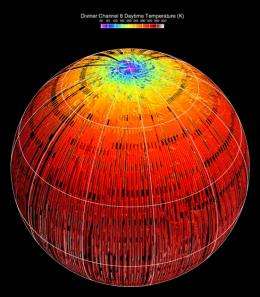
(PhysOrg.com) -- NASA's first-ever moon temperature-mapping effort has returned its first data.
NASA's Lunar Reconnaissance Orbiter (LRO), an unmanned mission to comprehensively map the entire moon, has returned its first data. One of the seven instruments aboard, the Diviner Lunar Radiometer Experiment, is making the first global survey of the temperature of the lunar surface while the spacecraft orbits some 31 miles above the moon.
Diviner has obtained enough data already to characterize many aspects of the moon's current thermal environment. The instrument has revealed richly detailed thermal behavior, throughout both the north and south polar regions, that extends to the limit of Diviner's spatial resolution of just a few hundred yards.
"Most notable are the measurements of extremely cold temperatures within the permanently shadowed regions of large polar impact craters in the south polar region," said David Paige, Diviner's principal investigator and a UCLA professor of planetary science. "Diviner has recorded minimum daytime brightness temperatures in portions of these craters of less than -397 degrees Fahrenheit. These super-cold brightness temperatures are, to our knowledge, among the lowest that have been measured anywhere in the solar system, including the surface of Pluto."
"After decades of speculation, Diviner has given us the first confirmation that these strange, permanently dark and extremely cold places actually exist on our moon," said science team member Ashwin Vasavada of NASA's Jet Propulsion Laboratory in Pasadena, Calif. "Their presence greatly increases the likelihood that water or other compounds are frozen there. Diviner has lived up to its name."
These observations, made during Diviner's "commissioning phase," provide a snapshot in time of current polar temperatures that will evolve with the lunar seasons.
"It is safe to conclude that the temperatures in these super-cold regions are definitely low enough to cold-trap water ice, as well as other more volatile compounds, for extended periods," Paige said. "The existence of such cold traps has been predicted theoretically for almost 50 years. Diviner is now providing detailed information regarding their spatial distribution and temperatures."
Diviner's thermal observations represent one component of the LRO's strategy for determining the nature and distribution of cold-trapped water ice in the lunar polar regions. Future comparisons between Diviner data, physical models and other polar data sets may provide important scientific conclusions regarding the nature and history of the moon's polar cold traps and any cold-trapped volatile materials they contain, Paige said.
The moon's surface temperatures are among the most extreme of any planetary body in the solar system. Noontime surface temperatures near the lunar equator are hotter than boiling water, while nighttime surface temperatures on the moon are almost as cold as liquid oxygen. It has been estimated that near the lunar poles, in areas that never receive direct sunlight, temperatures can dip to within a few tens of degrees of absolute zero.
Data accumulated by Diviner during August and the first half of September indicate that equatorial and mid-latitude daytime temperatures are 224 degrees Fahrenheit, and then decrease sharply poleward of 70 degrees north latitude. Equatorial and mid-latitude nighttime temperatures are -298 degrees Fahrenheit, and then decrease poleward of 80 degrees north latitude. At low and mid-latitudes, there are isolated warmer regions with nighttime temperatures of -208 degrees Fahrenheit.
"These correspond to the locations of larger, fresh impact craters that have excavated rocky material that remains significantly warmer than the surrounding lunar soil throughout the long lunar night," Paige said.
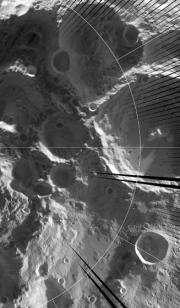
The thermal behavior at high latitudes contrasts sharply with that of the equatorial and mid-latitudes. Close to the poles, both daytime and nighttime temperatures are strongly influenced by local topography, and the thermal outlines of many partially illuminated impact craters are apparent.
"Getting a look at the first global thermal maps of the lunar surface is a whole new way of seeing the moon," Paige said.
NASA's LRO launched June 18. Diviner has been mapping the moon continuously during the LRO commissioning phase. Since the instrument was first activated on July 5, it has acquired more than 8 billion calibrated radiometric measurements and has mapped almost 50 percent of the surface area of the moon.
"The performance of the instrument has been excellent, and closely matches our predictions," said instrument engineer Marc Foote of JPL.
"We have already accumulated an enormous amount of high-quality data," Paige said.
There are large gaps between Diviner's individual ground tracks at the equator, but in the polar regions, the ground tracks overlap to create continuous high-resolution maps. During the commissioning phase, the plane of the LRO orbit moved from 5:40 to 1:10 a.m. and p.m., on the night side and day side, respectively. It will take about six months for LRO’s orbit to sample the full range of lunar local times.
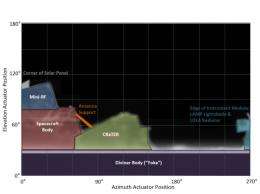
In addition to mapping the moon, Diviner executed a series of specialized calibration sequences during the commissioning phase. These included scans of the "limb," or visible edge of the moon to better define the instruments' fields of view and an infrared panorama of a portion of the LRO spacecraft, as well as infrared scans of the Earth from lunar orbit, which are presently being analyzed.
"Diviner has been put through her paces and has executed our commands brilliantly," said JPL scientist and lead observational sequence designer Benjamin Greenhagen. "Diviner's operations have run very smoothly."
During the course of LRO's mapping mission, Diviner will map the entire surface of the moon at high resolution to create the first global picture of the current thermal state of the moon and its daily and seasonal variability.
The moon's extreme temperature environment is of interest to future human and robotic explorers, especially if they plan to visit the moon for extended periods. Detailed thermal maps of the moon can also yield information regarding the locations of rocky areas that may be hazardous to landing vehicles and details for mapping compositional variations in lunar rocks and soils. In the moon's polar regions, temperature maps also point to the locations of cold traps where water ice and other volatile materials may have accumulated. Mapping the locations of these lunar cold traps and searching for the presence of frozen water are among the main goals of the LRO mission.
Diviner is operated by the California Institute of Technology Jet Propulsion Laboratory (JPL), which designed and built the instrument.
Diviner determines the temperature of the moon by measuring the intensity of infrared radiation emitted by the lunar surface. The hotter the surface, the greater the intensity of emitted infrared radiation. Diviner measures infrared radiation in seven infrared channels that cover an enormous wavelength range, from 7.6 to 400 microns. Diviner is the first instrument designed to measure the full range of lunar surface temperatures, from the hottest to the coldest. Diviner also includes two solar channels (channels 1 and 2) that measure the intensity of reflected solar radiation.
As the LRO orbits the moon every two hours, Diviner maps a nearly continuous swath on the lunar surface. Diviner's swath samples the full range of lunar longitudes once per month to create thermal maps. Diviner will acquire 24 thermal maps of the moon over the course of a year — 12 daytime maps and 12 nighttime maps — each covering a different range of lunar local times.
Provided by University of California Los Angeles (news : web)


