Probing Question: Is football similar to Roman gladiator games?
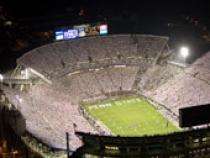
On six more Saturdays between now and mid-November, a caravan of pilgrims will arrive at University Park, Pennsylvania. Many will sport outlandishly colorful attire. Some will appear days beforehand and live in tents, setting up camp outside Beaver Stadium. And on game day, as many as 107,000 fans will crowd into one of the the largest stadiums in North America. Still more will feast and imbibe from their vehicles—a modern ritual called “tailgating,” while listening to the thunderous roar of the crowd inside.
Beneath the carnival atmosphere lies the fact these fans have gathered to watch young men hit and bruise one another—a violent spectacle that is one of America's favorite pastimes. Given its nature and its prominent position in our culture, is football the Roman gladiator sport for modern Americans?
American football has many similarities with gladiator games, said Garrett Fagan, associate professor of Classics and Ancient Mediterranean Studies and History at Penn State. Most obviously, both involve spectacular, violent displays before a massive, cheering audience. Fans choose sides and strongly identify with their team—just as Roman citizens cheered their favorite gladiators in combat. Do these superficial similarities suggest a deeper connection?
Fagan thinks so. Media mogul Ted Turner once called sports “war without the killing,” and, as Fagan sees it, football is rather like gladiatorial combat without the killing. The psychological lure remains much the same, he said. Large-scale sporting events create intense bonds among fans, provoking feelings of belonging, validation and camaraderie. Individuals feel part of a greater whole, and they feel empowered. “This is a very powerful emotional experience,” Fagan said. “This is one of the draws that brings people to these mass events. That would be true of Romans as much as modern Americans.” Fans often come to the stadium simply to feel a part of the crowd—107,000 strong.
A psychological connection between the Roman Colosseum and Beaver Stadium might make some readers queasy. After all, the values of ancient Rome and modern America are worlds apart. Fagan acknowledges this key distinction. “We value individual lives and believe they all have worth. The Romans had a completely different view of human beings, which was that there were people who were worthless: there were slaves, who were the walking dead as far as the Romans were concerned.” To the Roman spectators, gladiators’ lives were only as valuable as the entertainment they could provide.
While our shared beliefs might cause us to balk at gladiator games, Fagan suggests that the desire for violent entertainment appears not just in the arena — and not just in Rome or America. “There’s no shortage of such spectacles,” he said, pointing to dog fighting, bear-baiting, public executions and boxing as a few examples among many. “Looking across the landscape of history we have to admit there’s something bigger going on, a consistent appetite for violence as spectacle.” The recent rise of the Ultimate Fighting Championship, a mixed martial arts sport noted for its brutality, strikes Fagan as a prime example.
The distance between the Roman gladiator arena and the modern American football stadium is not as far as we might think or wish, said Fagan. Even today, he said, “I suspect if we staged a gladiator spectacle and we picked the right constituency to staff it — people who are commonly regarded by society as expendable, such as death row inmates — I think we could fill Beaver Stadium.”
Provided by Pennsylvania State University (news : web)


