Researchers working to develop, market embryonic test for bovine genetics
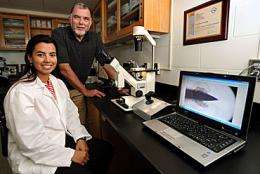
(PhysOrg.com) -- Looking at the genetic makeup of cattle to determine their value is nothing new. An examination of a small sample of hair or blood can reveal if a calf has any genetic diseases that will lower the market price.
Now, a team of clinicians and diagnosticians and genetic researchers at Iowa State University's College of Veterinary Medicine are looking to test those calves earlier . . . before they are born . . . even before their mother is pregnant.
Dr. Jim West and Dr. Paul Plummer are researching a method to determine if a bovine is genetically sound when it is still an embryo prior to being implanted in its mother.
This process, if successful, would allow producers to select which embryos are valuable before spending the time, effort and expense of producing a calf only to find out that it has genetic defects that render it of little value.
Until now, the problem has been biopsy samples of embryos are so small -- only a few cells - that it was impossible to accurately read the genetic information.
"There were limitations to the process," said West, director of Food Supply Veterinary Medicine. "You can't take very many cells when you do the biopsy. You have to leave enough cells to get a pregnancy."
New technology may allow West and Plummer to get accurate genetic information from samples as small as two to three cells and still keep the embryo viable, even if it is frozen for long-term storage.
"Our research is looking at the ability to biopsy the embryo, freeze it and then do a variety of tests on the sample after only seven days from when it was conceived," said West.
The study is being funded by a Grow Iowa Values Fund Grant. The goal of the grant program is to support development of technologies with commercial potential and to support the growth of companies using those technologies.
The researchers are working with Ames Center for Genetic Technologies, Inc. as their corporate partner.
Testing for traits can be very simple or more complex.
Checking the sex of a calf intended for dairy production is very important. Males have little value for dairy producers.
More complex testing can also screen embryos for genes that will indicate whether calves will carry traits for beef tenderness, feed efficiency, nutrition and more than a dozen others.
"Testing is going to happen," said West. "Right now the testing happens on animals that are already born. This test will allow us to go back a generation and only select those that have the desirable traits."
The new process will offer producers many advantages, according to Plummer, a clinician in Food Supply Veterinary Medicine.
"First, the new test allows very small samples," he said. "Also, it is affordable for the producer. It is also modular, so we can test for different traits. Finally, it is adaptable. When new diseases are identified we can change it."
West and Plummer see many possibilities in this new technology.
Overseas markets have specific preferences for how their beef and dairy taste. This new technology will allow producers to market embryos with specific traits to the markets they best fit, according to Plummer.
Another benefit is that embryos already in storage can be thawed and tested for diseases that may have not previously been detectable. These types of tests may allow many diseased cattle to be avoided.
Other members of the research team include Dr. Patrick Halbur, chair of Veterinary Diagnostic and Production Animal Medicine; Dr. Rodger Main, director of operations at the Veterinary Diagnostic Laboratory; and Marianna Jahnke, Embryo Transfer Unit.
Provided by Iowa State University (news : web)


