New Drake equation to quantify habitability?
September 17, 2009
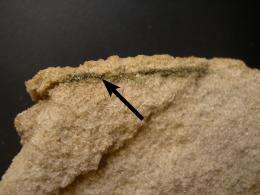
An image showing microbes living in sandstone in Antarctica (credit: C Cockell)
Researchers from the Open University are laying the groundwork for a new equation that could mathematically quantify a habitat's potential for hosting life, in a similar way to how the Drake equation estimates the number of intelligent extraterrestrial civilizations in the Milky Way.
Dr Axel Hagermann proposed a method to find this 'habitability index' at the European Planetary Science Congress in Potsdam, Germany today.
“At present, there is no easy way of directly comparing the suitability of different environments as a habitat for life. The classical definition of a habitable environment is one that has the presence of a solvent, for example water, availability of the raw materials for life, clement conditions and some kind of energy source, so we tend to define a place as ‘habitable’ if it falls into the area where these criteria overlap on a Venn diagram. This is fine for specific instances, but it gives us no quantifiable way of comparing exactly how habitable one environment is in comparison with another, which I think is very important,” said Dr Hagermann, who originates from Recklinghausen in Germany.
Dr Hagermann and colleague Prof Charles Cockell have the ambitious aim of developing a single, normalised indicator of habitability, mathematically describing all the variables of each of the four habitability criteria. Initially, they are focusing on describing all the qualities of an energy source that may help or hinder the development of life.
“Electromagnetic radiation may seem simple to quantify in terms of wavelengths and joules, but there are many things to consider in terms of habitability. For instance, while visible and infrared wavelengths are important for life and processes such as photosynthesis, ultraviolet and X-rays are harmful. If you can imagine a planet with a thin atmosphere that lets through some of this harmful radiation, there must be a certain depth in the soil where the ‘bad’ radiation has been absorbed but the ‘good’ radiation can penetrate. We are looking to be able to define this optimal habitable region in a way that we can say that it is ‘as habitable’ or ‘less habitable’ than a desert in Morocco, for example,” said Dr Hagermann.
The pair presented their initial study and asked for feedback from colleagues at the European Planetary Science Congress. “There may be good reasons why such a habitability index is not going to work and, with so many variables to consider, it is not going to be an easy task to develop. However, this kind of index has the potential to be an invaluable tool as we begin to understand more about the conditions needed for life to evolve and we find more locations in our Solar System and beyond that might be habitable.”
More information: http://en.wikipedi … ake_equation
Provided by European Planetary Science Congress
-
Tides Have Major Impact on Planet Habitability
Oct 13, 2008 |
not rated yet |
0
-
New definition could further limit habitable zones around distant suns
Jun 10, 2009 |
not rated yet |
0
-
Researchers Say Tides Can Cut Life Short On Planets Orbiting Smaller Stars
Nov 27, 2008 |
not rated yet |
0
-
M Dwarfs: The Search For Life Is On
Aug 30, 2005 |
not rated yet |
0
-
Gliese 581: one planet might indeed be habitable
Dec 13, 2007 |
not rated yet |
0
-
Engineers build first sub-10-nm carbon nanotube transistor
Feb 01, 2012 |
4.9 / 5 (33) |
30
-
Something old, something new: Evolution and the structural divergence of duplicate genes
Jan 31, 2012 |
4.6 / 5 (7) |
1
-
The hidden nanoworld of ice crystals: Revealing the dynamic behavior of quasi-liquid layers
Jan 30, 2012 |
5 / 5 (5) |
1
-
Stock market network reveals investor clustering
Jan 27, 2012 |
3.9 / 5 (23) |
8
-
Of microchemistry and molecules: Electronic microfluidic device synthesizes biocompatible probes
Jan 26, 2012 |
5 / 5 (2) |
0
-
Never ending outer space.....
Feb 11, 2012
-
Neutron Star fragments?
Feb 11, 2012
-
stationary or not?
Feb 11, 2012
-
Scale of the Universe
Feb 10, 2012
-
Titan's lack of impact craters
Feb 09, 2012
-
Real pictures of black hole eating a star?
Feb 08, 2012
- More from Physics Forums - General Astronomy
More news stories
With climate change, today's '100-year floods' may happen every three to 20 years: research
Last August, Hurricane Irene spun through the Caribbean and parts of the eastern United States, leaving widespread wreckage in its wake. The Category 3 storm whipped up water levels, generating storm surges ...
34 minutes ago |
2.3 / 5 (3) |
0
|
China's pollution puts a dent in its economy
Although China has made substantial progress in cleaning up its air pollution,a new MIT study shows that the economic impact from ozone and particulates in its air has increased dramatically. ...
11 minutes ago |
not rated yet |
0
New European rocket lifts off on maiden flight
A lightweight rocket aimed at securing Europe a stake in the market to launch small satellites lifted off from Kourou space base on its maiden flight on Monday.
Space & Earth / Space Exploration
1 hour ago |
5 / 5 (4) |
1
Climate change causes harmful algal blooms in North Atlantic: study
Warming oceans and increases in windiness could be causing of an abundance of harmful algal blooms in the North Atlantic Ocean and North Sea, according to new research.
3 hours ago |
not rated yet |
0
NASA budget will axe Mars deal with Europe: scientists
US President Barack Obama's budget proposal to be submitted next week for 2013 will cut NASA's budget by 20 percent and eliminate a major partnership with Europe on Mars exploration, scientists said Thursday.
Space & Earth / Space Exploration
Feb 10, 2012 |
5 / 5 (4) |
59
Researchers make better heat sensor based on butterfly wings
(PhysOrg.com) -- Scientists have long known that butterfly wings produce their iridescent colors by bouncing light around and between tiny ridges in structures made of chitin. More recently they’ve discovered ...
Manipulating genes with hidden TALENs
(PhysOrg.com) -- A better understanding of gene function in model plant and animal systems could be used to develop useful traits in livestock and crop plants, and might someday lead to developments in stem ...
The joy of cheques
An electronic cheque which eliminates the need for costly processing by banks but preserves the simplicity and ease of a traditional cheque book has been designed by a team of academics in the UK.
Research shows promise in converting camelina oil into jet fuel
(PhysOrg.com) -- Researchers at Montana State University-Northern have developed a process to convert camelina oil to jet fuel and other high-value chemicals. MSU has applied for a U.S. patent and research is ongoing.
Couples in the same place emotionally stay together, study says
(Medical Xpress) -- Despite lifes ups and downs, couples whose feelings are in sync consistently over time are more likely to stay together, says a University of California, Davis, study.
Researchers make breakthrough in stem cell research
(Medical Xpress) -- University of Queensland scientists have developed a world-first method for producing adult stem cells that will substantially impact patients who have a range of serious diseases.
Sep 17, 2009
Rank: 1.3 / 5 (4)
Sep 18, 2009
Rank: 1 / 5 (4)
Sep 18, 2009
Rank: 3.3 / 5 (3)
Sep 18, 2009
Rank: 1 / 5 (1)
Sep 19, 2009
Rank: 1 / 5 (1)
Sep 20, 2009
Rank: 1 / 5 (1)