Theory: Stone Age People had Sophisticated Navigation Networks
September 18, 2009 by Lin Edwards Theory: Stone Age People had Sophisticated Navigation Networks

Enlarge

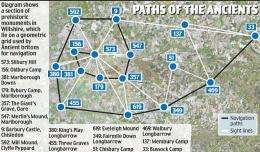
Connected by triangles: Some of the sites created by Stone Age man. Image: DailyMail

(PhysOrg.com) -- A new theory based on studies of locations of large landmarks in Britain, such as stone structures, hill forts and earthworks, suggests they were part of a grid used for navigation around 5,000 years ago, which implies people at the time were not as primitive as previously thought.

The theory, put forward by Tom Brooks, a retired marketing executive turned amateur historian, claims landmarks such as Silbury Hill and Stonehenge were part of a network that allowed people to travel long distances without maps.

Analyzing 1,500 sites in southern England and Wales, Brooks found that all the known sites could be connected to at least two others to make isosceles triangles, which have two equal sides. Some of the triangles have sides greater than 100 miles long, and the equal sides are accurate to +/- 110 yards, which Brooks says could not have happened by chance.

According to Brooks this finding means they were deliberately built landmarks intended to aid in navigation in the world before maps. For short journeys travelers were easily able to walk from one site to another, since many were within sight of each other. For traveling longer distances the routes could be broken up into an interconnected series of short steps.

Brooks said the navigation grid was so accurate and sophisticated that we need to either change our notions about how primitive people were, or accept the proposal they received help from extraterrestrial sources, an idea that Brooks does not dismiss.

The editor of British magazine, Mike Pitts, is not convinced by the theory, however. He pointed out that Britain was well-populated at the time and there were many earthworks and other archaeological landmarks. Finding patterns is not difficult, and the patterns therefore are not necessarily meaningful.

via DailyMail

© 2009 PhysOrg.com


print this article email this article download pdf blog this article bookmark this article     Stumble it Digg this share on Facebook retweet share on Reddit add to delicious
Rate this story - 3.5 /5 (16 votes)

Rank Filter

Move the slider to adjust rank threshold, so that you can hide some of the comments.


Display comments: newest first

  • mikehevans - Sep 18, 2009
    • Rank: 4.2 / 5 (5)
    Ley lines are an example of this sort of thinking. Pitts is right, there were lots of folks in Britain and the paths used to travel between popular destinations were well marked by use. It looks mysterious on a map, but so would the Roman roads and walls if we didn't know where they came from. Maybe they ought to restrict the distribution of Ordnance Survey maps to individuals without too much time on their hands.
  • googleplex - Sep 18, 2009
    • Rank: 5 / 5 (5)
    As the researcher believes aliens could be involved one has to question the scientific rigor.
  • jerryd - Sep 18, 2009
    • Rank: 5 / 5 (2)
    People back then were as smart as those now, just they had different things they had to know about.

    The fact one would not believe this or think this theory was true means there is at least one person not as smart as those back then. Amateur is a good way to describe him
  • alq131 - Sep 18, 2009
    • Rank: 5 / 5 (1)
    Shouldn't be too amazing, 5000 years ago the pyramids were being built. The Archemides screw was pumping water. We know there was commerce so there must have been sophisticated navigation. With GPS now so accessible, it might look archaic to look back even 300 years when the accurate measurement of time and longitude was fairly new.
  • Smellyhat - Sep 18, 2009
    • Rank: 4 / 5 (3)
    This article is based upon one appearing in the pages of the British newspaper The Daily Mail, and was written by David Derbyshire. It presents the theory of self-professed amateur historian and it features the infamous British 'ley lines', long a mainstay of both earnest pseudoscience and those preying on the credulous. There is even a suggestion of extraterrestrial intervention.

    I find it offensive that this would be presented as science news on a website that purports to specialize in the reportage of science. It is a disservice to the popular understanding of science. The author of such an article must sure be ignorant, indifferent, or contemptuous towards both scientific method and the notion of science journalism. The standards of evidence allowed here would not stand in a detective fiction, let alone in a peer reviewed journal. From the sop thrown to actuality in the final paragraph, it seems clear that both Ms. Edwards and Mr. Derbyshire are completely aware of this.
  • Mandan - Sep 18, 2009
    • Rank: 5 / 5 (4)
    Good criticisms all. Something else should be obvious-- since stone age hunter/gatherers were by definition seasonally nomadic, and that since the territories in which this cyclical hunting and gathering occurred were exploited generationally, over extremely long periods of time, it was not as if these people were strangers in a strange land, needing some kind of map to get around.

    I have read numerous cultural anthropologies of Native Americans, for instance, and their knowledge of their landscape was astonishing. They could remember, often many decades later, where they had encamped (at the headwaters of such and such river) at a particular time of year, how long they had stayed there, various stories associated with the place, and so on.

    Now, when people were migrating into new areas, something which obviously occurred, they might construct primitive markers here and there, but the proliferation of naturally occurring landmarks would surely make this redundant, even then.
  • russcelt - Sep 21, 2009
    • Rank: not rated yet
    Each generation is epochcentrist in their time, but only the naive and ignorant use epochcentrism to filter the facts.
  • docknowledge - Sep 21, 2009
    • Rank: not rated yet
    Each generation is epochcentrist in their time, but only the naive and ignorant use epochcentrism to filter the facts.

    Pithy, but I'm not sure I get what you mean?
  • Explorer22 - Sep 23, 2009
    • Rank: 5 / 5 (1)
    I think Tom Brooks may have made an important discovery which should not be dismissed so easily. It's decidedly unscientific to close-mindedly reject a new theory before the evidence has been studied objectively, impartially and with an open mind. Stubborn adherence to established doctrine, in the face of evidence to support new theories, is not the way of true scientific method.
  • googleplex - Sep 24, 2009
    • Rank: not rated yet
    I think Tom Brooks may have made an important discovery which should not be dismissed so easily. It's decidedly unscientific to close-mindedly reject a new theory before the evidence has been studied objectively, impartially and with an open mind. Stubborn adherence to established doctrine, in the face of evidence to support new theories, is not the way of true scientific method.

    True.
    However when there is no supporting evidence and you start mentioning aliens one has to expect a certain skeptical response from the scientific community. Far better to say I have no supporting evidence at this point and leave it at that. Presenting the "it was aliens" hypothesis only undermines the scientific method.

September 18, 2009 all stories

Comments: 10

3.5 /5 (16 votes)
  • Stumble this up

  • Digg this

  • share this

  • hide
  • Related Stories

  • The 'satellite navigation' in our brains
    created Sep 11, 2008 | popularity not rated yet | comments 0
  • Shells from 100,000 years ago may have been earliest jewelry
    created Jun 22, 2006 | popularity not rated yet | comments 0
  • Where in the world
    created Jan 30, 2008 | popularity not rated yet | comments 0
  • Sex and prenatal hormone exposure affect cognitive performance
    created Apr 13, 2007 | popularity not rated yet | comments 0
  • Software transforms digital photos into old-fashioned paintings
    created Sep 12, 2007 | popularity not rated yet | comments 0


  • hide
  • Relevant PhysicsForums posts

  • Super quick question about Starling forces?
    created 2 hours ago
  • Questions about diffusion
    created 8 hours ago
  • Human Leukocyte Antigen (HLA) typing
    created 14 hours ago
  • Breeding program
    created Nov 20, 2009
  • More from Physics Forums - Biology

Other News

Researcher: Faint writing seen on Shroud of Turin (AP)

Researcher: Faint writing seen on Shroud of Turin (Update)

Other Sciences / Archaeology & Fossils

created Nov 20, 2009 | popularity 2.1 / 5 (25) | comments 23

(AP) -- A Vatican researcher has rekindled the age-old debate over the Shroud of Turin, saying that faint writing on the linen proves it was the burial cloth of Jesus. Experts say the historian may be reading ...


Museum: Galileo's fingers, tooth are found (AP)

Museum: Galileo's fingers, tooth are found

Other Sciences / Archaeology & Fossils

created Nov 21, 2009 | popularity 4 / 5 (1) | comments 6

(AP) -- Two fingers and a tooth removed from Galileo Galilei's corpse in a Florentine basilica in the 18th century and given up for lost have been found again and will soon be put on display, an Italian museum ...


Maya

New insights into the life of the Maya

Other Sciences / Archaeology & Fossils

created Nov 16, 2009 | popularity 4.6 / 5 (15) | comments 7

(PhysOrg.com) -- Ancient artifacts are almost always concerned with rich and powerful religious and political leaders, but new excavations of an ancient Maya site have unearthed a pyramid decorated with murals ...


Three of a kind

Three of a kind: Revealing language’s universal essence

Other Sciences / Social Sciences

created Nov 20, 2009 | popularity 3.9 / 5 (11) | comments 6

(PhysOrg.com) -- On the surface, English, Japanese, and Kinande, a member of the Bantu family of languages spoken in the Democratic Republic of Congo, have little in common. It is not just that the vocabularies ...


Only tax increase can cure Illinois budget woes, study says

Other Sciences / Economics

created Nov 18, 2009 | popularity 1 / 5 (1) | comments 3

Tax increases are the only solution to a widening budget crisis that a new study says has landed Illinois among the nation's most financially troubled states, a soon-to-be-released report by a team of University of Illinois ...