It's a grind to make Mars red
September 18, 2009 It's a grind to make Mars red

Enlarge

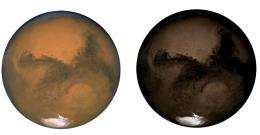
Should Mars really be more the colour of the image on the right? Credit: NASA/ESA/Hubble Team

(PhysOrg.com) -- The widespread idea that Mars is red due to rocks being rusted by the water that once flooded the red planet may be wrong. Recent laboratory studies show that the red dust may be formed by ongoing grinding of surface rocks and liquid water need not have played any significant role in the red dust formation process. These findings, which open up the debate about the history of water on Mars and whether it has ever been habitable, have been presented at the European Planetary Science Congress by Dr Jonathan Merrison.

should really look black, between its white polar caps, because most of the rocks at mid-latitudes are basalt. For decades we assumed that the reddish regions on Mars are related to the water-rich early history of the planet and that, at least in some areas, water-bearing heavily oxidized iron minerals are present,” said Dr. Merrison, of the Aarhus Mars Simulation Laboratory, Denmark

Accurate knowledge of the composition and mineralogy of the planet is vital in understanding the structure and evolution of the near-surface environment and its interaction with the atmosphere, as well as in searching for potential habitats on Mars. Fine red dust covers Mars’s surface and is even present in Mars’s atmosphere, dominating the weather and sometimes becoming so thick that it plunges the planet into darkness. Even though dust is ubiquitous, we do not fully understand its physical, chemical and geological properties.
It's a grind to make Mars red
Enlarge

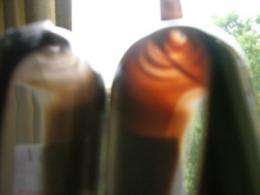
Figure (left) photograph of two sample flasks exposed to tumbling for a short time (around 2 months for the flask on the left) and a longer time (around 7 months for the flask to the right). Mars Simluation Laboratory, Univ. Aarhus.

In their recent laboratory study, scientists at the Mars Simulation Laboratory have pioneered a novel technique to simulate the sand transport on Mars. They hermetically sealed sand (quartz) t samples in glass flasks and mechanically “tumbled” them for several months, turning each flask ten million times. After gently tumbling pure quartz sand for seven months, almost 10% of the sand had been reduced to dust. When scientists added powdered magnetite, an present in Martian basalt, to the flasks they were surprised to see it getting redder as the flasks were tumbled.

“Reddish-orange material deposits, which resemble mineral mantles known as desert varnish, started appearing on the tumbled flasks. Subsequent analysis of the flask material and dust has shown that the magnetite was transformed into the red mineral hematite, through a completely mechanical process without the presence of water at any stage of this process,” said Dr. Merrison.

The scientists suspect that, as the quartz sand grains are tumbled around they get quickly eroded and an alteration of minerals through contact ensues. How exactly this happens need to be further investigated through more experimental and analytical work. What is clear though is that the first experiments show that this process occurs not only in air but also in a dried carbon dioxide atmosphere, that is, in conditions that perfectly resemble those occurring on Mars. It may also imply that the reddish Martian dust is geologically recent.

Scientists worldwide, aided by new missions and improved instrumentation reaching the planet, will continue developing new improved computer models and Earth-bound simulators to try to pierce through the red planet’s mysteries.

“By simulating the conditions and developing accurate analogues of the Martian environment, we will certainly gain a deeper understanding of its dusty nature. In particular, developing better analogues of the Martian surface and atmosphere is vital in interpreting observations made on Mars by landers as well as pioneering the next generation of experiments to be flown,” said Dr Merrison.

Provided by European Planetary Science Congress


print this article email this article download pdf blog this article bookmark this article     Stumble it Digg this share on Facebook retweet share on Reddit add to delicious
Rate this story - 4.6 /5 (5 votes)

Rank Filter

Move the slider to adjust rank threshold, so that you can hide some of the comments.


Display comments: newest first

  • austux - Sep 19, 2009
    • Rank: not rated yet
    Send people to examine the dust in the Pilbara region of Western Australia. Almost ALL of the dust there is red.

    A lot of places north of Carnarvon feature this, but the towns of Paraburdoo & Mount Tom Price almost exemplify it.
  • docknowledge - Sep 19, 2009
    • Rank: not rated yet
    austux, but there is at least some water there, and probably was more at some time in the past.

    This experiments suggests that the red color can be produced without water having been present at any time.

September 18, 2009 all stories

Comments: 2

4.6 /5 (5 votes)
  • Stumble this up

  • Digg this

  • share this

  • hide
  • Related Stories

  • Clay Studies Alter View of Early Mars Environment
    created Jul 18, 2007 | popularity not rated yet | comments 0
  • Mars Express latest findings give hints about water loss in the Martian atmosphere
    created Sep 27, 2004 | popularity not rated yet | comments 0
  • Mars under the spotlight again
    created Mar 13, 2006 | popularity not rated yet | comments 0
  • Mars Express mission extended
    created Sep 22, 2005 | popularity not rated yet | comments 0
  • Arizona State scientists keep an eye on Martian dust storm
    created Jul 11, 2007 | popularity not rated yet | comments 0


  • hide
  • Relevant PhysicsForums posts

  • Sideral question
    created 17 hours ago
  • Doppler shifted blackbody spectrum
    created 19 hours ago
  • Earth v. Moon
    created 21 hours ago
  • help me with coordinates and orbits
    created 22 hours ago
  • basic 'our universe' question..
    created Nov 20, 2009
  • deriving keplers law
    created Nov 19, 2009
  • More from Physics Forums - General Astronomy

Other News

Astronauts finish another spacewalk, still no baby (AP)

Astronauts finish another spacewalk, still no baby

Space & Earth / Space Exploration

created 8 hours ago | popularity 3 / 5 (2) | comments 0

(AP) -- A spacewalking astronaut put aside the impending birth of his daughter and blazed through his first-ever venture outside the International Space Station on Saturday.


Unseasonably hot and dry weather combined with strong winds to fan scores of blazes in the country's southeastern states

Australia issues 'catastrophic' alerts as fires rage

Space & Earth / Environment

created 14 hours ago | popularity 4.5 / 5 (2) | comments 0

Australia has issued "catastrophic" alerts after record-breaking temperatures and wild lightning storms sparked more than 100 fires across the country, officials said Saturday.


Commuters wait on the platform shrouded by fog in London

Climate change not man-made, say majority of Britons: poll

Space & Earth / Environment

created Nov 15, 2009 | popularity 3.3 / 5 (15) | comments 46

Less than half of Britons believes that human activity is to blame for global warming, according to a poll carried out for The Times newspaper and published on Saturday.


Mysteriously warm times in Antarctica

Mysteriously warm times in Antarctica

Space & Earth / Earth Sciences

created Nov 18, 2009 | popularity 4.2 / 5 (21) | comments 28

(PhysOrg.com) -- A new study of Antarctica's past climate reveals that temperatures during the warm periods between ice ages (interglacials) may have been higher than previously thought. The latest analysis ...


UN: Fight climate change with free condoms (AP)

UN: Fight climate change with free condoms

Space & Earth / Environment

created Nov 18, 2009 | popularity 3.1 / 5 (11) | comments 24

(AP) -- The battle against global warming could be helped if the world slowed population growth by making free condoms and family planning advice more widely available, the U.N. Population Fund said Wednesday.