Invading black holes explain cosmic flashes
September 18, 2009 Invading black holes explain cosmic flashes

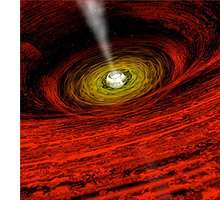
(PhysOrg.com) -- Black holes are invading stars, providing a radical explanation to bright flashes in the universe that are one of the biggest mysteries in astronomy today.

The flashes, known as gamma ray bursts, are beams of high energy radiation - similar to the radiation emitted by explosions of nuclear weapons - produced by jets of plasma from massive dying .

The orthodox model for this cosmic jet engine involves plasma being heated by in a disk of matter that forms around a black hole, which is created when a star collapses.

But mathematicians at the University of Leeds have come up with a different explanation: the jets come directly from , which can dive into nearby massive stars and devour them.

Their theory is based on recent observations by the Swift satellite which indicates that the central jet engine operates for up to 10,000 seconds - much longer than the neutrino model can explain.

Mathematicians believe that this is evidence for an electromagnetic origin of the jets, i.e. that the jets come directly from a rotating black hole, and that it is the magnetic stresses caused by the rotation that focus and accelerate the jet's flow.

For the mechanism to operate the collapsing star has to be rotating extremely rapidly. This increases the duration of the star's collapse as the gravity is opposed by strong centrifugal forces.

One particularly peculiar way of creating the right conditions involves not a collapsing star but a star invaded by its black hole companion in a binary system. The black hole acts like a parasite, diving into the normal star, spinning it with gravitational forces on its way to the star's centre, and finally eating it from the inside.

"The neutrino model cannot explain very long gamma ray bursts and the Swift observations, as the rate at which the black hole swallows the star becomes rather low quite quickly, rendering the neutrino mechanism inefficient, but the magnetic mechanism can," says Professor Komissarov from the School of Mathematics at the University of Leeds.

"Our knowledge of the amount of the matter that collects around the black hole and the rotation speed of the star allow us to calculate how long these long flashes will be - and the results correlate very well with observations from satellites," he adds.

More information: The research is published in the Monthly Notices of the Royal Astronomical Society.

Source: University of Leeds (news : web)


print this article email this article download pdf blog this article bookmark this article     Stumble it Digg this share on Facebook retweet share on Reddit add to delicious
Rate this story - 4.2 /5 (25 votes)

Rank Filter

Move the slider to adjust rank threshold, so that you can hide some of the comments.


Display comments: newest first

  • Alexa - Sep 18, 2009
    • Rank: 2.1 / 5 (7)
    In classical Schwarzschild model, black hole manifests by relatively weak gravitational force only. But black holes are behaving like wildly rotating magnetars exhibiting strong electromagnetic field at distance. And this field is 10E+42-times stronger, then the gravity. Such black hole would interact with neighboring matter pretty fast just due its magnetic field while changing it into giant vortex of plasma.

    http://www.space....tic.html

    From the same reason the belief, we could survive black hole formation in LHC many years at the case, when black hole would fall into Earth core appears pretty naive for me. We would evaporate in much faster way.
  • Caliban - Sep 18, 2009
    • Rank: 3 / 5 (2)
    Sadly, I lack the skills to do any math-based theorizing on what the outcome would be in such a scenario, but it seems that, unless one of these supposedly "microscopic" black holes, created in a/the LHC is surrounded by hard vacuum and perfectly-and I mean perfectly- balanced magnetic field, then what can or would prevent it from being able to interact with its material surroundings, and almost instantaneously? Over what distance would it's gravity/magnetic field enable it to interact? What is its lifespan before it "evaporates" assuming it is deprived of a ready supply of material to consume?
    It seems that if it remained in existence long enough to come into contact with anything solid, then it would very, very quickly-perhaps in only a few minutes make it to the gravitationally stable center of the planet. One would expect that soon after, the planet would begin to break apart or implode. Great movie idea, but how real is this proposed sequence of events? Anyone?
  • Question - Sep 18, 2009
    • Rank: 2.7 / 5 (3)
    Why would black holes be necessary. Wouldn't a rotating galaxy create a galaxy size washer type magnetic field on it own? These galaxy size magnetic fields could answer other question like the origin of super strong cosmic radiation.
  • axemaster - Sep 19, 2009
    • Rank: 5 / 5 (3)
    Scientists have good reason to believe that black holes, even if they do form at the LHC, will evaporate nearly instantaneously - so quickly that they will have no chance to interact before evaporation (in fact the number is something like 10^-20 seconds).

    One piece of evidence, which is generally considered quite convincing, is that the Earth is constantly being bombarded with cosmic rays with far more energy than could ever be achieved by the LHC. The fact that the Earth still exists makes the evaporation model a high statistical probability, even without the accompanying logical argument.

    Note: It's not just the Earth either - if BHs didn't evaporate, one would expect the Sun or any of the other planets to have been destroyed by now. The fact that they, and the many bodies in our stellar neighborhood still exist lends further credence to black hole evaporation.
  • Alexa - Sep 19, 2009
    • Rank: 1 / 5 (3)
    Wouldn't a rotating galaxy create a galaxy size washer type magnetic field on it own
    If it would be formed by charged objects, then yes. But why stars should be charged, if they contain negative and positively charged particles in balanced equilibrium?
  • Alexa - Sep 19, 2009
    • Rank: 1 / 5 (2)
    .Scientists have good reason to believe that black holes, even if they do form at the LHC, will evaporate nearly instantaneously ..
    On the other hand, they're searching for confirmation of supersymmetry, which is just an effect, which would prohibit such evaporation. In recent FERMILAB experiments a formation od dimuon pairs was observed well outside of collider tube. Some scientists recognized it correctly as a supersymmetry event and as a sign of "new physics"

    http://www.physor...766.html

    If scientists are searching for theories, which would violate existing theories, which predict black hole evaporation, they shouldn't be surprised in near future.

    Safety is the main concern of LHC experiments. You can be perfectly sure, LHC experiments are safe because of many theories. After all, the main purpose of these experiments is to verify these theories.

    Isn't the only purpose of LHC to verify it's own safety at the very end? Is it really enough for everybody?
  • earls - Sep 19, 2009
    • Rank: 3.7 / 5 (3)
    [...] they contain negative and positively charged particles in balanced equilibrium?


    Says WHO?
  • Caliban - Sep 19, 2009
    • Rank: not rated yet
    Keep yer fingers X'd One comforting thought- if it were to happen, it should be mercifully quick!
  • Question - Sep 19, 2009
    • Rank: 3 / 5 (2)
    Wouldn't a rotating galaxy create a galaxy size washer type magnetic field on it own
    If it would be formed by charged objects, then yes. But why stars should be charged, if they contain negative and positively charged particles in balanced equilibrium?


    Don't magnets have positive and negative charged parts in equilibrium? So why would a galaxy need an imbalance in charged particles to have a strong magnetic field?
  • SpiffyKavu - Sep 19, 2009
    • Rank: 5 / 5 (2)
    Most objects in the universe have a net neutral charge. That doesn't mean that the internal distributions have to be homogeneous, just that the total number of positive charges equals the negative charges. Electromagnetism is a very strong force. If a sizable object (such as the sun) had any net charge, it would quickly grab particles from around it to balance out the charge. But there are flows of like-charged particles inside the sun. Ions flow in convection zones close to the surface of the sun. This is likely where the sun's magnetic field comes from.

    There is evidence of a galactic magnetic field. It is very weak, but it constrains sources of cosmic rays.
  • mscir - Sep 20, 2009
    • Rank: not rated yet
    Do they have computer models of this yet?
  • hush1 - Sep 24, 2009
    • Rank: 2.3 / 5 (3)
    I'm going to side with mathematician Stephen J. Crothers on this one until the entire astrophysical society (or in his words "relativists and big bangers") either formally provide a rigorous mathematical rebuttal to his rigorous mathematical proofs - pointing out Einstein's hopelessly flawed GR and SR Theories. In short, Crothers mathematical proofs - his argumentations - are irrefutable towards dispensing with the myths called black holes and gravitational waves.

    I just feel sorry for the hundreds of thousands of "scientists" who are forced to propagate the myths.
    It's not science at all. And I condemn those trying to suppress and ignore Crothers work for the sake of jobs, reputations, false pride and money.

September 18, 2009 all stories

Comments: 12

4.2 /5 (25 votes)
  • Stumble this up

  • Digg this

  • share this

  • hide
  • Related Stories

  • Neutron stars join the black hole jet set
    created Jun 27, 2007 | popularity not rated yet | comments 0
  • The Oddball Hosts of Gamma-ray Bursts
    created Oct 22, 2008 | popularity not rated yet | comments 0
  • Huge Black Holes Stifle Star Formation
    created Aug 23, 2006 | popularity not rated yet | comments 0
  • Researchers discover star orbiting a 'medium-sized' black hole
    created Jan 05, 2006 | popularity not rated yet | comments 0
  • X-ray flashes tied to low-end massive stars
    created Aug 30, 2006 | popularity not rated yet | comments 0


  • hide
  • Relevant PhysicsForums posts

  • Sideral question
    created 14 hours ago
  • Doppler shifted blackbody spectrum
    created 17 hours ago
  • Earth v. Moon
    created 19 hours ago
  • help me with coordinates and orbits
    created 20 hours ago
  • More from Physics Forums - General Astronomy

Other News

Astronauts finish another spacewalk, still no baby (AP)

Astronauts finish another spacewalk, still no baby

Space & Earth / Space Exploration

created 6 hours ago | popularity 3 / 5 (2) | comments 0

(AP) -- A spacewalking astronaut put aside the impending birth of his daughter and blazed through his first-ever venture outside the International Space Station on Saturday.


Unseasonably hot and dry weather combined with strong winds to fan scores of blazes in the country's southeastern states

Australia issues 'catastrophic' alerts as fires rage

Space & Earth / Environment

created 12 hours ago | popularity 4.5 / 5 (2) | comments 0

Australia has issued "catastrophic" alerts after record-breaking temperatures and wild lightning storms sparked more than 100 fires across the country, officials said Saturday.


Commuters wait on the platform shrouded by fog in London

Climate change not man-made, say majority of Britons: poll

Space & Earth / Environment

created Nov 15, 2009 | popularity 3.3 / 5 (15) | comments 45

Less than half of Britons believes that human activity is to blame for global warming, according to a poll carried out for The Times newspaper and published on Saturday.


Mysteriously warm times in Antarctica

Mysteriously warm times in Antarctica

Space & Earth / Earth Sciences

created Nov 18, 2009 | popularity 4.2 / 5 (21) | comments 28

(PhysOrg.com) -- A new study of Antarctica's past climate reveals that temperatures during the warm periods between ice ages (interglacials) may have been higher than previously thought. The latest analysis ...


UN: Fight climate change with free condoms (AP)

UN: Fight climate change with free condoms

Space & Earth / Environment

created Nov 18, 2009 | popularity 3.1 / 5 (11) | comments 23

(AP) -- The battle against global warming could be helped if the world slowed population growth by making free condoms and family planning advice more widely available, the U.N. Population Fund said Wednesday.