'Apples-to-apples' analysis of Arab development yields fresh view
The Arab world is not the socioeconomic basket case that conventional wisdom holds, says University of California, San Diego economist James Rauch.
An "apples-to-apples" analysis, coauthored by Rauch and published in the current issue of the Journal of Economic Perspectives, refutes the unfavorable view painted by the United Nations' Arab Human Development Report from 2002 onward and seized on by Western media.
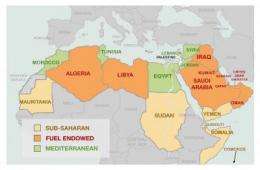
Unlike the Arab Human Development Report which groups all Arab nations together, the peer-reviewed study divides the countries - which range from the Sudan, in destitute and disease-challenged sub-Saharan Africa, to the fabulously oil-wealthy Qatar - into three categories: sub-Saharan, fuel-endowed and the remainder, termed the "Arab Mediterranean."
The study compares population-weighted averages in "the three Arab worlds" from 1970 to 2006 with their non-Arab counterparts on the basis of health, educational attainment and income, the indices also used by the U.N. in its Human Development Index. Comparisons are also provided for population growth, gender gaps and democracy.
"By almost every standard socioeconomic measure, Arab countries have average or above-average development when compared to similar non-Arab nations," said Rauch.
However, where the common view has a legitimate gripe, he said, is in the areas of democracy and women's labor-force participation.
"All in all, the picture is far more nuanced than the Arab Human Development Report suggests," Rauch said. "It is important, too, to note not only absolute levels of attainment but also change over time. On that score, many of the Arab countries have done remarkably well."
The study's sub-Saharan group includes Comoros, Djibouti, Mauritania, Somalia, Sudan and Yemen. The fuel-endowed countries are Algeria, Bahrain, Iraq, Kuwait, Libya, Oman, Qatar, Saudi Arabia and the United Arab Emirates. The remainder, or "Arab Mediterranean," comprises Egypt, Jordan, Lebanon, Morocco, Syria and Tunisia. (The authors decided to exclude the Palestinian occupied territories because they are not recognized as a nation by the U.N.)
The first two of these groupings are compared, respectively, to non-Arab sub-Saharan and non-Arab fuel-endowed countries. The "Arab Mediterranean," meanwhile, is compared to the rest of the non-Arab world, as well as, perhaps more meaningfully according to Rauch, to Latin America and to southern Europe. (For a complete listing of the comparison countries, see the paper.)
In 1970, all the Arab countries had lower life expectancies than comparison country groups, but by 2006 average life expectancy was higher in the Arab sub-Saharan and fuel-endowed countries than in their counterpart country groups. Life expectancy in the Arab Mediterranean was higher than in the remainder of the non-Arab world but, while catching up, was still lower than in Latin America and southern Europe.
On education, all three Arab groups had lower years of education than comparison country groups in 1970, but by 2000 the Arab Mediterranean and fuel-endowed countries had substantially caught up with their counterparts, Rauch said. In the Mediterranean, educational attainment almost equaled Latin America.
Per capita GDP comparisons also show favorable growth for the Arab nations. Though at a rate of 2.7 percent, incomes in Arab Mediterranean countries have grown more slowly than the rest of the world (which is dominated by the rapid growth of China), they have grown faster than counterpart groupings in Latin America and in southern Europe.
"These development gains could be threatened by runaway population growth," noted Rauch. "But there is progress here as well." Births are down from an average of seven per woman across the Arab world in 1970 to below three in the Mediterranean and fuel-endowed countries.
The relative progress in reduced birth rates comes up against the reputation of Arab countries for discrimination against girls and women, causing the author to ask, "Have Arab women converged towards non-Arab women in other aspects of their lives?" To find an answer, the study reviewed female percentages of total school enrollment and gender gaps in labor force participation rates.
In all three Arab country groups, the female shares of school enrollment were rapidly approaching 50 percent. "This means that going forward," Rauch said, "Arab women will almost certainly attain parity with men on literacy rates."
With regard to labor force participation, the Arab gender gaps exceed those in the comparison country groups across the board and by large margins. That finding begs the question of "why?" Contrary to popular perception, no Arab country except Saudi Arabia legally prohibits its women from voting, driving or leaving their heads uncovered in public. So the authors examined whether the low rates of women working outside the home were attributable to Islam and ran comparisons to other Muslim-majority countries. To their surprise, it seemed to have little to do with religion. "Instead it appears to be a feature of Arab culture," Rauch said, and would need further research to explain.
Finally, the study measured levels of democracy and found that all three groupings of Arab countries lag behind their non-Arab counterparts in political development and on that score mirror the larger Muslim world.
Source: University of California - San Diego (news : web)


