Memories of the way they used to be
September 18, 2009
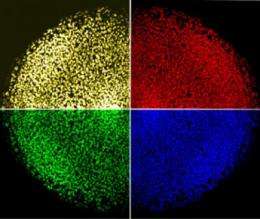
This is a mosaic of human iPS cells generated by "footprint-free" technology expressing the pluripotent marker Oct4. Credit: University of California, San Diego School of Medicine
A team of researchers from the University of California, San Diego School of Medicine and the Salk Institute for Biological Studies in La Jolla have developed a safe strategy for reprogramming cells to a pluripotent state without use of viral vectors or genomic insertions. Their studies reveal that these induced pluripotent stem cells (iPSCs) are very similar to human embryonic stem cells, yet maintain a "transcriptional signature." In essence, these cells retain some memory of the donor cells they once were.
The study, led by UCSD Stem Cell Program researcher Alysson R. Muotri, assistant professor in the Departments of Pediatrics at UCSD and Rady Children's Hospital and UCSD's Department of Cellular and Molecular Medicine, will be published online in PLoS ONE on September 17.
"Working with neural stem cells, we discovered that a single factor can be used to re-program a human cell into a pluripotent state, one with the ability to differentiate into any type of cell in the body" said Muotri. Traditionally, a combination of four factors was used to create iPSCs, in a technology using viral vectors - viruses with the potential to affect the transcriptional profile of cells, sometimes inducing cell death or tumors.
In addition, while both mouse and human iPSCs have been shown to be similar to embryonic stem cells in terms of cell behavior, gene expression and their potential to differentiate into different types of cells, researchers had not achieved a comprehensive analysis to compare iPSCs and embryonic stem cells.
"One reason is that previous methodologies used to derive iPSCs weren't 'footprint free,'" Muotri explained. "Viruses could integrate into the genome of the cell, possibly affecting or disrupting genes."
"In order to take full advantage of reprogramming, it is essential to develop methods to induce pluripotency in the absence of permanent changes in the genome," added Fred H. Gage, PhD, a professor in the Laboratory for Genetics at the Salk Institute and the Vi and John Adler Chair for Research on Age-Related Neurodegenerative Diseases.
By creating iPSCs from human neural stem cells without the use of viruses, the scientists learned something new. While the genetic transcriptional profile of the new iPSCs was closer to that of embryonic stem cells than to human neural stem cells, the iPSCs still carried a transcriptional "signature" of the original neural cell.
"While most of the original genetic memory was erased when the cells were reprogrammed, some were retained," said Muotri. He added that, in the past, it wasn't known if this was caused by the use of viral vectors. "By using a footprint-free methodology, we have shown a safe way to generate human iPSCs for clinical purposes and basic research. We've also raised an interesting question about what, if any, effect the 'memory retention' of these cells might have."
-
Reprogrammed mouse fibroblasts can make a whole mouse
Jul 23, 2009 |
not rated yet |
0
-
Virus-free embryonic-like stem cells made from skin of Parkinson's disease patients
Mar 05, 2009 |
not rated yet |
0
-
Scientists develop method for generating novel types of stem cells
Dec 18, 2008 |
not rated yet |
0
-
New study hopeful on neural stem cells
Aug 05, 2006 |
not rated yet |
0
-
Researchers develop human stem cell line containing sickle cell anemia mutation
May 29, 2008 |
not rated yet |
0
-
Engineers build first sub-10-nm carbon nanotube transistor
Feb 01, 2012 |
4.9 / 5 (33) |
30
-
Something old, something new: Evolution and the structural divergence of duplicate genes
Jan 31, 2012 |
4.6 / 5 (7) |
1
-
The hidden nanoworld of ice crystals: Revealing the dynamic behavior of quasi-liquid layers
Jan 30, 2012 |
5 / 5 (4) |
1
-
Stock market network reveals investor clustering
Jan 27, 2012 |
3.9 / 5 (23) |
8
-
Of microchemistry and molecules: Electronic microfluidic device synthesizes biocompatible probes
Jan 26, 2012 |
5 / 5 (2) |
0
-
Factors affecting beet root cell membrane
9 hours ago
-
Stem cell question.
Feb 10, 2012
-
Protease cleavage
Feb 10, 2012
-
Pertubance in a model
Feb 10, 2012
-
Cancer drugs and Alzheimer's, Oh my!
Feb 09, 2012
-
Squishing cells
Feb 09, 2012
- More from Physics Forums - Biology
More news stories
A mitosis mystery solved: How chromosomes align perfectly in a dividing cell
Although the process of mitotic cell division has been studied intensely for more than 50 years, Whitehead Institute researchers have only now solved the mystery of how cells correctly align their chromosomes during symmetric ...
5 hours ago |
4.5 / 5 (8) |
0
|
Researchers find extensive RNA editing in human transcriptome
In a new study published online in Nature Biotechnology, researchers from BGI, the world's largest genomics organization, reported the evidence of extensive RNA editing in a human cell line by analysis of RNA-seq data, demons ...
5 hours ago |
5 / 5 (4) |
0
|
The proteins ensuring genome protection
Researchers from the University of Geneva (UNIGE), Switzerland, have discovered the crucial role of two proteins in developing a cell 'anti-enzyme shield'. This protection system, which operates at the level of molecular ...
5 hours ago |
5 / 5 (3) |
0
|
Entire genome of extinct human decoded from fossil
(PhysOrg.com) -- In 2010, Svante Pääbo and his colleagues presented a draft version of the genome from a small fragment of a human finger bone discovered in Denisova Cave in southern Siberia. The ...
Feb 07, 2012 |
4.7 / 5 (59) |
48
|
Why are there so few fish in the Earth's oceans?
(PhysOrg.com) -- A Stony Brook University researcher has found that, contrary to popular belief, there are not plenty of fish in the sea.
Feb 08, 2012 |
4.2 / 5 (18) |
27
|
Declining health-care productivity in England: Who says so?
Reports that the National Health Service in England has been declining in productivity in the last decade appear to have been accepted as fact. However, a Viewpoint published Online First by The Lancet disputes this. The Vi ...
Scientists discover molecular secrets of 2,000-year-old Chinese herbal remedy
For roughly two thousand years, Chinese herbalists have treated Malaria using a root extract, commonly known as Chang Shan, from a type of hydrangea that grows in Tibet and Nepal. More recent studies suggest that halofuginone, ...
New method to examine batteries -- MRI from the inside
There is an ever-increasing need for advanced batteries for portable electronics, such as phones, cameras, and music players, but also to power electric vehicles and to facilitate the distribution and storage of energy derived ...
Overeating may double risk of memory loss
New research suggests that consuming between 2,100 and 6,000 calories per day may double the risk of memory loss, or mild cognitive impairment (MCI), among people age 70 and older. The study was released today and will be ...
Lab study raises questions over nano-particle impact
Tests involving chickens have raised questions about the impact on health from engineered nano-particles, the ultra-fine grains commonly used in drugs and processed foods, scientists said on Sunday.
Starve a virus, feed a cure? Findings show how some cells protect themselves against HIV
A protein that protects some of our immune cells from the most common and virulent form of HIV works by starving the virus of the molecular building blocks that it needs to replicate, according to research published online ...
Sep 18, 2009
Rank: not rated yet
Sep 18, 2009
Rank: not rated yet
Well Simon is supposed to improve memory. Maybe that's how stem cells do it.