Reconstruct Mars automatically in minutes
September 18, 2009
Reconstruct Mars automatically in minutes

Enlarge

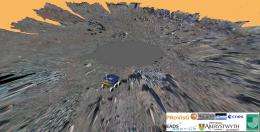
This is a frame from an animation generated from 33 stereo image pairs taken at the CNES SEROM Marsyard in Toulouse. Processing was performed using the ExoMars PanCam 3D Vision Software by Joanneum Research, Graz, Austria. The camera equipment (PanCam Analogue Camera - PAC) was provided by Aberystwyth University, UK (Prof. Dave Barnes). The images were acquired by ESA (Luc Joudrier). The ExoMars Rover model (status: Early 2008) was compiled by EADS Astrium Space, Stevenage, UK.

A computer system is under development that can automatically combine images of the Martian surface, captured by landers or rovers, in order to reproduce a three dimensional view of the red planet. The resulting model can be viewed from any angle, giving astronomers a realistic and immersive impression of the landscape. This important new development was presented at the European Planetary Science Congress in Potsdam by Dr Michal Havlena.

“The feeling of ‘being right there’ will give scientists a much better understanding of the images. The only input we need are the captured raw images and the internal camera calibration. After minutes of computation on a standard PC, a three dimensional model of the captured scene is obtained,” said Dr Havlena.

The growing amount of available imagery from makes the manual image processing techniques used so far nearly impossible to handle. The new automated method which allows fast high quality image processing, was developed at the Center for Machine Perception of the Technical University of Prague, under the supervision of Tomas Pajdla, as a part of the EU FP7 Project PRoVisG.
Reconstruct Mars automatically in minutes
Enlarge

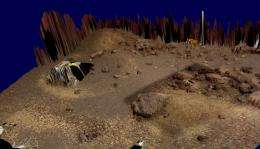
This is a visualization of combining two digital elevation models (DEMs) from the ESTEC Planetary Test Bed (PTB). Two hand-held stereo views were used for DEM reconstruction, and automatically combined. Image courtesy of Joanneum Research, Graz, Austria.

From the technical point of view, the consists of three stages: the first step is determining the image order. If the input images are unordered, i.e. they do not form a sequence but still are somehow connected, a state-of-the-art image indexing technique is able to find images of cameras observing the same part of the scene. To start with, up to a thousand features on each image are detected and “translated” into visual words, according to a visual vocabulary trained on images from Mars. Then, starting from an arbitrary image, the following image is selected as such if it shares the highest number of visual words with the previous image.

The second step of the pipeline, the so-called “structure-from-motion computation”, helps scientists determine the accurate camera positions and rotations in three dimensional space. To do this for each image pair representing neighboring frames, it is enough to find 5 corresponding features to obtain a relative camera pose between the two images.

The last and most important step is the so-called “dense 3D model generation” of the captured scene, which essentially creates and fuses the Martian surface depth maps. To do, this the model uses the intensity disparities (parallaxes) present in images taken at two distinct camera positions, which were identified in the second step.

“The pipeline has already been used successfully to reconstruct a three dimensional model from nine images captured by the Phoenix Mars Lander, which were obtained just after performing some digging operation on the Mars surface,” said Dr Havlena.

“The challenge is now to reconstruct larger parts of the surface of the red planet, captured by the Mars Exploration Rovers Spirit and Opportunity,” concluded Dr Havlena.

Provided by European Planetary Science Congress

Filter


Move the slider to adjust rank threshold, so that you can hide some of the comments.


Display comments: newest first

docknowledge
Sep 19, 2009

Rank: not rated yet
Interesting that non-NASA groups decided to do this. That NASA didn't do it first.
Rank 5 /5 (4 votes)
Related Stories
Relevant PhysicsForums posts
  • Never ending outer space.....
    created18 hours ago
  • Neutron Star fragments?
    created20 hours ago
  • stationary or not?
    createdFeb 11, 2012
  • Scale of the Universe
    createdFeb 10, 2012
  • Titan's lack of impact craters
    createdFeb 09, 2012
  • Real pictures of black hole eating a star?
    createdFeb 08, 2012
  • More from Physics Forums - General Astronomy

More news stories

Latin America mining boom clashes with conservation

Latin America is experiencing a mining boom as prices rise fuelled by a hike in global demand, but the region is also being hit by a wave of violent protests, strikes and rallies by environmentalists.

Space & Earth / Environment

created 12 hours ago | popularity 5 / 5 (1) | comments 1

Salvage workers begin pumping fuel from Italian shipwreck

Salvage workers Sunday began pumping fuel from the shipwrecked Italian cruise liner Costa Concordia, a day ahead of schedule, officials said.

Space & Earth / Environment

created 4 hours ago | popularity not rated yet | comments 0

Political leaders play key role in how worried Americans are by climate change: study

More than extreme weather events and the work of scientists, it is national political leaders who influence how much Americans worry about the threat of climate change, new research finds.

Space & Earth / Environment

created Feb 06, 2012 | popularity 5 / 5 (6) | comments 73

NASA budget will axe Mars deal with Europe: scientists

US President Barack Obama's budget proposal to be submitted next week for 2013 will cut NASA's budget by 20 percent and eliminate a major partnership with Europe on Mars exploration, scientists said Thursday.

Space & Earth / Space Exploration

created Feb 10, 2012 | popularity 5 / 5 (3) | comments 58

Humans may have helped the decline of African rainforests 3000 years ago

(PhysOrg.com) -- Large areas of rainforests in Central Africa mysteriously disappeared over three thousand years ago, to be replaced by savannas. The prevailing theory has been that the cause was a change ...

Space & Earth / Environment

created Feb 10, 2012 | popularity 4.1 / 5 (14) | comments 20 | with audio podcast report


Overeating may double risk of memory loss

New research suggests that consuming between 2,100 and 6,000 calories per day may double the risk of memory loss, or mild cognitive impairment (MCI), among people age 70 and older. The study was released today and will be ...

Google might launch Drive for cloud storage soon

(PhysOrg.com) -- Google's next big move, according to the Wall Street Journal, is a cloud storage service called Drive. Hardly first to the plate, Google is simply catching up to introducing its cloud reposi ...

Scientists discover molecular secrets of 2,000-year-old Chinese herbal remedy

For roughly two thousand years, Chinese herbalists have treated Malaria using a root extract, commonly known as Chang Shan, from a type of hydrangea that grows in Tibet and Nepal. More recent studies suggest that halofuginone, ...

New method to examine batteries -- MRI from the inside

There is an ever-increasing need for advanced batteries for portable electronics, such as phones, cameras, and music players, but also to power electric vehicles and to facilitate the distribution and storage of energy derived ...

Lab study raises questions over nano-particle impact

Tests involving chickens have raised questions about the impact on health from engineered nano-particles, the ultra-fine grains commonly used in drugs and processed foods, scientists said on Sunday.

Injured boomers beware: Know when to see doctor

(AP) -- It happened to nurse Jane Byron years after an in-line skating fall, business owner Haralee Weintraub while doing "men's" push-ups, and avid cyclist Gene Wilberg while lifting a heavy box.