Could salt crusts be key ingredient in cooking up prebiotic molecules?
German scientists investigating the complex chemical mixture thought to be present in the early Earth’s oceans have found that amino acids can be 'cooked' into many other important chemical building blocks of life when embedded in salt crusts. Results of the laboratory experiments were presented by Dr Stefan Fox at the European Planetary Science Congress in Potsdam, Germany, on Thursday 17 September.
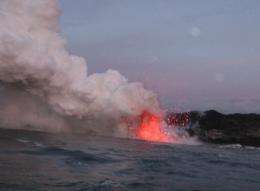
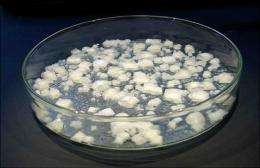
Approximately 4.5 - 3.8 billion years ago, the Earth was probably covered by a salty ocean, rich in organic compounds, dotted with active volcanic islands and short-lived continents. The team from the University of Hohenheim in Stuttgart has simulated some of the chemical processes that might have taken place along hot volcanic coasts during this Hadean era by evaporating solutions of artificial primordial seawater and then baking the salty residue in an atmosphere of nitrogen and carbon dioxide to volcanic temperatures of 350 degrees Celsius. They found that compounds such as pyrroles, which are contained in chlorophyll and haeme (the oxygen-carrying component of haemoglobin), are created.
The group’s experiments show that interaction of amino acids with metal ions in the salt crusts fundamentally changes the thermal behaviour of the molecules, preventing them from turning into gas at high temperatures and allowing unexpected compounds to form.
“We embedded the amino acid DL-alanine in a salt crust mixture of sodium, calcium, potassium and magnesium chlorides and, after heating, we found that a compound formed with calcium salt chemically bonded to the amino acid. This particular compound has never been seen before and, although similar compounds are known to exist, we did not expect to see them in our experiments. This bond between the salt and the amino acid stabilises the compound at high temperatures and prevents sublimation. Without the bond, pyrroles would not be able to form,” said Dr Fox.
Amino acids are the chemical subunits of proteins. The amino acids present in the young Earth’s oceans would have been created in atmospheric reactions, perhaps during lightning discharges in clouds of volcanic ash, and there is increasing evidence that they would have been supplemented by impacting comets and meteorites. Although the concentration of amino acids in the primordial oceans would have been very small - about ten thousand times weaker than the salt concentrations - these reactions would have taken place over many hundreds of thousands of years, allowing significant concentrations of pyrroles to build up. Pyrroles are also created during volcanic eruptions, which were much more common during the Hadean era than today.
“Our aim is to identify types of small molecules that might have participated in a hypothetical next step of chemical evolution - the formation of energy driven networks of molecules that were the precursors to the first primitive electron-transfer and light-harvesting molecules. Our recent results show that amino acids, peptides and pyrroles could all have been present at this stage of the Earth’s evolution and would be good candidates for components of those networks,” said Fox.
These processes have important implications for Earth-like planets orbiting other stars, which may also be seeded with amino acids by impactors. A clear chemical pathway for the development of the raw materials of life would add support to the theory of life evolving beyond Earth.
Provided by European Planetary Science Congress


