SMOS arrives safely at Russian launch site
September 18, 2009
SMOS arrives safely at Russian launch site

Enlarge

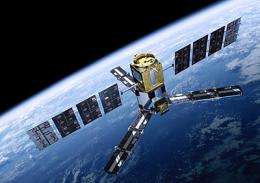
The Soil Moisture and Ocean Salinity (SMOS) mission will make global observations of soil moisture over Earth’s landmasses and salinity over the oceans. Variations in soil moisture and ocean salinity are a consequence of the continuous exchange of water between the oceans, the atmosphere and the land - Earth’s water cycle. Credits: ESA - AOES Medialab

After leaving Thales Alenia Space in the south of France on 15 September, ESA’s SMOS Earth Explorer has arrived safely at the Plesetsk Cosmodrome in northern Russia, where it will be prepared for launch on 2 November.

The Antonov aircraft carrying the and Ocean Salinity (SMOS) satellite, along with seven containers of support equipment, arrived at Arkhangelsk early in the morning of 16 September. Once unloaded from the aircraft, the precious cargo was transported by truck to the train station and then loaded onto wagons for the 12-hour ride to the launch site.  

The train arrived at the yesterday morning and the containers have now all been placed in the integration facilities where they are being unpacked today. The long journey seems to have gone well, and the signs are that satellite and equipment have arrived in good shape.

The SMOS team will now spend the next six weeks testing the satellite and preparing for launch. SMOS will be encapsulated, along with ESA’s Proba-2 satellite, in the fairing of the Rockot launcher in preparation for liftoff at 02.50 CET on 2 November. 
 
The Proba-2 team have already carried out their initial preparations and will return to Plesetsk later this month to resume the campaign.

The arrival of SMOS at the launch site marks a significant milestone for ESA’s next Earth Explorer mission. Also known as ESA’s Water Mission, it is the first dedicated to providing global measurements of soil moisture and ocean salinity. By regularly and consistently mapping these two variables, the mission will improve our understanding of the .
 
ESA’s Project Manager for the SMOS mission, Achim Hahne, commented, “I am really excited that the end is getting close, and so is the team.”

Provided by European Space Agency (news : web)


Rank not rated yet
Related Stories
Relevant PhysicsForums posts
  • Never ending outer space.....
    created8 hours ago
  • Neutron Star fragments?
    created10 hours ago
  • stationary or not?
    created14 hours ago
  • Scale of the Universe
    createdFeb 10, 2012
  • Titan's lack of impact craters
    createdFeb 09, 2012
  • Real pictures of black hole eating a star?
    createdFeb 08, 2012
  • More from Physics Forums - General Astronomy

More news stories

Latin America mining boom clashes with conservation

Latin America is experiencing a mining boom as prices rise fuelled by a hike in global demand, but the region is also being hit by a wave of violent protests, strikes and rallies by environmentalists.

Space & Earth / Environment

created 1 hour ago | popularity not rated yet | comments 0

Europe stakes billion-dollar bet on new rocket

A pencil-slim rocket is scheduled to lift into space from South America on Monday, carrying a billion-dollar bet that Europe can grab a juicy slice of the market to place satellites in low orbit.

Space & Earth / Space Exploration

created 20 hours ago | popularity 4 / 5 (3) | comments 0

Political leaders play key role in how worried Americans are by climate change: study

More than extreme weather events and the work of scientists, it is national political leaders who influence how much Americans worry about the threat of climate change, new research finds.

Space & Earth / Environment

created Feb 06, 2012 | popularity 5 / 5 (6) | comments 72

NASA budget will axe Mars deal with Europe: scientists

US President Barack Obama's budget proposal to be submitted next week for 2013 will cut NASA's budget by 20 percent and eliminate a major partnership with Europe on Mars exploration, scientists said Thursday.

Space & Earth / Space Exploration

created Feb 10, 2012 | popularity 5 / 5 (3) | comments 54

Humans may have helped the decline of African rainforests 3000 years ago

(PhysOrg.com) -- Large areas of rainforests in Central Africa mysteriously disappeared over three thousand years ago, to be replaced by savannas. The prevailing theory has been that the cause was a change ...

Space & Earth / Environment

created Feb 10, 2012 | popularity 4.1 / 5 (14) | comments 20 | with audio podcast report


Google might launch Drive for cloud storage soon

(PhysOrg.com) -- Google's next big move, according to the Wall Street Journal, is a cloud storage service called Drive. Hardly first to the plate, Google is simply catching up to introducing its cloud reposi ...

Love a click away in Indonesia's Twitter Republic

He was a geeky kid from Yogyakarta, she a glamorous city girl in Jakarta. In a country with one of the world's most vibrant social networking scenes they fell in love on Twitter.

Walney offshore wind farm is world's biggest (for now)

(PhysOrg.com) -- The Walney wind farm on the Irish Sea--characterized by high tides, waves and windy weather--officially opened this week. The farm is treated in the press as a very big deal as the Walney ...

GPS court ruling leaves US phone tracking unclear

A US Supreme Court decision requiring a warrant to place a GPS device on the car of a criminal suspect leaves unresolved the bigger issue of police tracking using mobile phones, legal experts say.

Europeans protest controversial Internet pact

Tens of thousands of people marched in protests in more than a dozen European cities Saturday against a controversial anti-online piracy pact that critics say could curtail Internet freedom.

Study finds that anti-diabetic medication can prevent the long-term effects of maternal obesity

In a study to be presented today at the Society for Maternal-Fetal Medicine's annual meeting, The Pregnancy Meeting, in Dallas, Texas, researchers will report findings that show that short therapy with the anti-diabetic medication ...