HIV's ancestors 'plagued first mammals'
September 18, 2009 HIV's ancestors 'plagued first mammals'

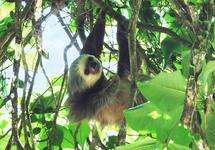
The remains of an ancient HIV-like virus have been discovered in the genome of the two-toed sloth.

(PhysOrg.com) -- The retroviruses which gave rise to HIV have been battling it out with mammal immune systems since mammals first evolved around 100 million years ago - about 85 million years earlier than previously thought, scientists now believe.

The remains of an ancient HIV-like virus have been discovered in the genome of the two-toed sloth [Choloepus hoffmanni] by a team led by Oxford University scientists who publish a report of their research in this week’s Science.

'Finding the fossilised remains of such a virus in this sloth is an amazing stroke of luck,’ said Dr Aris Katzourakis from Oxford’s Department of Zoology and the Institute for Emergent Infections, James Martin 21st Century School. ‘Because this sloth is so geographically and genetically isolated its genome gives us a window into the ancient past of mammals, their immune systems, and the types of viruses they had to contend with.’

The researchers found evidence of ‘foamy viruses’, a particular kind of retrovirus that resembles the complex lentiviruses, such as and simian retroviruses (SIVs) - as opposed to simple retroviruses that are found throughout the genomic record.

‘In previous work we had found evidence for similar viruses in the genomes of rabbits and lemurs but this new research suggests that the ancestors of complex retroviruses, such as HIV, may have been with us from the very beginnings of mammal evolution,’ said Dr Aris Katzourakis.

Understanding the historical conflict between complex viruses and mammal immune systems could lead to new approaches to combating existing retroviruses, such as HIV. It can also help scientists to decide which viruses that cross species are likely to cause dangerous pandemics - such as swine flu (H1N1) - and which, like (H5N1) and foamy viruses, cross this species barrier but then never cause pandemics in new mammal populations.

Provided by Oxford University (news : web)


print this article email this article download pdf blog this article bookmark this article     Stumble it Digg this share on Facebook retweet share on Reddit add to delicious
Rate this story - 4.5 /5 (4 votes)


September 18, 2009 all stories

Comments: 0

4.5 /5 (4 votes)
  • Stumble this up

  • Digg this

  • share this

  • hide
  • Related Stories


  • hide
  • Relevant PhysicsForums posts

  • What is transpulmonary pressure?
    created Nov 24, 2009
  • Is there a gay gene?
    created Nov 23, 2009
  • Super quick question about Starling forces?
    created Nov 22, 2009
  • Questions about diffusion
    created Nov 22, 2009
  • More from Physics Forums - Biology

Other News

Biology, training and profit sharing make best traders

Biology, training and profit sharing make best traders

Other Sciences / Mathematics

created 1hour ago | popularity not rated yet | comments 0

(PhysOrg.com) -- Cambridge researchers have identified a group of traders consistently able to outperform the market, even during the credit crisis.


Explained: The Discrete Fourier Transform

Explained: The Discrete Fourier Transform

Other Sciences / Mathematics

created 1hour ago | popularity 5 / 5 (2) | comments 2

(PhysOrg.com) -- In 1811, Joseph Fourier, the 43-year-old prefect of the French district of Isčre, entered a competition in heat research sponsored by the French Academy of Sciences. The paper he submitted ...


Political views may skew perception of skin tone, new study finds

Other Sciences / Social Sciences

created 15 hours ago | popularity 3.6 / 5 (5) | comments 5

(PhysOrg.com) -- Political affinity could influence how some people view the skin tone of biracial political candidates, according to a new study from the University of Chicago Booth School of Business, New York University ...


Workplace literacy schemes are too short to improve skills

Other Sciences / Social Sciences

created 3 hours ago | popularity not rated yet | comments 0

The five billion pound Skills for Life programme is based on the assumption that an improvement in literacy and numeracy will increase people's earning potential, as well as their productivity and employability. However, ...


In College Football, Home Field Advantage Often Overestimated

Other Sciences / Mathematics

created 15 hours ago | popularity 4 / 5 (1) | comments 0

This year, many of college football's biggest rivalry games take place over Thanksgiving weekend. A win earns bragging rights for the year. Visiting teams are often thought to be at a considerable disadvantage, especially ...