Postmenopausal women benefit from endurance training as much as younger women
(PhysOrg.com) -- After menopause, decreased estrogen and changes in body composition affect women's metabolism. But does this affect women's response to exercise? A new UC Berkeley study shows that postmenopausal women benefit as much as younger women do from endurance training, improving both cardiovascular and respiratory fitness.
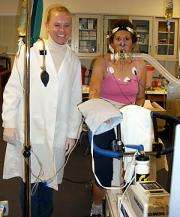
Marilyn Graham was 56 when she signed up for a grueling hour of cycling each morning for 12 weeks, occasionally decked out in a mask, a heart monitor and a bag of intravenous fluid and subjected to needle pricks to obtain blood samples.
"I was probably the biggest whiner of the group, complaining loudly about the seats and how my butt hurt," said Graham, who writes software for business units on the University of California, Berkeley campus. "It was really intense, and on some days my legs felt like wet noodles. On a cranky day I'd say, 'Let me off this stupid bike!'"
But once the training "kicked in," she said," I was feeling good. I had energy left over at the end of the day, less mental sluggishness. And I dropped two dress sizes without any weight loss."
Graham's experience was typical of the 10 healthy but sedentary women, averaging 55 years of age, who participated in a 2006 study of endurance training in 50-something women.
In two papers based on the experiments and published in recent months, UC Berkeley researchers report that postmenopausal women can achieve the same health benefits from regular, vigorous exercise as younger women do.
"There is some good news here for older women in the population, in that they respond much like younger women do to training," said study leader and exercise physiologist George Brooks, UC Berkeley professor of integrative biology. "The results are very encouraging for exercise without weight loss as an effective means for increasing vigor and controlling risk factors for chronic diseases in older women."
"There have been very few studies looking at postmenopausal women, who are different because of decreased estrogen, decreased lean body mass and decreased aerobic capacity," said Zinta Zarins, a newly minted UC Berkeley Ph.D. who conducted the experiments and is now a post-doctoral fellow at UC San Francisco. "Yet, despite changes in hormones and changes in body composition, postmenopausal women can make significant changes in their cardiovascular fitness without going on extreme diets."
Although the endurance training involved cycling on an exercise bike for an hour, five days a week, at 65 percent of maximum lung capacity, the researchers noted that even less strenuous aerobic exercise would likely produce some benefit.
"Most people don't exercise at this level, but some exercise is better than none at all," Zarins said, noting that 60 minutes of jogging on a treadmill or swimming should be as effective as an hour on a stationary bike.
Brooks noted that a woman's metabolism changes as her hormone levels change after menopause, affecting glucose clearance from the blood, for example. He proposed the study, which was funded by the National Institutes of Health, to determine whether women achieve the same benefits from endurance training after menopause as they did before.
"We've done lots of studies on the effects of activity and training on metabolism in younger men and women, but this is the first in an older population," Brooks said.
In a paper appearing in the September issue of the journal Metabolism - Clinical and Experimental, Brooks and Zarins report that participants increased their body's capacity to consume and use oxygen - their VO2 max - by an average of 16 percent and dropped their resting heart rates by an average of 4 beats per minute. Brooks said that after the age of 30, people lose the capacity to consume and use oxygen at about 1 percent per year.
"So, in effect, the women in our study had the cardiovascular and metabolic capabilities of women 16 years younger," he said.
By the end of the study, the women's blood pressure during exercise had dropped by 8 millimeters of mercury, while their heart rates were 19 beats per minute less when performing at the same intensity as early in the study. In addition, the women decreased their carbohydrate burning during exercise and increased their fat burning by about 10 percent. Women in the study maintained their body weight as a way to balance energy input and expenditures.
"While men tend to burn carbohydrates first during exercise, women are better fat burners, and in our study, the women improved fat burning and decreased their reliance on carbohydrate after training," Brooks said. Because they burn fat more than carbohydrates during exercise, women, in general, are better than men at maintaining stable blood glucose levels - the glucose comes from stored carbohydrates - and maintaining their weight, even while undergoing vigorous training, he said. In fact, men continue to burn carbohydrates for several hours after exercise, while women's metabolism immediately returns to normal.
A second paper, published in the July issue of the Journal of Applied Physiology, showed that the women's use of blood glucose and their insulin levels during exercise showed similarities to those of younger women.
Like Graham, most training participants noticed health benefits. Carol Nyhoff, a UC Berkeley alumna who was 57 at the time of the study, admits that exercise on a treadmill at a pace suitable for reading pales in comparison to the endurance training she completed while in the study. During the final VO2 max tests, she said, "I pushed myself very hard to see how much I could do, thinking, 'Wow this could be dangerous, you're way out there somewhere.'" Yet, two weeks after the study ended, her acupuncturist told her she had the pulse of an athlete.
"I was really proud of my accomplishment and the fact that a lot of joint pain and malaise that I had been seeing the acupuncturist for was GONE two weeks after starting the study!" she wrote in an e-mail.
While many of the women who participated in the 2006 study have given up such vigorous training, claiming lack of time in a too-busy schedule, most say they have plans to resume regular exercise.
"Before, I didn't even know if getting in shape was a possibility," said Graham, who recently installed a treadmill at home. "Now I know I can, and I know how to do it."
Patti Owen, who was 54 when she participated in the study, retired in July and is finally finding time for daily vigorous walks. She aims for a pulse rate of 145, which was her target rate in the cycling study.
"Since we had to maintain our weight, the study taught me that losing weight isn't necessarily healthy, that exercise is what keeps us healthy and fit," said Owen, formerly the head of the campus's Academic Personnel office. During the 12-week study, she found herself no longer huffing and puffing as she walked uphill through campus.
"People were even noticing changes in my body shape, and I actually dropped about one size," she said. "It was all good."
Provided by University of California - Berkeley (news : web)


