Watching a Supernova Come and Go
September 18, 2009 Watching a Supernova Come and Go

Enlarge

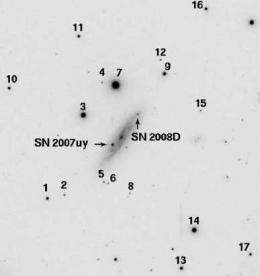
An image of the galaxy NGC 2770, showing the location of supernova 2008D (as well as an earlier supernovae, 2007uy, along with stars in the field numbered to help locate the supernovae precisely). Astronomers have modeled this explosion as originating in a massive star with a comparatively rare, small outer envelope. Credit: Modjaz et al. 2009, and the Fred L. Whipple Observatory

(PhysOrg.com) -- Supernovae, the explosive deaths of massive stars, disburse into space all of the chemical elements that were spawned inside the progenitor stars.

Furthermore, these violent explosions themselves generate most of the elements above iron in the periodic table, and scatter them as well. Chemical enrichment alone makes supernovae immensely important contributors to the cosmic ecosystem. One class of supernova (type Ia) provide yet another asset: they are thought to be "standard candles," and are used by astronomers to estimate the distances to remote galaxies whose supernovae appear faint because they are far away, thus helping to calibrate the cosmic distance scale.

Because of the importance of supernovae, astronomers want to understand in detail all the pathways by which stars erupt. The peak of the explosions, however, typically last only a matter of days. Unless astronomers are quick to identify and measure the rapidly changing properties of a supernova, the star will fade away and the mechanisms that made it bright will quickly dissipate.

Writing in the latest issue of The , ten CfA astronomers led by Maryam Modjaz (a recent graduate student at CfA and now a Miller Fellow at U.C. Berkeley) and a large team of colleagues report on extensive observations of a recent supernova observed at wavelengths from the through the infrared. The cataclysm was serendipitously spotted shortly after it began by the Swift satellite, a mission specifically designed to look for energetic, transient events; the mission had already been studying another supernova in the same galaxy. The discovery enabled the team to start collecting data five hours before the first transient X-rays could be detected, and well before the peaked; they continued to monitor it closely for another 150 days.

The team's relatively complete set of data enabled them to diagnose the nature of the supernova. It began as a massive star characterized by having only a small outer envelope. This type of is comparatively rare, and previous observations of the class had only modest information about its earliest stages of evolution. The new results enable the astronomers to estimate the size of the star, asymmetries in the outflow, and other details that add to our understanding of these critical cosmic phenomena.

Provided by Harvard University (news : web)


print this article email this article download pdf blog this article bookmark this article     Stumble it Digg this share on Facebook retweet share on Reddit add to delicious
Rate this story - 3.5 /5 (4 votes)

Rank Filter

Move the slider to adjust rank threshold, so that you can hide some of the comments.


Display comments: newest first

  • omatumr - Sep 20, 2009
    • Rank: 1 / 5 (1)
    Did Element Layers of the Supernova Mix?

    A few yours ago, NASA reported that the onion skin layers of elements in a supernova are not mixed in the explosion.

    http://www.nasa.g...901.html

    That might explain the high concentration of iron (Fe) in the central region of the solar system and the high concentration of H, He, C and N in the outer region.

    Were layers of elements in the parent star retained in the supernova debris of this new study?

    With kind regards,
    Oliver K. Manuel

September 18, 2009 all stories

Comments: 1

3.5 /5 (4 votes)
  • Stumble this up

  • Digg this

  • share this

  • hide
  • Related Stories

  • Swift sees double supernova in galaxy
    created Jun 26, 2007 | popularity not rated yet | comments 0
  • XMM-Newton reveals the origin of elements in galaxy clusters
    created May 10, 2006 | popularity not rated yet | comments 0
  • The Quiet Explosion: Object intermediate between normal supernovae and gamma-ray bursts found
    created Jul 24, 2008 | popularity not rated yet | comments 0
  • New Type of Cosmic Explosion More Powerful Than Supernovae
    created Aug 05, 2004 | popularity not rated yet | comments 0
  • Supernovae -- cosmic lighthouses
    created Feb 09, 2007 | popularity not rated yet | comments 0


  • hide
  • Relevant PhysicsForums posts

  • Sideral question
    created Nov 21, 2009
  • Doppler shifted blackbody spectrum
    created Nov 21, 2009
  • Earth v. Moon
    created Nov 21, 2009
  • help me with coordinates and orbits
    created Nov 21, 2009
  • More from Physics Forums - General Astronomy

Other News

Baby can wait as expectant dad finishes spacewalk (AP)

Baby can wait as expectant dad finishes spacewalk

Space & Earth / Space Exploration

created 20 hours ago | popularity 3 / 5 (2) | comments 0

(AP) -- A spacewalking astronaut put aside the impending birth of his daughter and blazed through his first-ever venture outside the International Space Station on Saturday.


Commuters wait on the platform shrouded by fog in London

Climate change not man-made, say majority of Britons: poll

Space & Earth / Environment

created Nov 15, 2009 | popularity 3.3 / 5 (15) | comments 46

Less than half of Britons believes that human activity is to blame for global warming, according to a poll carried out for The Times newspaper and published on Saturday.


Mysteriously warm times in Antarctica

Mysteriously warm times in Antarctica

Space & Earth / Earth Sciences

created Nov 18, 2009 | popularity 4.2 / 5 (21) | comments 28

(PhysOrg.com) -- A new study of Antarctica's past climate reveals that temperatures during the warm periods between ice ages (interglacials) may have been higher than previously thought. The latest analysis ...


UN: Fight climate change with free condoms (AP)

UN: Fight climate change with free condoms

Space & Earth / Environment

created Nov 18, 2009 | popularity 3.1 / 5 (11) | comments 30

(AP) -- The battle against global warming could be helped if the world slowed population growth by making free condoms and family planning advice more widely available, the U.N. Population Fund said Wednesday.


Mystery of the Solar Tsunami -- Solved

Mystery of the Solar Tsunami -- Solved (w/ Video)

Space & Earth / Astronomy

created Nov 19, 2009 | popularity 4.9 / 5 (24) | comments 8

(PhysOrg.com) -- Sometimes you really can believe your eyes. That's what NASA's Solar Terrestrial Relations Observatory (STEREO) is telling researchers about a controversial phenomenon on the sun known as ...