Arctic ice pack at third lowest extent since 1979: US
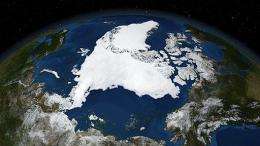
September 18, 2009 NASA Blue Marble captures ice conditions at the end of the melt season in the Arctic

Enlarge

Handout picture captured in 2007 by the Advanced Microwave Scanning Radiometer (AMSR-E) Instrument on NASA?s Aqua satellite overlaid on the NASA Blue Marble captures ice conditions at the end of the melt season in the Arctic. The Arctic sea ice pack thawed to its third smallest size on record during the northern hemisphere summer of 2009, US government scientists said, citing satellite images.

The Arctic sea ice pack thawed to its third smallest size on record during the northern hemisphere summer of 2009, US government scientists said, citing satellite images.

While the sea ice pack at its lowest 2009 point was slightly larger than both the record-low ice pack measured in 2007 and the summer 2008 ice pack, the data confirms a shrinkage trend seen over the past 30 years, the US National Snow and Ice Data Center said in a statement late Thursday.

The ice pack size has fallen sharply since 1979, especially during the summer months, the center said.

As of September 12, the surface of the Arctic sea ice pack was 5.1 million square kilometers (1.97 million square miles), its smallest point of the year.

At the peak of the summer 2007 melt the Arctic pack measured 4.1 million square kilometers -- a record low -- while the following year at the lowest point it measured 4.5 million square kilometers.

The summer 2009 low point however was still 1.61 million square kilometers (620,000 square miles) less than the annual 1979 to 2000 average ice pack size, the NSIDC said.

The center's glaciologists attributed the difference in the size of the 2009 ice pack compared to the previous two years to prevailing winds blowing in a different direction.

(c) 2009 AFP


print this article email this article download pdf blog this article bookmark this article     Stumble it Digg this share on Facebook retweet share on Reddit add to delicious
Rate this story - 2.4 /5 (5 votes)

Rank Filter

Move the slider to adjust rank threshold, so that you can hide some of the comments.


Display comments: newest first

  • ricarguy - Sep 18, 2009
    • Rank: 3.9 / 5 (7)
    If there is clear reversal in the size reduction of the ice sheet over two prior years, why the pessimism? After two years from the all time low, we are just shy of half way back to the 30 year average, in terms of square miles. Yet some guy at NASA concludes "...the data confirms a shrinkage trend..." It does nothing of the sort. And why recycle the OLD picture of the all time low? Show me the image from THIS year!

    Meanwhile, looking at the state of the economy, the rate of loss of jobs is less, meaning people are still losing jobs, and they call it signs of a recovery. What the spin doctors at NASA, other branches of the gov't, and elsewhere try to get away with, never ceases to amaze. Then they all wonder why there are so many skeptics out there. Skepticism is simply the most sensible reaction when preconceived conclusions are being applied to reality.
  • GrayMouser - Sep 18, 2009
    • Rank: 3.7 / 5 (3)
    And it still isn't as small as it was in the mid-1930s when it was really hot and cargo ships used the northwest passage in the summer.
  • dachpyarvile - Sep 19, 2009
    • Rank: 5 / 5 (2)
    Ok. I, too, am annoyed by the use of a picture from 2007 without the concurrent use of one from 2009. This article also seems to fail to take into consideration other historical data that have been out there for quite some time.
  • Velanarris - Sep 19, 2009
    • Rank: 5 / 5 (1)
    They need to stop using the term size and start using the term area.

    Size is not indicative of area as it connotates volume, which is the real measure of frozen water and packed precipitation.
  • dachpyarvile - Sep 19, 2009
    • Rank: 5 / 5 (3)
    Agreed. Here is the 2007 NSIDC data overlapped with the 2009 NSIDC data.

    http://nsidc.org/...ure3.png

    As can be seen, there was more ice this year at the end of the melt season than there was in 2007.
  • Velanarris - Sep 20, 2009
    • Rank: 5 / 5 (2)
    The NSIDC and NCDC stats have something toxic to them. NCDC was reporting this was the warmest ever summer of the Northeast. If you're from the Northeast you know that was complete bunk.
  • dachpyarvile - Sep 20, 2009
    • Rank: 5 / 5 (3)
    ...NCDC was reporting this was the warmest ever summer of the Northeast. If you're from the Northeast you know that was complete bunk.


    Even where I live it would be complete bunk. I tracked temperatures in my region and found that overall, the summer was much milder than the last, with early fall temperatures occurring in the midst of summer!
  • GrayMouser - Sep 22, 2009
    • Rank: 5 / 5 (1)
    How about: "2009 Arctic Sea Ice Extent exceeds 2005 for this date"?
    http://wattsupwit...is-date/
  • Snowhare - Oct 11, 2009
    • Rank: not rated yet
    And it still isn't as small as it was in the mid-1930s when it was really hot and cargo ships used the northwest passage in the summer.


    Reference? I can't find any record of this.

September 18, 2009 all stories

Comments: 9

2.4 /5 (5 votes)
  • Stumble this up

  • Digg this

  • share this

  • hide
  • Related Stories


  • hide
  • Relevant PhysicsForums posts

  • Which countries around the world cause the most destruction to the rain forest
    created 18 hours ago
  • HadleyCru data hacked
    created Nov 20, 2009
  • Younger Dryas Caused by Ice Dam Collapse?
    created Nov 17, 2009
  • Modeling rainfall and flooding
    created Nov 15, 2009
  • More from Physics Forums - Earth

Other News

Baby can wait as expectant dad finishes spacewalk (AP)

Baby can wait as expectant dad finishes spacewalk

Space & Earth / Space Exploration

created 17 hours ago | popularity 3 / 5 (2) | comments 0

(AP) -- A spacewalking astronaut put aside the impending birth of his daughter and blazed through his first-ever venture outside the International Space Station on Saturday.


Unseasonably hot and dry weather combined with strong winds to fan scores of blazes in the country's southeastern states

Australia issues 'catastrophic' alerts as fires rage

Space & Earth / Environment

created 23 hours ago | popularity 4 / 5 (3) | comments 0

Australia has issued "catastrophic" alerts after record-breaking temperatures and wild lightning storms sparked more than 100 fires across the country, officials said Saturday.


Commuters wait on the platform shrouded by fog in London

Climate change not man-made, say majority of Britons: poll

Space & Earth / Environment

created Nov 15, 2009 | popularity 3.3 / 5 (15) | comments 46

Less than half of Britons believes that human activity is to blame for global warming, according to a poll carried out for The Times newspaper and published on Saturday.


Mysteriously warm times in Antarctica

Mysteriously warm times in Antarctica

Space & Earth / Earth Sciences

created Nov 18, 2009 | popularity 4.2 / 5 (21) | comments 28

(PhysOrg.com) -- A new study of Antarctica's past climate reveals that temperatures during the warm periods between ice ages (interglacials) may have been higher than previously thought. The latest analysis ...


UN: Fight climate change with free condoms (AP)

UN: Fight climate change with free condoms

Space & Earth / Environment

created Nov 18, 2009 | popularity 3.1 / 5 (11) | comments 27

(AP) -- The battle against global warming could be helped if the world slowed population growth by making free condoms and family planning advice more widely available, the U.N. Population Fund said Wednesday.