Zooming to the centre of the Milky Way -- GigaGalaxy Zoom phase 2
September 21, 2009 Zooming to the centre of the Milky Way -- GigaGalaxy Zoom phase 2

Enlarge

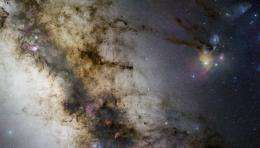
The second of three images of ESO’s GigaGalaxy Zoom project is a new and wonderful 340-million-pixel vista of the central parts of our galactic home, a 34 by 20-degree wide image that provides us with a view as experienced by amateur astronomers around the world. Taken by Stéphane Guisard, an ESO engineer and world-renowned astrophotographer, from Cerro Paranal, home of ESO’s Very Large Telescope, this second image directly benefits from the quality of Paranal’s sky, one of the best on the planet. The image shows the region spanning the sky from the constellation of Sagittarius (the Archer) to Scorpius (the Scorpion). The very colourful Rho Ophiuchi and Antares region features prominently to the right, as well as much darker areas, such as the Pipe and Snake Nebulae. The dusty lane of our Milky Way runs obliquely through the image, dotted with remarkable bright, reddish nebulae, such as the Lagoon and the Trifid Nebulae, as well as NGC 6357 and NGC 6334. This dark lane also hosts the very centre of our Galaxy, where a supermassive black hole is lurking. The image was obtained by observing with a 10-cm Takahashi FSQ106Ed f/3.6 telescope and a SBIG STL CCD camera, using a NJP160 mount. Images were collected through three different filters (B, V and R) and then stitched together. This mosaic was assembled from 52 different sky fields made from about 1200 individual images totalling 200 hours exposure time, with the final image having a size of 24 403 x 13 973 pixels. Note that the final, full resolution image is only available through Stéphane Guisard. Image: ESO/S. Guisard

(PhysOrg.com) -- The second of three images of ESO's GigaGalaxy Zoom project has just been released online. It is a new and wonderful 340-million-pixel vista of the central parts of our home galaxy as seen from ESO's Paranal Observatory with an amateur telescope.

This 34 by 20-degree wide image provides us with a view as experienced by amateur astronomers around the world. However, its incredible beauty and appeal owe much to the quality of the observing site and the skills of Stéphane Guisard, the world-renowned astrophotographer, who is also an ESO engineer. This second image directly benefits from the quality of Paranal's sky, one of the best on the planet, where ESO's Very Large Telescope is located. In addition, Guisard has drawn on his professional expertise as an optical engineer specialising in telescopes, a rare combination in the world of astrophotographers. Guisard, as head of the optical engineering team at Paranal, is responsible for ensuring that the Very Large Telescope has the best optical performance possible.

To create this stunning, true-colour mosaic of the Galactic Centre region, Guisard assembled about 1200 individual images, totalling more than 200 hours of exposure time, collected over 29 nights, during Guisard's free time, while working during the day at Paranal.
Zooming to the centre of the Milky Way -- GigaGalaxy Zoom phase 2
Enlarge

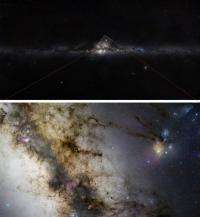
The two first images of ESO’s GigaGalaxy Zoom project combined to show the whole panorama of the Milky Way as could be seen with the unaided eye, and a more central region observed with an amateur telescope.

The image shows the region spanning the sky from the constellation of Sagittarius (the Archer) to Scorpius (the Scorpion). The very colourful Rho Ophiuchi and Antares region is a prominent feature to the right, although much darker areas, such as the Pipe and Snake nebulae also stand out. The dusty lane of our Milky Way runs obliquely through the image, dotted with remarkable bright, reddish nebulae, such as the Lagoon and the Trifid Nebulae, as well as NGC 6357 and NGC 6334. This dark lane also hosts the very centre of our Galaxy, where a supermassive black hole is lurking.

"The area I have depicted in this image is an incredibly rich region of the sky, and the one I find most beautiful," says Guisard.

This gorgeous starscape is the second of three extremely high resolution images featured in the GigaGalaxy Zoom project, launched by ESO as part of the International Year of Astronomy 2009 (IYA2009). The project allows stargazers to explore and experience the Universe as it is seen with the unaided eye from the darkest and best viewing locations in the world. GigaGalaxy Zoom features a web tool that allows users to take a breathtaking dive into our . With this tool users can learn more about many different and exciting objects in the image, such as multicoloured nebulae and exploding stars, just by clicking on them. In this way, the project seeks to link the sky we can all see with the deep, "hidden" cosmos that astronomers study on a daily basis. The wonderful quality of the images is a testament to the splendour of the night sky at ESO's sites in Chile, which are the most productive astronomical observatories in the world.

The third GigaGalaxy Zoom image will be revealed next week, on 28 September 2009.

More information: http://www.gigagalaxyzoom.org/

Provided by ESO (news : web)


print this article email this article download pdf blog this article bookmark this article     Stumble it Digg this share on Facebook retweet share on Reddit add to delicious
Rate this story - 4.6 /5 (16 votes)


September 21, 2009 all stories

Comments: 0

4.6 /5 (16 votes)
  • Stumble this up

  • Digg this

  • share this

  • hide
  • Related Stories

  • Astronomers unveil an amazing, interactive, 360-degree panoramic view of the entire night sky
    created Sep 14, 2009 | popularity not rated yet | comments 0
  • The Planet, the Galaxy and the Laser
    created Aug 03, 2007 | popularity not rated yet | comments 0
  • Solar games at Paranal
    created May 02, 2008 | popularity not rated yet | comments 0
  • ESO plans construction of giant telescope
    created Jul 19, 2006 | popularity not rated yet | comments 0
  • The great Easter egg hunt: The void's incredible richness
    created Apr 13, 2006 | popularity not rated yet | comments 0


  • hide
  • Relevant PhysicsForums posts

  • Question about 2-body gravity
    created 7 hours ago
  • life on Mars
    created 9 hours ago
  • Semi-major axis from cartesian co-ordinates
    created 22 hours ago
  • Primary Mirror grinding
    created Nov 23, 2009
  • dark energy can escape black holes.
    created Nov 23, 2009
  • Are there green, purple and pink stars?
    created Nov 22, 2009
  • More from Physics Forums - General Astronomy

Other News

Does carbon labelling give developing countries a bad deal?

Space & Earth / Environment

created 53 minutes ago | popularity not rated yet | comments 0

Carbon labelling could unfairly disadvantage economies in the developing world, and mislead consumers, according to an interdisciplinary project carried out by the UK Research Councils' Rural Economy and Land Use Programme. ...


NASA Releases Climate Change Multimedia Resource Reel

Space & Earth / Environment

created 6 minutes ago | popularity not rated yet | comments 0

In advance of the United Nations Climate Change Conference in Copenhagen, NASA has released a new multimedia climate change "resource reel" showcasing free downloadable videos, data visualizations, animations, and still images ...


First black holes may have incubated in giant, starlike cocoons, says CU-Boulder study

First black holes may have incubated in giant, starlike cocoons

Space & Earth / Astronomy

created 2 hours ago | popularity 5 / 5 (5) | comments 6

(PhysOrg.com) -- The first large black holes in the universe likely formed and grew deep inside gigantic, starlike cocoons that smothered their powerful x-ray radiation and prevented surrounding gases from ...


Icebergs head from Antarctica for New Zealand (AP)

Icebergs head from Antarctica for New Zealand

Space & Earth / Earth Sciences

created 1hour ago | popularity not rated yet | comments 0

(AP) -- Ships in the south Pacific Ocean have been alerted that hundreds of icebergs believed to have split off Antarctic ice shelves are drifting north toward New Zealand, officials said Tuesday.


The drying shores of the Dead Sea

Dead Sea needs world help to stay alive

Space & Earth / Environment

created 1hour ago | popularity 5 / 5 (1) | comments 0

The Dead Sea may soon shrink to a lifeless pond as Middle East political strife blocks vital measures needed to halt the decay of the world's lowest and saltiest body of water, experts say.