New species discovered on whale skeletons
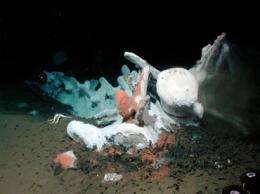
When a whale dies, it sinks to the seafloor and becomes food for an entire ecosystem. Researchers at the University of Gothenburg, Sweden, have discovered previously unknown species that feed only on dead whales - and use DNA technology to show that the species diversity in our oceans may be higher than previously thought.
Dead whales constitute an unpredictable food source - it is impossible to know when and where a whale is going to die, and when it does, the food source does not last forever. Nevertheless, some marine species have specialised in feeding on whale cadavers.
This is shown by researchers at the University of Gothenburg who have studied the ecosystem around dead whales using underwater cameras. A dead whale is an enormous source of nutrients. In fact, one cadaver offers the same amount of nutrients that normally sinks from the surface to the seafloor in 2000 years, and this is of great benefit to innumerable species: First the meat is eaten by for example sharks and hagfish, then tremendous amounts of various organisms come to feast on the skeleton.
One group of animals commonly found on whale skeletons is bristleworms, which are related to the earthworm. Some bristleworm species are so specialised in eating dead whales they would have problems surviving elsewhere. One example is Osedax, which uses its root system to penetrate the whale bones when searching for food. Other species specialise in eating the thick layers of bacteria that quickly form around the bones.
A dissertation from the Department of Zoology at the University of Gothenburg describes no fewer than nine previously unknown species of these bacteria-grazing bristleworms.
Four of the new species were found on whale cadavers placed at a depth of 125 metres in the new national park Kosterhavet off the coast of Strömstad, Sweden. The other five species feed on whale bones in the deep waters off the coast of California, USA. The family tree of bristleworms was explored using molecular data. The DNA analyses show that there are several so-called cryptic bristleworm species, meaning species that despite looking identical differ very much genetically.
The analyses show that the adaptation to a life on whale cadavers has occurred in species from different evolutionary paths and at several points in time. The study also shows that some species that are assumed to inhabit many different areas globally, so-called cosmopolitan species, may in fact be cryptic species. This finding may be very significant for our understanding of how animals spread around the world and of how many different species dwell on our planet.
More information:
I. Dahlgren TG, Wiklund H, Källström B, Lundälv T, Smith CR,
Glover AG. 2006. A shallow-water whale-fall experiment in the north
Atlantic. Les Cahiers de Biologie Marine 47(4): 385-389.
II. Wiklund H, Glover AG, Johannessen PJ, Dahlgren TG. 2009.
Cryptic speciation at organic-rich marine habitats: a new bacteriovore
annelid from whale-fall and fish farms in the North East Atlantic.
Zoological Journal of the Linnean Society 155: 774-785.
III. Wiklund H, Glover AG, Dahlgren TG. In press. Three new species of Ophryotrocha (Annelida: Dorvilleidae) from a whale-fall in the North East Atlantic. Zootaxa.
IV. Wiklund H, Altamira I, Glover AG, Smith CR, Baco-Taylor A, Dahlgren TG. Manuscript. Five new species of Ophryotrocha (Annelida: Dorvilleidae) from whale-fall and sunken wood habitats off California.
Provided by University of Gothenburg (news : web)


