Ozone layer depletion leveling off
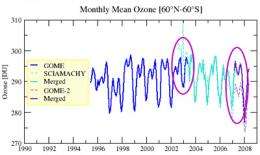
By merging more than a decade of atmospheric data from European satellites, scientists have compiled a homogeneous long-term ozone record that allows them to monitor total ozone trends on a global scale - and the findings look promising.
Scientists merged monthly total ozone data derived from the vertically downward-looking measurements of the GOME instrument on ESA's ERS-2 satellite, SCIAMACHY on ESA's Envisat and GOME-2 on the European Meteorological Satellite Organization's MetOp-A.
"We found a global slightly positive trend of ozone increase of almost 1% per decade in the total ozone from the last 14 years: a result that was confirmed by comparisons with ground-based measurements," said Diego G. Loyola R. who worked on the project with colleagues from the German Aerospace Center (DLR).
Ozone is a protective layer found about 25 km above us mostly in the stratospheric layer of the atmosphere that acts as a sunlight filter shielding life on Earth from harmful ultraviolet rays. The thinning of this layer increases the risk of skin cancer, cataracts and harm to marine life.
The ozone layer is not distributed evenly, with more changes occurring in the upper stratosphere. By collecting data while looking sideways (limb viewing) rather than vertically downwards, instruments are able to provide highly accurate measurements of the stratosphere.
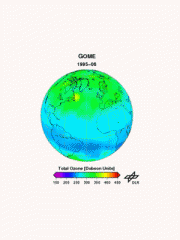
A team of scientists around Ashley Jones and Jo Urban from Sweden's Chalmers University of Technology combined the limb measurements of US instruments SBUV, SAGE I+II and HALOE with data from OSIRIS, SMR and SCIAMACHY on the European satellites Odin and Envisat to analyse the long-term evolution of stratospheric ozone from 1979 to the present. These data show a decrease in ozone from 1979 until 1997, and a small increase since then.
"Our analysis shows that upper stratospheric ozone declines at northern and southern mid-latitudes at roughly 7% per decade during 1979, consistent with earlier studies based on data from satellites and ground networks. A clear statistically significant change of trend can be seen around 1997. The small increase (of 0.8 - 1.4% per decade) observed thereafter, from 1997 to 2008, is however not yet statistically different from a zero trend. We hope to see a significant recovery of (upper stratospheric) ozone in the next years using longer, extended satellite time-series," Urban said.
The thinning of the ozone layer is caused by chemicals such as human-produced bromine and chlorine gases that have long lifetimes in the atmosphere. The Montreal Protocol (1987) was introduced to regulate and phase out the production of these substances. Its effect can clearly be seen in the satellite observations of ozone and these chemicals.
Using SCIAMACHY data in limb-viewing observation mode from 2002 to 2008, François Hendrick from the Belgian Institute for Space Aeronomy (BIRA/IASB) and his colleagues from the University of Bremen performed a trend analysis of bromine monoxide (BrO) in the stratosphere. BrO is a highly efficient catalyst in ozone destruction. The results show a negative trend in BrO abundance in the stratosphere during this period, marking the first time a decline in stratospheric bromine has been reported from a spaceborne observation.
"The good agreement with ground-based observations at high and mid-latitudes show that SCIAMACHY limb data can be used for stratospheric BrO trend monitoring. These findings provide strong evidences that the Montreal Protocol restrictions on brominated substances have now reached the stratosphere," Hendrick said.
Having access to these atmospheric satellite data over long periods is important for scientists to identify and analyse long-term trends and changes. In addition to monitoring ozone trends, scientists will continue to monitor ozone-depleting substances that were phased out under the Montreal Protocol but continue to linger in the atmosphere.
All of these results were presented at ESA's five-day 'Atmospheric Science Conference' held in Barcelona, Spain, 7-11 September. The objective of the conference was to provide scientists and researchers with the opportunity to present up-to-date results from their atmospheric research and application projects using space-based atmospheric sensors.
The conference, with some 200 participants, included presentations that detail the current use of satellite instruments for remote sensing of trace gases in the stratosphere and troposphere, clouds and aerosols, pollution and greenhouse gas monitoring.
Source: European Space Agency (news : web)


