Students design portable Braille label maker
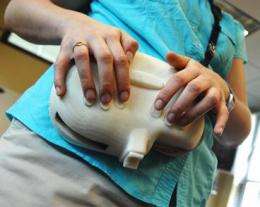
(PhysOrg.com) -- A device that started out as a class project last fall is moving rapidly toward becoming a commercial product that could make the lives of millions of visually impaired people a bit easier.
One everyday problem for people who are blind or have very limited sight is distinguishing things that are completely identical to the sense of touch, such as different CDs and DVDs, or canned goods that are all the same size and shape. To cope with that difficulty, many people make Braille labels to attach to these items.
But the existing devices for doing this are either expensive and heavy — one costs about $650 and has limited portability — or light and inexpensive but very difficult for a blind person to operate, and limited in the number of characters they can imprint.
A team of MIT students in last fall's Product Engineering Processes (2.009) class searched for a better way. They came up with a prototype device that is small and easily portable, can produce the entire panoply of possible Braille characters (including commonly used two-character contractions), and can be relatively easily loaded and operated by touch. Although it is still under development, they hope the device, which they have named the 6dot Braille Labeler, can ultimately be produced for sale at around $200.
Some of the students continued to refine the product after the class ended, producing an improved version that won a $7,500 prize in the spring IDEAS competition (a joint project of the MIT Public Service Center and the Edgerton Center that recognizes innovations that benefit communities worldwide). Eight students from the mechanical engineering department, some who graduated in June and others who are still enrolled, joined by two others, are in the process of forming a company to continue development of the labeler. Over the summer they conducted field tests around the country with 25 potential users of the product, giving each about a half-hour to work with the device.
"Blind people really wanted to see this product on the market," says Karina Pikhart '09, who is CEO of the new company. "We worked really closely with blind people" in developing it, she says, because "you really can't develop a product without being in close touch with the people you're developing it for. They gave us a lot of good feedback." One of the comments they received was that the clear quality of the Braille produced by the device "felt like what really neat handwriting must look like," she says.
The company doesn't plan to actually manufacture the device, but to license it to an existing company so that they can concentrate on research to continue refining and improving the system. They are currently negotiating with some manufacturers. They hope to have it on the market sometime next year.
Hands-on testing
"I'm very excited about it," says Kim Charlson, director of the Braille and Talking Book Library at Perkins School for the Blind in Watertown, Mass., who is blind herself and has tried a prototype of the product. "It's much quicker" than other systems, she says, and could be "much more affordable."
Steven Rothstein, president of the Perkins School, whose subsidiary Perkins Products makes the $650 Braille typewriter that can produce Braille pages as well as labels, said that he welcomes the competition. "We'll have to see what the final product will be, and its price," he said. But potentially the new product "meets a different need" than the Perkins Brailler, he says.
"I support more products that can help blind and visually impaired people lead more independent lives. This could be one of those," he notes, adding, "There is a lot more that needs to be done to bring it to market, but I think they've taken some great steps."
The battery-operated 6dot device uses standard Dymo label tape, and has a built-in microprocessor that can store up to 16 characters in case the user types faster than the device can emboss the tape. It has six buttons across the top — one for each of the six dots in that make up a Braille character — that can be operated by placing two hands on the unit's top, very much like touch-typing. The device makes sounds as it embosses each character, providing some auditory feedback to confirm that it's working.
When the label is finished, the user activates a built-in blade to cut the label off. Ultimately, the developers plan to add another blade that will score the end of the tape to make it easier to peel off the backing, but that has proved more difficult to achieve than they had anticipated.
They're also working on simplifying the system for loading and unloading a roll of tape to make that easier to do by touch. Right now, "it's a little more challenging than we'd like it to be," Pikhart says. They hope to make it as easy as loading and ejecting a VHS tape cartridge.
"The goal is to get it into the hands of as many people as possible," she says. "We're ... looking for a manufacturer who would take this on for the long haul. We want to keep improving it."
Provided by Massachusetts Institute of Technology (news : web)


