Study Positively Identifies Giant Squid Presence in Gulf of Mexico
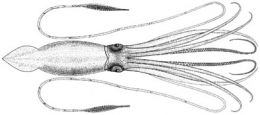
September 21, 2009 Architeuthis

Enlarge

Architeuthis. Image: Wikimedia Commons

(PhysOrg.com) -- During a recent research cruise, a rare giant squid was captured in the Gulf of Mexico.

The research cruise was partially funded through an interagency agreement between the Department of the Interior’s Minerals Management Service (MMS) and the National Oceanic and Atmospheric Administration (NOAA). The 19.5 foot long, 103 pound squid was caught at a water depth of more than 1,500 feet in a special trawl net pulled by the NOAA vessel Gordon Gunter during a pilot study for the MMS, "Sperm Whale Acoustic Prey Study."

The two-year, $550,000 MMS prey study hopes to identify the species composition and biomass of squid and fish that represent the feeding base for sperm whales in the Gulf of Mexico.

“This is the first time a giant squid has been captured during scientific research in the Gulf of Mexico,” explained Dr. Deborah Epperson, the MMS biologist responsible for this study. Numerous MMS-sponsored studies of sperm whale abundance, distribution, habitat, and response to sound conducted since the 1990’s showed the need for more information about their prey which consist mainly of squid and fish.

Photos of the squid were sent to experts around the nation to confirm the specimen was indeed the Architeuthis (Ar-chi-teu-this) species. The giant squid is now at the Smithsonian Institution National Museum of Natural History where it will be studied.

Additional field work for the “ Acoustic Prey Study” is scheduled for early 2010. A survey to assess the relationship between sperm whales and their based on lessons learned from this pilot study will be conducted.

Provided by Minerals Management Service


print this article email this article download pdf blog this article bookmark this article     Stumble it Digg this share on Facebook retweet share on Reddit add to delicious
Rate this story - 4.7 /5 (6 votes)

Rank Filter

Move the slider to adjust rank threshold, so that you can hide some of the comments.


Display comments: newest first

  • cmn - Sep 22, 2009
    • Rank: not rated yet
    I'm assuming it's not alive now?

September 21, 2009 all stories

Comments: 1

4.7 /5 (6 votes)
  • Stumble this up

  • Digg this

  • share this

  • hide
  • Related Stories

  • Giant squid displayed in London
    created Feb 28, 2006 | popularity not rated yet | comments 0
  • Sperm Whales in Gulf Seemingly Unaffected by Distant Seismic Sounds
    created Aug 21, 2008 | popularity not rated yet | comments 0
  • Giant squid photographed for first time
    created Sep 28, 2005 | popularity not rated yet | comments 0
  • Tracking sperm whales and jumbo squid
    created Mar 09, 2007 | popularity not rated yet | comments 0
  • Sonar monitors California squid fishery
    created Feb 07, 2006 | popularity not rated yet | comments 0


  • hide
  • Relevant PhysicsForums posts

  • Human Leukocyte Antigen (HLA) typing
    created 3 hours ago
  • Breeding program
    created Nov 20, 2009
  • How does a concentration gradient provide energy?
    created Nov 20, 2009
  • Eyesight and Neural Damage from Electronics
    created Nov 19, 2009
  • More from Physics Forums - Biology

Other News

The Monarchs' annual migration ritual has yet to be scientifically explained

Tree-eating bugs threaten Monarch butterfly in Mexico

Biology / Ecology

created 4 hours ago | popularity 4 / 5 (1) | comments 0

The mysterious Monarch butterfly, which migrates en masse annually between Canada and Mexico, is now facing a new peril: another insect thriving in Western Mexican forests.


Extinct goat Myotragus balearicus

Extinct goat was cold-blooded

Biology / Plants & Animals

created Nov 18, 2009 | popularity 4.9 / 5 (32) | comments 10

(PhysOrg.com) -- An extinct goat that lived on a barren Mediterranean island survived for millions of years by reducing in size and by becoming cold-blooded, which has never before been discovered in mammals.


Bigger not necessarily better, when it comes to brains

Bigger not necessarily better, when it comes to brains

Biology / Plants & Animals

created Nov 17, 2009 | popularity 4.5 / 5 (17) | comments 11

(PhysOrg.com) -- Tiny insects could be as intelligent as much bigger animals, despite only having a brain the size of a pinhead, say scientists at Queen Mary, University of London.


Right-handed chimpanzees provide clues to the origin of human language

Biology / Plants & Animals

created Nov 16, 2009 | popularity 3 / 5 (1) | comments 7

Most of the linguistic functions in humans are controlled by the left cerebral hemisphere. A study of captive chimpanzees at the Yerkes National Primate Research Center (Atlanta, Georgia), reported in the January 2010 issue ...


The creature was found at a depth of 161 metres

Japanese researchers film rare baby fish 'fossil'

Biology / Plants & Animals

created Nov 17, 2009 | popularity 4.7 / 5 (7) | comments 4

Japanese marine researchers said Tuesday they had found and successfully filmed a young coelacanth -- a rare type of fish known as "a living fossil" -- in deep water off Indonesia.