Adolescent alcohol expsoure may lead to long-term risky decision making
September 21, 2009 by Joel Schwarz
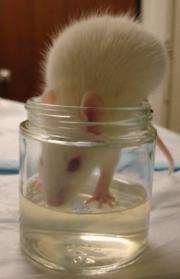
An adolescent rat eager to sample a gel containing 10 percent ethanol climbs into a jar for his Jell-O shot. Image: University of Washington
(PhysOrg.com) -- Picture this. A bunch of adolescent rats walk into a bar and start consuming Jell-O shots. Lots of them.
Then, three weeks later, some of those party rats are given the choice of pushing one lever that always will give them two sugary pellets or another lever that will give them a larger but uncertain reward of either four or zero treats. The alcohol-consuming rats tend to opt for uncertain rewards while a control group of teetotaling rodents match their choice well to whichever lever had the probability giving the larger reward.
That's what happened in a scenario created by University Washington scientists investigating the neurobiological underpinnings of a link between adolescent alcohol abuse and later adult decision-making impairments. The research, being published this week in the online edition of the Proceedings of the National Academy of Sciences, appears to show a causal link between early heavy drinking and adult decision-making.
"We know early exposure to alcohol and other substances is a predictor of later substance abuse in humans. It is a novel concept to think that early exposure might have long-term cognitive effects. But we can't test this on people. This model using rats lends support to causal link between early alcohol use and later increased risky decision making," said Nicholas Nasrallah, a UW psychology doctoral student and co-author of the study.
"We can't establish causal links based on existing human data but this animal model allowed us to establish this link," said corresponding author Ilene Bernstein, a UW professor of psychology and faculty member of the program in neurobiology and behavior.
"Scientists believe regions of the brain, including those implicated in decision making, are slow to develop and development extends into adolescence. This study shows that these late-developing structures in rats are affected by high alcohol use."
Rats typically do not drink alcohol, but researchers have found that they will consume ethanol when it is combined with gelatin. For this study, one group of rats was given 24-hour access to a 10 percent solution of ethanol in a tasty gel. The rats were 30 to 49 days old during the experiment, a time span that corresponds to human adolescence. These rats consumed the alcohol-laced gel each day, in amounts equivalent to a large number of drinks in human term," Bernstein said.
A separate control group of rats was given a gel made without any alcohol. At the end of the 20 days the gelatin was withdrawn from both groups. Three weeks later, half of the animals from each group were trained to press the levers to receive the treats. Part of the training included what is called a forced choice where there was only one lever to press. This gave the rats an opportunity to sample the pay off schedule on the uncertain lever that day. Three days of trials were run with the payoff for the large but uncertain reward coming 75 percent of the time and then dropping to 50 percent and 25 percent on subsequent days.
The alcohol-exposed rats showed a strong bias toward the uncertain lever, even when the chance of receiving rewards on the third day diminished to only one in four. The control rats, however, behaved differently and adjusted perfectly to the changing conditions of the experiment, thus gaining more treats than the alcohol-exposed rats.
A second experiment tested whether effects of adolescent alcohol exposure were persistent by waiting three months after the gelatin was withdrawn before testing the remaining rats. The effects were the same suggesting that the influence of adolescent alcohol exposure on decision making does not diminish over time.
"The known association between behavior and high levels of alcohol use puts people at risk for a number of bad outcomes, particularly substance use," said Bernstein. "Age of exposure to drugs is the No. 1 factor predictive of substance abuse later in life. Adolescent drinking is an epidemic today. This research raises a concern that if the brain is permanently changed by alcohol we need to place more emphasis on preventing adolescent alcohol use."
-
Preference for Alcohol in Adolescence May Lead to Heavy Drinking
May 05, 2008 |
not rated yet |
0
-
Alcohol exposure in the womb affects 'teenage' booze behavior
Jan 15, 2009 |
not rated yet |
0
-
New study reveals brain cell mechanism of alcohol dependence
May 28, 2008 |
not rated yet |
0
-
Why binge drinking is bad for your bones
Oct 23, 2008 |
not rated yet |
0
-
Scientists find seizure drug reverses cellular effects
May 28, 2008 |
not rated yet |
0
-
Engineers build first sub-10-nm carbon nanotube transistor
Feb 01, 2012 |
4.9 / 5 (32) |
30
-
Something old, something new: Evolution and the structural divergence of duplicate genes
Jan 31, 2012 |
4.6 / 5 (7) |
1
-
The hidden nanoworld of ice crystals: Revealing the dynamic behavior of quasi-liquid layers
Jan 30, 2012 |
5 / 5 (4) |
1
-
Stock market network reveals investor clustering
Jan 27, 2012 |
3.9 / 5 (23) |
8
-
Of microchemistry and molecules: Electronic microfluidic device synthesizes biocompatible probes
Jan 26, 2012 |
5 / 5 (2) |
0
-
Is Everyday Technology Killing Us?
Feb 08, 2012
-
Exercise and weight loss
Feb 08, 2012
-
Why do we have head aches? Our brains can't feel anything.
Feb 07, 2012
-
"The end of diseases" by David Agus, interview from Daily Show with Jon Stewart
Feb 04, 2012
-
Oncolytic adenovirus
Feb 04, 2012
-
Nutrition label stuffs and diets
Feb 02, 2012
- More from Physics Forums - Medical Sciences
More news stories
Starve a virus, feed a cure? Findings show how some cells protect themselves against HIV
A protein that protects some of our immune cells from the most common and virulent form of HIV works by starving the virus of the molecular building blocks that it needs to replicate, according to research published online ...
2 hours ago |
5 / 5 (1) |
0
|
Injured boomers beware: Know when to see doctor
(AP) -- It happened to nurse Jane Byron years after an in-line skating fall, business owner Haralee Weintraub while doing "men's" push-ups, and avid cyclist Gene Wilberg while lifting a heavy box.
4 hours ago |
5 / 5 (1) |
0
FDA-approved drug rapidly clears amyloid from the brain, reverses Alzheimer's symptoms in mice
Neuroscientists at Case Western Reserve University School of Medicine have made a dramatic breakthrough in their efforts to find a cure for Alzheimer's disease. The researchers' findings, published in the journal Science, show t ...
Medicine & Health / Neuroscience
Feb 09, 2012 |
4.9 / 5 (55) |
21
|
Green tea found to reduce disability in the elderly
(Medical Xpress) -- A lot of research has been done over the past several years looking into the health benefits of green tea. As a result, scientists have found that regular consumption of the beverage leads ...
Teen school drop-outs three times as likely to be on benefits in later life
Teen school drop-outs are almost three times as likely to be on benefits in later life as their peers who complete their schooling, indicates research published online in the Journal of Epidemiology and Community Health.
Feb 06, 2012 |
not rated yet |
13
Scientists discover molecular secrets of 2,000-year-old Chinese herbal remedy
For roughly two thousand years, Chinese herbalists have treated Malaria using a root extract, commonly known as Chang Shan, from a type of hydrangea that grows in Tibet and Nepal. More recent studies suggest that halofuginone, ...
New method to examine batteries -- MRI from the inside
There is an ever-increasing need for advanced batteries for portable electronics, such as phones, cameras, and music players, but also to power electric vehicles and to facilitate the distribution and storage of energy derived ...
Google might launch Drive for cloud storage soon
(PhysOrg.com) -- Google's next big move, according to the Wall Street Journal, is a cloud storage service called Drive. Hardly first to the plate, Google is simply catching up to introducing its cloud reposi ...
Lab study raises questions over nano-particle impact
Tests involving chickens have raised questions about the impact on health from engineered nano-particles, the ultra-fine grains commonly used in drugs and processed foods, scientists said on Sunday.
A mitosis mystery solved: How chromosomes align perfectly in a dividing cell
Although the process of mitotic cell division has been studied intensely for more than 50 years, Whitehead Institute researchers have only now solved the mystery of how cells correctly align their chromosomes during symmetric ...
Researchers find extensive RNA editing in human transcriptome
In a new study published online in Nature Biotechnology, researchers from BGI, the world's largest genomics organization, reported the evidence of extensive RNA editing in a human cell line by analysis of RNA-seq data, demons ...
Sep 21, 2009
Rank: 5 / 5 (1)
What is needed in America is the development of
social skills dealing with alcohol at an early age
that carry through to adulthood.
Sep 21, 2009
Rank: not rated yet
Still, an exact neuropsychiatric mechanism needs to be formulated, otherwise it's just conventional wisdom. That alcohol makes you do stupid things and can wreck your life is nothing new.
Sep 21, 2009
Rank: 5 / 5 (1)
Marijuana may indeed be safer, but adolescents shouldn't be consuming either one. Evidence shows that the human brain continues to develop until age 25. So even the teen years aren't the best time to be getting "hammered", "stoned", or "wasted".
I often wonder how I might have turned out differently if I hadn't grown up in the 70s and started smoking pot socially after school when I was 14 and drinking alcohol pretty much every weekend after I was 16. Even though I found it no problem to get straight A grades through grad school, I've often struggled with depression, and now that I'm getting older I'm noticing some cognitive changes (such as not being able to remember the right word or name as quickly, making more spelling mistakes, etc). Some credible evidence points to early pot and alcohol use as possible factors in earlier-onset deficiencies in such areas as these.
For any intoxicants, I believe restricting legal useage until age 18 is still socially prudent.