'Evolutionary forecasting' for drug resistance
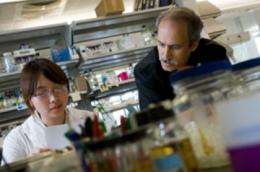
Rice University biochemists are developing a system of "evolutionary forecasting" to better understand the mechanisms of antibiotic resistance.
"Our goal is to show antibiotic makers which sets of genes a pathogen will modify to become drug-resistant," said Yousif Shamoo, the principal investigator on a new $1 million grant from the National Institute of Allergy and Infectious Diseases. "If they know the molecular path that an organism will take to become resistant to a new drug, our hope is that they can find ways to cut off that path."
Drug resistance is a major and growing problem in the U.S. Despite the best efforts of the medical community, documented cases of antibiotic-resistant pathogens like methicillin-resisistant Staphylococcus aureus (MRSA) and vancomycin-resistant Enterococci (VRE) have increased dramatically in recent years. For example, a national study found that in 2004 more than 60 percent of patients in intensive care had MRSA and nearly 30 percent had VRE, compared with just 37 percent and 14 percent, respectively, in 1995.
Shamoo, associate professor of biochemistry and cell biology and director of Rice's Institute of Biosciences and Bioengineering, said the four-year study will follow two common pathogens, Escherichia coli and Enterococcus faecalis, as they adapt to front-line antibiotics. The researchers will identify the network of genetic adaptations that allow the pathogens to become increasingly drug-resistant.
"We'll start with a batch of bacteria in a controlled vessel, and on day one we'll add a small amount of the drug," Shamoo said. "Each day, we'll ramp up how much drug we add, and we'll do that continuously for weeks. The organism is forced to evolve or die. In previous studies using both drugs and using environmental changes like increased heat, we have found that organisms do evolve, and they do it in a repeatable, predictable way."
In the upcoming study, Shamoo's team will sequence the genome of each organism both before and after the test. In addition, they'll take daily samples of the bacteria from the vessel and hold onto those for analyses. The stored samples are essentially a fossil record of the organism's adaptation to the drug. Using these, investigators can piece together the molecular path to resistance.
To determine the order the mutations occurred in, the team will use a technique created by Rice's Sarah Wu, a Will Rice College senior majoring in biochemistry and cell biology who began working in Shamoo's lab as a freshman. Using an instrument called a mass spectrometer, Wu found a way to translate the molecular changes from a particular mutation to the molecular weights of samples analyzed with the mass spectrometer.
Shamoo said the technique is important because it will allow his team to determine which mutations occurred first and to build those changes into a network-style representation that show's how an organism adapts to a specific drug.
Once the team has identified the particular mutations that convey drug resistance, they'll use X-ray crystallography to try and determine the exact molecular modifications that occur in the proteins those genes encode.
"We're interested in building those physical relationships that show how molecules confer drug resistance," Shamoo said. "The idea is that if you understand the mutation and what the mutation does to an enzyme or protein, then you can understand how that helps increase the fitness of a population of bacteria."
Shamoo said the team hopes to find a general set of rules or patterns that bacteria follow as they evolve to become drug-resistant.
For example, while the specific mutations that allow bacteria to become drug-resistant may differ from strain to strain, there may be patterns or rules that govern the order in which mutations occur and the regions of genome in which they occur.
"We hope there are common ideas and common themes among organisms," he said.
Source: Rice University (news : web)


