Cancer predisposition from genetic variation shows strong gender bias
September 21, 2009 Cancer predisposition from genetic variation shows strong gender bias

Enlarge

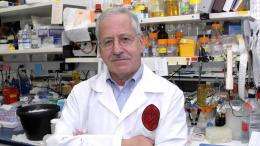
Peter Stambrook, PhD

(PhysOrg.com) -- Cancer predisposition resulting from the presence of a specific gene variant shows a strong gender bias, researchers at the University of Cincinnati (UC) have demonstrated.

In addition, the research indicates that the risk for development of cancer in individuals harboring the can be further increased as a result of environmental exposure.

Peter Stambrook, PhD, a professor in the department of , biochemistry and microbiology, and colleagues report their findings this week in (PNAS). Co-authors include researchers from Wright State University and the Laboratory for Health Protection Research, National Institute of Public Health and the Environment, the Netherlands.

Stambrook says the gene CHEK2 is part of a response pathway that can have an impact on whether or not cancers develop. A CHEK2 variant, CHEK2*1100delC, is associated with increased risk of cancer.

"Women who carry this particular gene variant are predisposed to developing breast or ," says Stambrook, "while men have a higher risk of developing prostate cancer."

Stambrook's team has produced a mouse model in which the CHEK2 gene was replaced by the variant and found that the overwhelming majority of mice that developed cancer were female—about 80 percent, as opposed to slightly more than 15 percent for males. This contrasts sharply with the incidence of cancer in wild-type mice (those with the normal CHEK2 gene), in which male and female mice developed cancer to about the same extent but at a much lower frequency.

Stambrook says his team will be exploring possible reasons behind the difference, looking at hormonal involvement and possible interactions between the gene variant and estrogen receptors or estrogen itself.

By using a known carcinogen, dimethyl benzanthracene, the researchers also determined that mice that harbor the variant are more susceptible to an environmental challenge than those that don't. The compound was administered orally to female mice.

"When they delivered the compound, the lifespan of the mice was reduced significantly—they developed breast cancer as well as other types of cancers," Stambrook says. "In addition, the mice that harbored this variant were more susceptible—in other words, they developed tumors more quickly than wild-type mice."

Stambrook says that by learning more about the signaling pathway of the CHEK2 gene, researchers can explore ways to "rescue" it and identify potential therapeutic targets.

"It's an interesting gene," says Stambrook, "and there are a lot of interesting directions that this finding will take us."

Source: University of Cincinnati (news : web)


print this article email this article download pdf blog this article bookmark this article     Stumble it Digg this share on Facebook retweet share on Reddit add to delicious
Rate this story - not rated yet


September 21, 2009 all stories

Comments: 0

not rated yet
  • Stumble this up

  • Digg this

  • share this

  • hide
  • Related Stories

  • New link between estrogen and breast cancer
    created Aug 24, 2007 | popularity not rated yet | comments 0
  • Gene may lead to early onset of brain tumor
    created Jan 26, 2009 | popularity not rated yet | comments 0
  • The abortion pill compound prevents breast tumor growth
    created Nov 30, 2006 | popularity not rated yet | comments 0
  • Researchers find new gene linked to breast cancer
    created Oct 07, 2007 | popularity not rated yet | comments 0
  • Type 2 diabetes gene discovered
    created Jan 16, 2006 | popularity not rated yet | comments 0


  • hide
  • Relevant PhysicsForums posts

  • Obsessive Compulsive Disorder
    created Nov 20, 2009
  • West's zone 2 starling resistor respiratory physiology
    created Nov 18, 2009
  • 50-0-50 rule
    created Nov 18, 2009
  • What is the evidence in support of the anti-vaccine movement?
    created Nov 17, 2009
  • More from Physics Forums - Medical Sciences

Other News

Swine flu vaccine effective despite mutations: experts

Medicine & Health / Diseases

created 18 hours ago | popularity 1 / 5 (1) | comments 1

Swine flu vaccines are still effective despite reported cases of mutations in the A(H1N1) virus, health experts in Europe and North America said Saturday.


Study raises concerns about outdoor second-hand smoke

Medicine & Health / Health

created Nov 18, 2009 | popularity 1.8 / 5 (5) | comments 21

Indoor smoking bans have forced smokers at bars and restaurants onto outdoor patios, but a new University of Georgia study in collaboration with the Centers for Disease Control and Prevention suggests that these outdoor smoking ...


smoking, cigarette

Vaccine being developed to help smokers quit

Medicine & Health / Medications

created Nov 20, 2009 | popularity 4.5 / 5 (11) | comments 10

(PhysOrg.com) -- Glaxo-SmithKline has joined forces with Nabi Pharmaceuticals to produce a vaccine to help smokers give up their addiction permanently.


Pilot study relates phthalate exposure to less-masculine play by boys

Medicine & Health / Research

created Nov 16, 2009 | popularity 4.8 / 5 (9) | comments 9

A study of 145 preschool children reports, for the first time, that when the concentrations of two common phthalates in mothers' prenatal urine are elevated their sons are less likely to play with male-typical toys and games, ...


wine

Alcohol helps lower heart disease risk for men: study

Medicine & Health / Health

created Nov 19, 2009 | popularity 4.2 / 5 (6) | comments 7

Men who drink alcohol every day see a nearly one-third average reduction in the risk of coronary heart disease, according to a long-term study among Spanish men published on Thursday.