Study tries to detect flu before the first sneeze
(AP) -- Coughed on by somebody with the flu? Duke University researchers are developing a test to determine - with a mere drop of blood - who will get sick before the sniffling and fever set in. And they're turning to hundreds of dorm-dwelling freshmen this fall to see if it works.
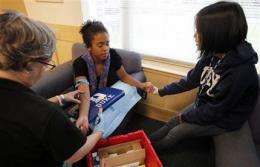
It's a novel experiment: Students report daily whether they have any cold or flu symptoms. If they do, a team swoops in to test not just the sneezer but, more importantly, seemingly healthy friends and hallmates who might be incubating the infection.
"We're redefining the definition of being ill," says Col. Geoffrey Ling, a physician with the Defense Research Projects Agency, the Defense Department's research arm, which came up with the idea.
The reason: The military faces huge problems when flu or other viruses sweep through crowded barracks, and knowing an outbreak was brewing could allow them to separate and protect those not infected. We're not just talking about the challenge of replacing fevered soldiers on the day's patrol. Your body may be slowing down even before that fever erupts, as it tries to fight off a brewing virus.
And flu is contagious up to 24 hours before people show symptoms, one of the insidious ways that it spreads.
"If you've got a group of people living together and you can identify who's likely to become sick, you can much more efficiently use whatever your intervention is - a vaccine, an antiviral - to prevent disease," explains Duke infectious disease specialist Dr. Christopher Woods.
Respiratory viruses sweep through crowded college dorms just as easily as military squads, and with the new swine flu - the 2009 H1N1 strain - targeting mostly the young, Duke scientists may learn sooner than they had hoped just how well their experimental test really works.
It's based on a simple principle: Your immune system revs up to fight infection long before you show symptoms or before today's tests could detect the actual virus in your body. The Duke team discovered a so-called genomic fingerprint, a pattern of subtle molecular changes as genes are activated to fight viral respiratory infections.
Working with colleagues at the University of Virginia and in London, the Duke team first dripped various viruses into the noses of healthy volunteers. The people were quarantined, and scientists collected daily blood, saliva and nasal-fluid samples. Sure enough, they spotted the RNA-based fingerprint that separated who got sick from who didn't, in a few cases just hours after the person was exposed.
But does it work in the real world?
Armed with a $19.5 million Defense grant, Duke is trying to find out - and to create an easy-to-use test kit that could read a blood drop in minutes and signal with, say, a color change who's going to get sick.
"A vision for this would be similar to a diabetic who pricks their finger every day," says project leader Dr. Geoffrey Ginsburg, director of Duke's Center for Genomic Medicine. "The science will tell us what the limitations will be."
Enter the Duke dorm study. It's enrolling up to 800 students who agree to log onto a Web site every day and report if they have any cold- or flu-like symptoms.
Researchers signed up Sean Cadley, a freshman from New York City, when she walked by them already hacking. She admits being enticed in part by $75 in compensation for the pokes and prods of testing.
"I'm getting something out of being sick, which is always nice," said Cadley, a sharp cough still punctuating every few sentences nearly two weeks later.
Cadley, 18, thought nothing of the bug at first, but a fever of 103 hit a few days after the cough and she says she didn't leave her room for two days. Researchers won't say if it was the flu or another virus. But they quickly e-mailed her dorm-mates to say someone in the building was sick, and Cadley's friends raced to volunteer for up to five days of tests - pocketing $150 apiece - to see if they, too, would fall ill.
Beyond the pre-symptom test, the dorm study could shed crucial new light on how flu ripples through communities. Using sophisticated mapping techniques, researchers will tease out social aspects of infection - how close you must be to the sick to catch their bug, for example. And they may identify hot spots of transmission where they can warn students to take extra precautions.
If the study pans out, the Defense agency's Ling hopes to seek Food and Drug Administration approval for a pre-symptom test within two years, aimed at crowded quarters like the military, colleges, nursing homes, even hospital intensive care units.
To Ginsburg, the work is only the beginning. He envisions catching deadly bacterial or fungal infections far earlier in vulnerable people like organ transplant recipients, or even a day when there's a treatment for the common cold - should you detect it early enough.
"Infectious disease is ripe for this," Ginsburg says.
©2009 The Associated Press. All rights reserved. This material may not be published, broadcast, rewritten or redistributed.


