Cassini Reveals New Ring Quirks, Shadows During Saturn Equinox
September 21, 2009
Cassini Reveals New Ring Quirks, Shadows During Saturn Equinox

Enlarge

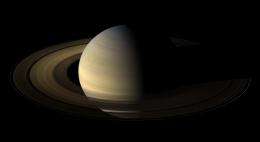
Of the countless equinoxes Saturn has seen since the birth of the solar system, this one, captured here in a mosaic of light and dark, is the first witnessed up close by an emissary from Earth ... none other than our faithful robotic explorer, Cassini. Image credit: NASA/JPL/Space Science Institute

(PhysOrg.com) -- NASA scientists are marveling over the extent of ruffles and dust clouds revealed in the rings of Saturn during the planet's equinox last month. Scientists once thought the rings were almost completely flat, but new images reveal the heights of some newly discovered bumps in the rings are as high as the Rocky Mountains. NASA released the images Monday.

"It's like putting on 3-D glasses and seeing the third dimension for the first time," said Bob Pappalardo, Cassini project scientist at NASA's Jet Propulsion Laboratory in Pasadena, Calif. "This is among the most important events Cassini has shown us."

On Aug. 11, sunlight hit Saturn's rings exactly edge-on, performing a celestial magic trick that made them all but disappear. The spectacle occurs twice during each orbit Saturn makes around the sun, which takes approximately 10,759 Earth days, or about 29.7 Earth years. Earth experiences a similar equinox phenomenon twice a year; the autumnal equinox will occur Sept. 22, when the sun will shine directly over Earth's equator.

For about a week, scientists used the Cassini orbiter to look at puffy parts of Saturn's rings caught in white glare from the low-angle lighting. Scientists have known about vertical clumps sticking out of the rings in a handful of places, but they could not directly measure the height and breadth of the undulations and ridges until Saturn's equinox revealed their shadows.

"The biggest surprise was to see so many places of vertical relief above and below the otherwise paper-thin rings," said Linda Spilker, deputy project scientist at JPL. "To understand what we are seeing will take more time, but the images and data will help develop a more complete understanding of how old the rings might be and how they are evolving."

The chunks of ice that make up the main rings spread out 140,000 kilometers (85,000 miles) from the center of Saturn, but they had been thought to be only around 10 meters (30 feet) thick in the main rings, known as A, B, C, and D.

In the new images, particles seemed to pile up in vertical formations in each of the rings. Rippling corrugations -- previously seen by Cassini to extend approximately 804 kilometers (500 miles) in the innermost D ring -- appear to undulate out to a total of 17,000 kilometers (11,000 miles) through the neighboring C ring to the B ring.

The heights of some of the newly discovered bumps are comparable to the elevations of the Rocky Mountains. One ridge of icy ring particles, whipped up by the gravitational pull of Saturn's moon Daphnis as it travels through the plane of the rings, looms as high as about 4 kilometers (2.5 miles). It is the tallest vertical wall seen within the rings.

"We thought the plane of the rings was no taller than two stories of a modern-day building and instead we've come across walls more than 2 miles [3 kilometers] high," said Carolyn Porco, Cassini imaging team leader at the Space Science Institute in Boulder, Colo. "Isn't that the most outrageous thing you could imagine? It truly is like something out of science fiction."

Scientists also were intrigued by bright streaks in two different rings that appear to be clouds of dust kicked up in collisions between small space debris and ring particles. Understanding the rate and locations of impacts will help build better models of contamination and erosion in the rings and refine estimates of their age. The collision clouds were easier to see under the low-lighting conditions of equinox than under normal lighting conditions.

At the same time Cassini was snapping visible-light photographs of Saturn's rings, the Composite Infrared Spectrometer instrument was taking the rings' temperatures. During equinox, the rings cooled to the lowest temperature ever recorded. The A ring dropped down to a frosty 43 Kelvin (382 degrees below zero Fahrenheit). Studying ring temperatures at equinox will help scientists better understand the sizes and other characteristics of the ring particles.

The Cassini spacecraft has been observing , its moons and rings since it entered the planet's orbit in 2004. The spacecraft's instruments have discovered new rings and moons and have improved our understanding of Saturn's ring system.

Provided by JPL/NASA (news : web)

4.6 /5 (9 votes)  

Filter


Move the slider to adjust rank threshold, so that you can hide some of the comments.


Display comments: newest first

290163
Sep 21, 2009

Rank: not rated yet
More mysteriouis than we imagine. Perhaps more mysterious than we can imagine (to paraphrase) and this is just a ring system. Who knows what lies out there? It could even be sausage rolls!
brant
Sep 21, 2009

Rank: not rated yet
"The spacecraft's instruments have discovered new rings and moons and have improved our understanding of Saturn's ring system."

How?? Seems more like they have discovered more mysteries....
Rank 4.6 /5 (9 votes)
Related Stories
Relevant PhysicsForums posts
  • Titan's lack of impact craters
    createdFeb 09, 2012
  • Real pictures of black hole eating a star?
    createdFeb 08, 2012
  • Hypothetical way to travel faster than light, but not technically exceed lightspeed
    createdFeb 06, 2012
  • How do scientists monitor the Sun's activity?
    createdFeb 05, 2012
  • Search patterns in observational studies
    createdFeb 05, 2012
  • Derivation of Pogson's law
    createdFeb 03, 2012
  • More from Physics Forums - General Astronomy

More news stories

Humans may have helped the decline of African rainforests 3000 years ago

(PhysOrg.com) -- Large areas of rainforests in Central Africa mysteriously disappeared over three thousand years ago, to be replaced by savannas. The prevailing theory has been that the cause was a change ...

Space & Earth / Environment

created 10 hours ago | popularity 5 / 5 (4) | comments 10 | with audio podcast report

Could Venus be shifting gear?

(PhysOrg.com) -- ESA’s Venus Express spacecraft has discovered that our cloud-covered neighbour spins a little slower than previously measured. Peering through the dense atmosphere in the infrared, the ...

Space & Earth / Space Exploration

created 6 hours ago | popularity 5 / 5 (5) | comments 7 | with audio podcast

Mars Science Laboratory computer issue resolved

(PhysOrg.com) -- Engineers have found the root cause of a computer reset that occurred two months ago on NASA's Mars Science Laboratory and have determined how to correct it.

Space & Earth / Space Exploration

created 7 hours ago | popularity 5 / 5 (5) | comments 3 | with audio podcast

Clam fields found at deep, low-temperature Mariana vents

(PhysOrg.com) -- Scientists have marveled at the unusual life forms thriving at high temperature hydrothermal vents of the deep ocean.

Space & Earth / Earth Sciences

created 7 hours ago | popularity not rated yet | comments 0 | with audio podcast

Two new moons for Jupiter

Advances in technology have lead to the discovery of new planets outside of our Solar System, and now even new moons in our own backyard.

Space & Earth / Space Exploration

created 6 hours ago | popularity not rated yet | comments 4


Complex wiring of the nervous system may rely on a just a handful of genes and proteins

Researchers at the Salk Institute have discovered a startling feature of early brain development that helps to explain how complex neuron wiring patterns are programmed using just a handful of critical genes. ...

The power of estrogen -- male snakes attract other males

A new study has shown that boosting the estrogen levels of male garter snakes causes them to secrete the same pheromones that females use to attract suitors, and turned the males into just about the sexiest ...

Human cognitive performance suffers following natural disasters, researchers find

Not surprisingly, victims of a natural disaster can experience stress and anxiety, but a new study indicates that it might also cause them to make more errors - some serious - in their daily lives. In their upcoming Human Fa ...

New error-correcting codes guarantee the fastest possible rate of data transmission

Error-correcting codes are one of the triumphs of the digital age. They’re a way of encoding information so that it can be transmitted across a communication channel — such as an optical fiber o ...

Both maternal and paternal age linked to autism

Older maternal and paternal age are jointly associated with having a child with autism, according to a recently published study led by researchers at The University of Texas Health Science Center at Houston (UTHealth).

Curry spice component may help slow prostate tumor growth

Curcumin, an active component of the Indian curry spice turmeric, may help slow down tumor growth in castration-resistant prostate cancer patients on androgen deprivation therapy (ADT), a study from researchers ...